
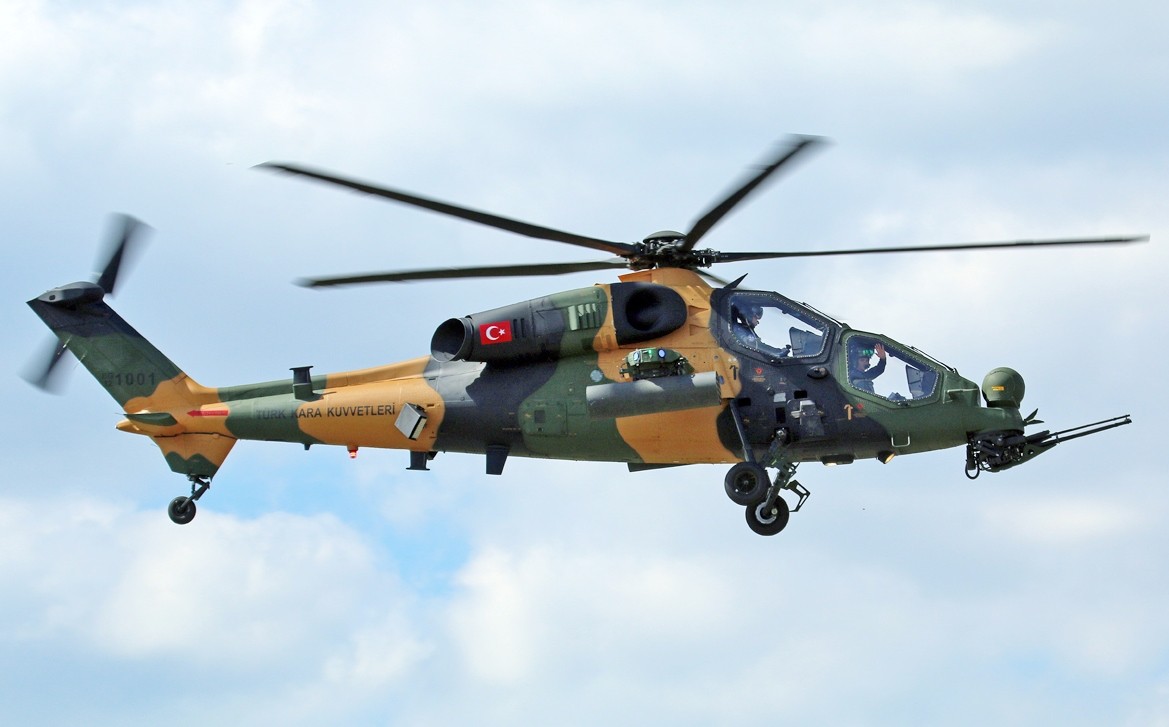
Development and Design
The A129 Mangusta emerged from the Italian Army's 1978 requirement for a dedicated attack helicopter comparable to the American AH-64 Apache. Agusta's engineering team focused on creating a platform capable of area suppression, low-altitude agility, and reliable operation in hot climates. The design emphasized survivability through a narrow fuselage profile and advanced defensive systems, while maintaining the firepower necessary for anti-armor operations.
Five prototypes underwent extensive flight testing between 1983 and 1986, with the final test aircraft taking flight in March 1986. The program validated the helicopter's design objectives, demonstrating exceptional maneuverability and weapons integration capabilities that would define its operational career.
Production and Variants
Production commenced at Agusta's Cascina Costa di Samarate facility in Varese, Italy, during 1986. The Italian Army received its first operational Mangustas in October 1990, marking the beginning of a production run that would span 17 years. By 2003, Agusta had completed manufacture of exactly 65 A129 helicopters, including five prototypes, fulfilling the Italian military's requirement for 60 operational aircraft plus pre-production examples.
The original A129 variant utilized twin Rolls-Royce Gem 2-1004D turboshaft engines, each producing 664 kilowatts. These powerplants, license-built by Piaggio, provided reliable performance but limited growth potential. Later variants, designated A129 International for export markets, incorporated more powerful LHTEC T800 engines delivering 1,335 horsepower each, significantly enhancing payload and performance capabilities.
Military Service Record
The Italian Army deployed Mangustas extensively in United Nations peacekeeping operations throughout the 1990s and 2000s. Somalia represented the helicopter's first major overseas deployment, where the aircraft demonstrated exceptional reliability in harsh desert conditions. Subsequent missions included operations in Angola and the Republic of Macedonia, establishing the Mangusta's reputation for versatility beyond its primary anti-armor role.
Afghanistan marked the A129's transition to active combat operations following extensive upgrades. The Combat Block Improvement (CBT) program, completed in 2002, enhanced multirole capabilities and integrated advanced targeting systems. These modifications enabled effective engagement of both armored vehicles and personnel targets, expanding tactical flexibility for ground commanders.
Manufacturer Legacy
Constructions Aeronautiche Giovanni Agusta SpA, founded in 1907, established helicopter production capabilities following World War II. The company initially focused on licensed Bell helicopter production before developing indigenous designs like the A129. Agusta's 2001 merger with Westland Helicopters created AgustaWestland, combining Italian and British rotorcraft expertise under unified management.
Leonardo S.p.A., as the company became known in 2016, continues operations today as a major European aerospace manufacturer. The A129 program demonstrated Leonardo's capability to develop complex military systems independently, establishing credibility for future projects including the AW249 next-generation attack helicopter.
Technical Innovation
The Mangusta's four-bladed main rotor system provided exceptional agility while maintaining structural simplicity. Export variants incorporated five-bladed rotors for enhanced performance, particularly at high altitudes and temperatures. The tandem cockpit arrangement optimized crew coordination, with the gunner positioned forward for target acquisition and the pilot elevated aft for improved visibility.
Advanced fire control systems enabled integration of TOW anti-tank missiles and later Spike-ER precision weapons. The A129CBT and subsequent AH-129D variants featured TopLite electro-optical systems, providing day/night targeting capabilities essential for modern battlefield operations. Maximum takeoff weight increased from 4,100 kilograms in early variants to 4,600 kilograms in upgraded configurations.
Operational Performance
Pilots consistently praised the Mangusta's responsiveness and stability in combat maneuvers. The helicopter's service ceiling of 20,000 feet and climb rate of 2,750 feet per minute enabled rapid positioning and threat avoidance. Operational range of 303 nautical miles provided sufficient endurance for extended missions without requiring forward refueling bases.
By 2018, the Italian Army operated 48 Mangustas comprising 32 upgraded AH-129D combat aircraft and 16 training variants. This fleet represented the culmination of continuous improvement programs spanning nearly three decades of service.
International Impact
Turkey's licensed production of the T-129, based on A129 technology, demonstrated the design's export potential. Turkish Aerospace Industries assembled over 50 T-129s beginning in 2013, incorporating indigenous systems and weapons integration. The first Turkish prototype flew on September 29, 2009, validating technology transfer arrangements established during the original development program.
The Mangusta's significance extends beyond production numbers, representing Europe's successful entry into attack helicopter development and establishing technological foundations for subsequent rotorcraft programs across the continent.