
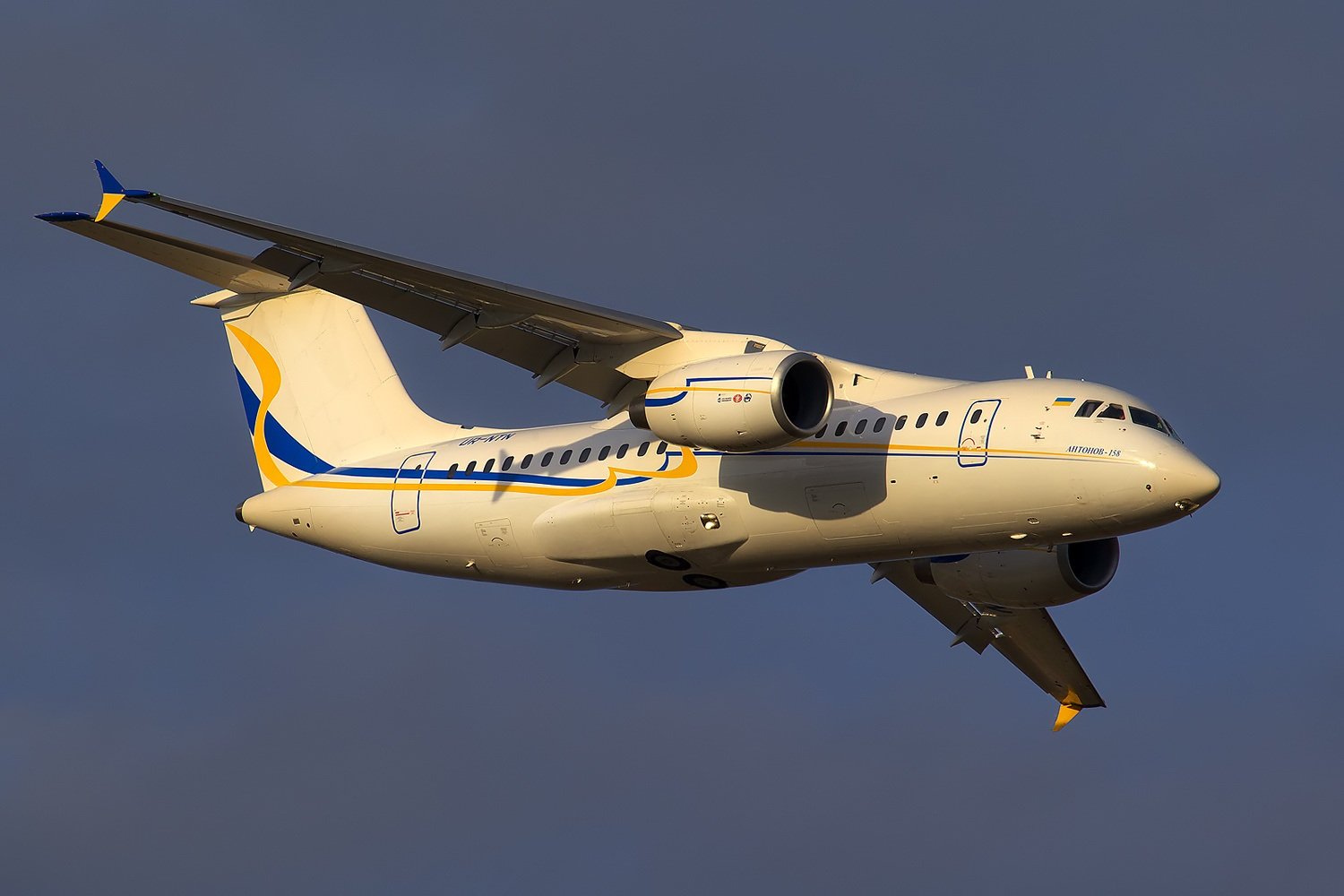
Development and Design
The An-158 emerged from Antonov's post-Soviet strategy to compete in the regional jet market dominated by Western manufacturers. Development officially launched on September 26, 2009, under the leadership of the Antonov Aeronautical Scientific-Technical Complex team. The design philosophy centered on maximizing commonality with the baseline An-148, achieving 95 percent parts compatibility including engines, avionics, and cockpit systems to reduce operating costs.
Test pilot Sergii Troshin commanded the maiden flight on April 28, 2010, accompanied by co-pilot Andrii Spasibo and leading engineer Mykola Sidorenko. The aircraft rolled out of Antonov's Kyiv facility on April 15, 2010, just 13 days before its first flight. Ukrainian certification followed in February 2011, with Russian approval granted on March 3, 2011.
The Manufacturer
The Antonov Company traces its heritage to 1946 when legendary designer Oleg Antonov established OKB-153 in Novosibirsk before relocating to Kyiv. In December 2009, by order of the Ukrainian Cabinet of Ministers, Antonov merged with the Kyiv AVIANT plant to form the Antonov Serial Production Plant, enabling full-scale aircraft manufacturing. This state-owned enterprise handles complete aircraft development cycles from initial design through customer support.
The company's reputation rested primarily on cargo aircraft like the massive An-124 and record-breaking An-225. The An-158 represented a strategic pivot toward the commercial passenger market, leveraging decades of aerospace expertise in a dramatically different market segment.
Engine and Technical Specifications
Two Progress D-436-148 turbofan engines power the An-158, manufactured by Ukraine's Ivchenko-Progress design bureau with Motor Sich handling production. These high-bypass turbofans belong to the D-436 family, which entered service in the 1980s with over 1,000 units produced across various applications. The engines enable cruise speeds between 800 and 870 kilometers per hour with a service ceiling of 3,100 meters.
The aircraft incorporated several design innovations including wingtip fences for improved fuel efficiency and short-field performance capabilities. The cockpit required a standard two-pilot crew, with additional flight engineers for certain operations. Passenger configurations ranged from 99 seats in all-economy layout to 86 seats in mixed business and economy class arrangements.
Production and Service History
Production commenced with serial number 201-01 completing its first flight on March 20, 2013. By April 2014, Antonov had manufactured five aircraft with consecutive serial numbers 201-01 through 201-05. All initial production units went to Cuba's national carrier, Cubana de Aviación, receiving registrations CU-T1710 through CU-T1715.
Cubana took delivery of the first aircraft (CU-T1710) on April 22, 2013, followed by the second unit (CU-T1711) in July 2013. Deliveries continued with CU-T1712 in October 2013, CU-T1714 in April 2014, and CU-T1715 in July 2014. The Cuban airline reportedly ordered up to ten aircraft total, though subsequent deliveries remain unconfirmed.
The aircraft made its international debut at the Farnborough Airshow in 2010, followed by appearances at Le Bourget in June 2013 and MAKS-2013 in August-September 2013. These exhibitions represented Antonov's marketing push to establish the An-158 as a viable competitor to established regional jets from Embraer and Bombardier.
Operational Challenges and Legacy
Despite initial promise, the An-158 program encountered significant obstacles. Cubana grounded its entire fleet in May 2018 due to unspecified technical issues, effectively ending commercial service. The decision followed broader industry concerns about the An-148/An-158 family after a February 2018 crash involving an An-148 operated by Saratov Airlines in Russia.
Geopolitical tensions between Ukraine and Russia further complicated the program. Russian production of the related An-148 at Voronezh Aircraft Production Association ceased in October 2018, eliminating potential manufacturing capacity and market access.
Total production remained extremely limited, with only five confirmed aircraft built and no active operators as of 2018. The program's failure reflected multiple challenges including limited marketing reach, reliability concerns, and the difficulty of breaking into a market dominated by established Western manufacturers with extensive support networks.
Current Status
As of the latest available information, no An-158 aircraft remain in commercial service. The type's brief operational history and minimal production numbers ensure it will be remembered primarily as an ambitious but ultimately unsuccessful attempt to establish Ukraine as a player in the competitive regional jet market. The ongoing conflict in Ukraine since 2022 has further complicated any potential revival of the program.