
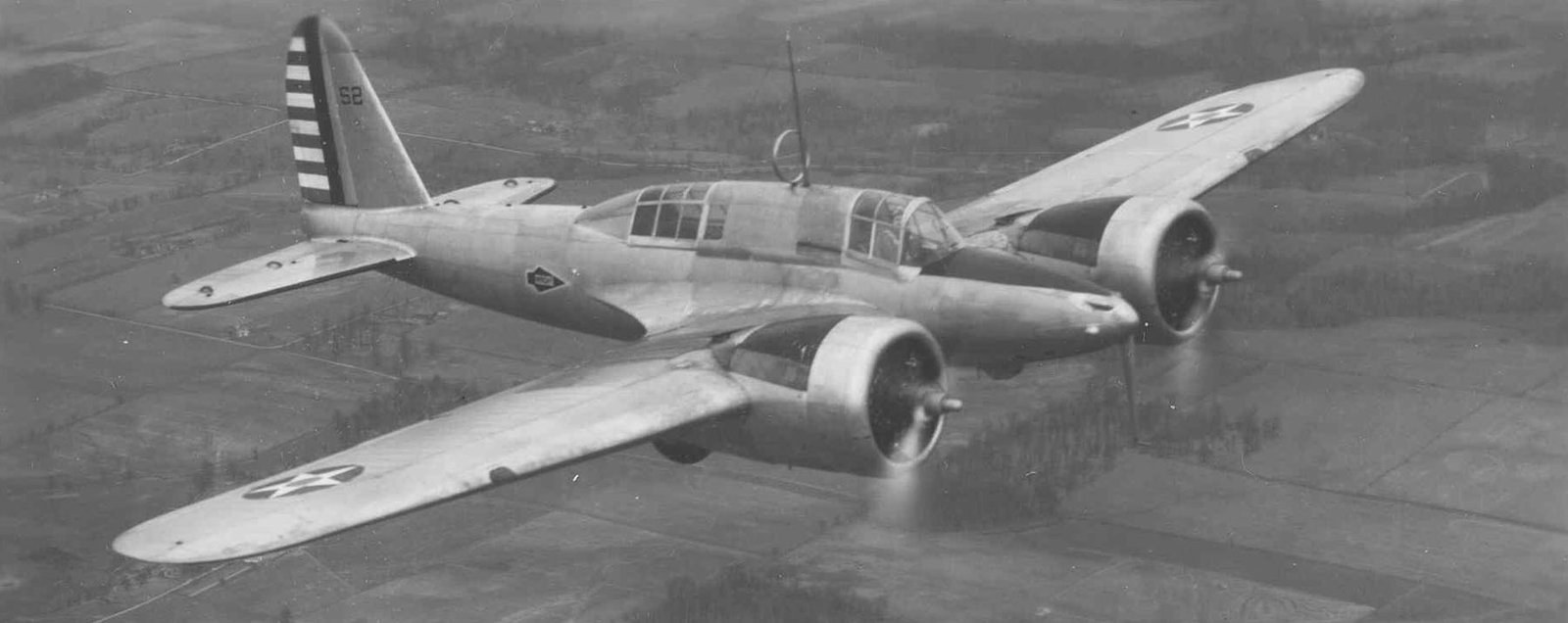
Production and Manufacturer History
The Curtiss A-18 Shrike was produced by the Curtiss-Wright Corporation, a company formed in 1929 through the merger of the Wright Aeronautical Corporation and the Curtiss Aeroplane and Motor Company. While the modern Curtiss-Wright Corporation still exists today as a diversified defense and industrial entity, it no longer operates as an aircraft manufacturer in the manner it did during the interwar period. The A-18 was manufactured in the United States, with production occurring between 1936 and 1937. This run was notably small, resulting in a total of only 13 aircraft being completed.
Design and Technical Specifications
Developing from the Model 76 series, the A-18 was designed to fulfill the need for a fast, twin-engine attack platform capable of delivering heavy bomb loads and utilizing strong forward-facing firepower. Following initial prototype work, the U.S. Army Air Corps ordered the aircraft into service-test production in July 1936 under the designation Y1A18.
Technically, the production models were powered by two Pratt & Whitney R-1820 radial piston engines, each producing 850 hp. In terms of performance, the aircraft demonstrated a modest increase in speed during its development, progressing from 243 mph at sea level to a maximum of 247 mph when flown at an altitude of 2,500 feet.
Military Service and Legacy
The A-18 served a limited role within the U.S. Army Air Corps as a ground-attack aircraft, though it was also categorized more broadly as a heavy fighter/attack aircraft during the interwar era. Despite its capabilities, the aircraft never saw large-scale procurement, and its active service remained brief due to the limited number of airframes produced.
While the Shrike did not achieve widespread operational success, it remains historically significant as an early exploration of the twin-engine attack concept in the United States. This developmental path eventually informed the creation of more effective and famous attack aircraft used during World War II, specifically the Douglas A-20 Havoc and the A-26 Invader series.