
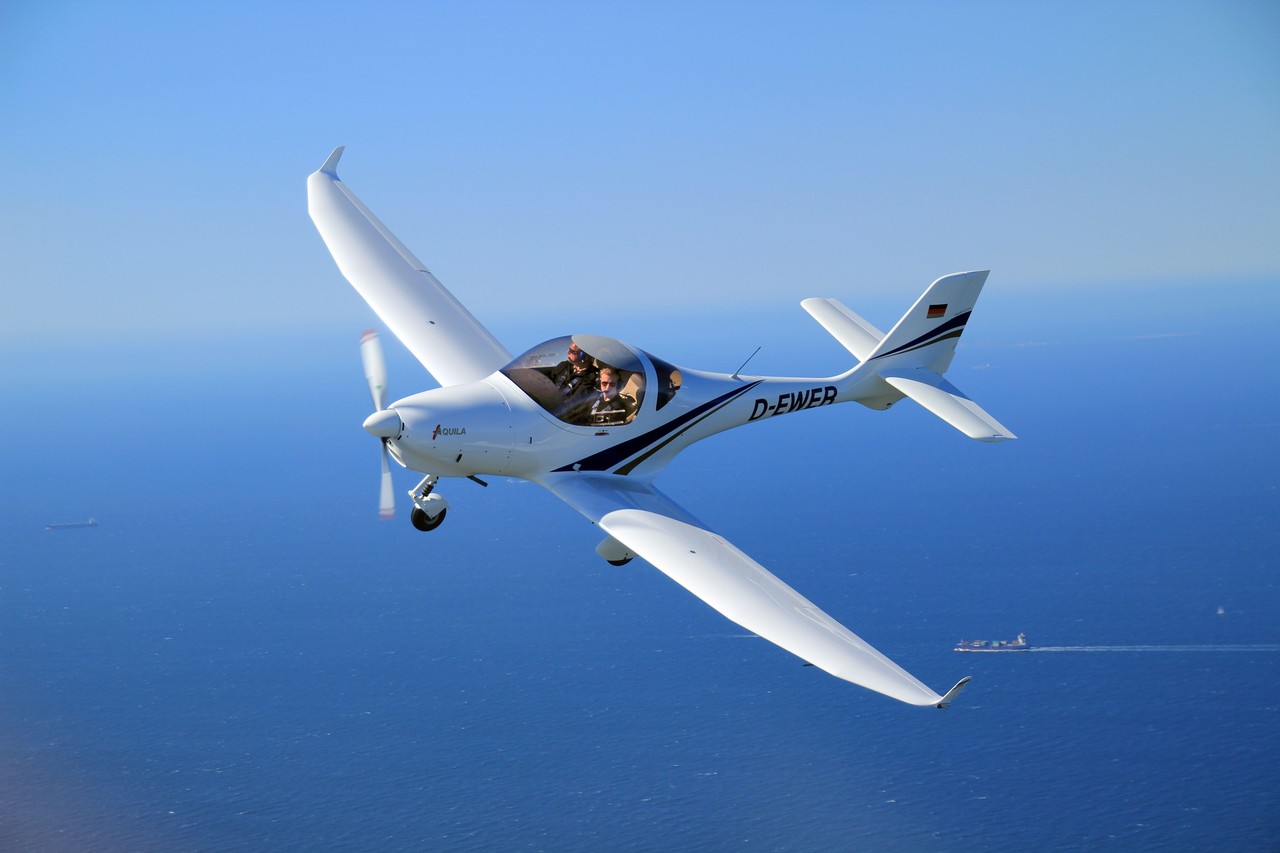
Development and Design
Aquila Aviation began developing the A-210 in 1997 using computer-aided design techniques with assistance from Berlin Technical University. The company's engineers set ambitious goals: create a crashworthy training aircraft with forgiving handling characteristics, low operating costs, and versatility for pilot training, cross-country cruising, and glider towing operations. The prototype, registered D-EQUI, made its public debut at Aero '99 in Friedrichshafen in April 1999, though it initially flew without the winglets that would become standard on production aircraft.
Technical Innovation
The A-210's construction represented cutting-edge technology for light aircraft of its era. The entire airframe utilized composite materials: a glass fiber reinforced plastic (GFRP) monocoque fuselage strengthened with carbon fiber reinforced plastic (CFRP) stringers and frames, while the wings and tail employed GFRP and foam sandwich construction with CFRP spars. This extensive use of composites provided exceptional strength-to-weight ratios and smooth aerodynamic surfaces.
The wing design incorporated a modified Horstmann/Quast HQ-42 airfoil section optimized for laminar flow, combined with high aspect ratio wings featuring upturned tips for improved efficiency. Electric Fowler flaps enhanced low-speed handling characteristics crucial for training operations. The aircraft's 120-liter fuel capacity, housed in two integral wing tanks, provided a range of 535 nautical miles.
Powerplant and Performance
Powering the A-210 was the proven Rotax 912S flat-four engine producing 73.5 kilowatts (98.6 horsepower). This Austrian-built powerplant drove an MT-Propeller MTV-21-A/175-05 two-blade hydraulic variable-pitch propeller. The engine choice reflected modern light aircraft trends toward automotive-derived technology, offering reliability and fuel efficiency superior to traditional aircraft engines.
Performance figures demonstrated the A-210's suitability for training operations. The aircraft achieved a maximum cruise speed of 130 knots with a stall speed of just 43 knots, providing a comfortable speed range for student pilots. Initial climb rate reached 750 feet per minute, with a service ceiling of 14,500 feet. Most importantly for flight training, the A-210 required only 820 feet for takeoff and 650 feet for landing, making it suitable for shorter training airfields.
Production and Certification
Aquila Aviation achieved JAR-VLA (Joint Aviation Requirements - Very Light Aircraft) certification in September 2001, with additional certifications planned for Australia, Scandinavia, Switzerland, the United Kingdom, and the United States by late 2003. The aircraft also received FAA certification for day and visual flight rules operations.
Production began in 2002 at the company's Schönhagen facility. The first delivery occurred in July 2002, with aircraft D-ETHG going to Flugschule Hans Grade at Schönhagen, Germany. By April 2003, Aquila had delivered nine aircraft against 31 firm orders placed by January 2003. The company projected production of 50 aircraft for 2004, though total production numbers remain unclear as the company appears to have ceased operations shortly thereafter.
Operational Service
The A-210 found its primary role in flight training operations across Europe. Beyond Flugschule Hans Grade, operators included the DaimlerChrysler flying club and major airlines using the type for pilot training programs. Both Lufthansa and Swiss international airlines incorporated A-210s into their pilot training fleets, recognizing the aircraft's modern avionics and forgiving handling characteristics.
Standard avionics included a Honeywell KX 125 communication and navigation radio with KT 76A transponder. Optional equipment featured the advanced Garmin GNS 430 GPS system, providing modern navigation capabilities for instrument training. The side-by-side seating arrangement with excellent visibility through the large canopy made the aircraft ideal for instruction.
The Manufacturer's Fate
Aquila Aviation, also known as Aquila Technische Entwicklungen GmbH, represented one of several European attempts to modernize the light aircraft training market in the early 2000s. However, the company appears to have ceased operations around 2003-2004, with no evidence of continued production or support. This fate was not uncommon among smaller aircraft manufacturers attempting to break into the competitive training aircraft market dominated by established players like Cessna and Piper.
Current Status
Despite the manufacturer's apparent demise, some A-210 aircraft remain operational today. Flight tracking data confirms continued activity, and aviation safety databases record incidents involving the type as recently as 2008, indicating ongoing operations. The aircraft's modern composite construction and reliable Rotax powerplant have likely contributed to continued airworthiness among the small production run.
Variants included the A 210 ASP and A 210 SXT models, though specific differences between these designations are not well documented. The related A 211 represented an evolution of the basic design, suggesting Aquila had planned expanded production before the company's apparent closure.
The A-210 remains a footnote in aviation history, representing the challenges facing innovative aircraft manufacturers in the competitive general aviation market, despite offering genuinely advanced technology and performance capabilities.