
Service History
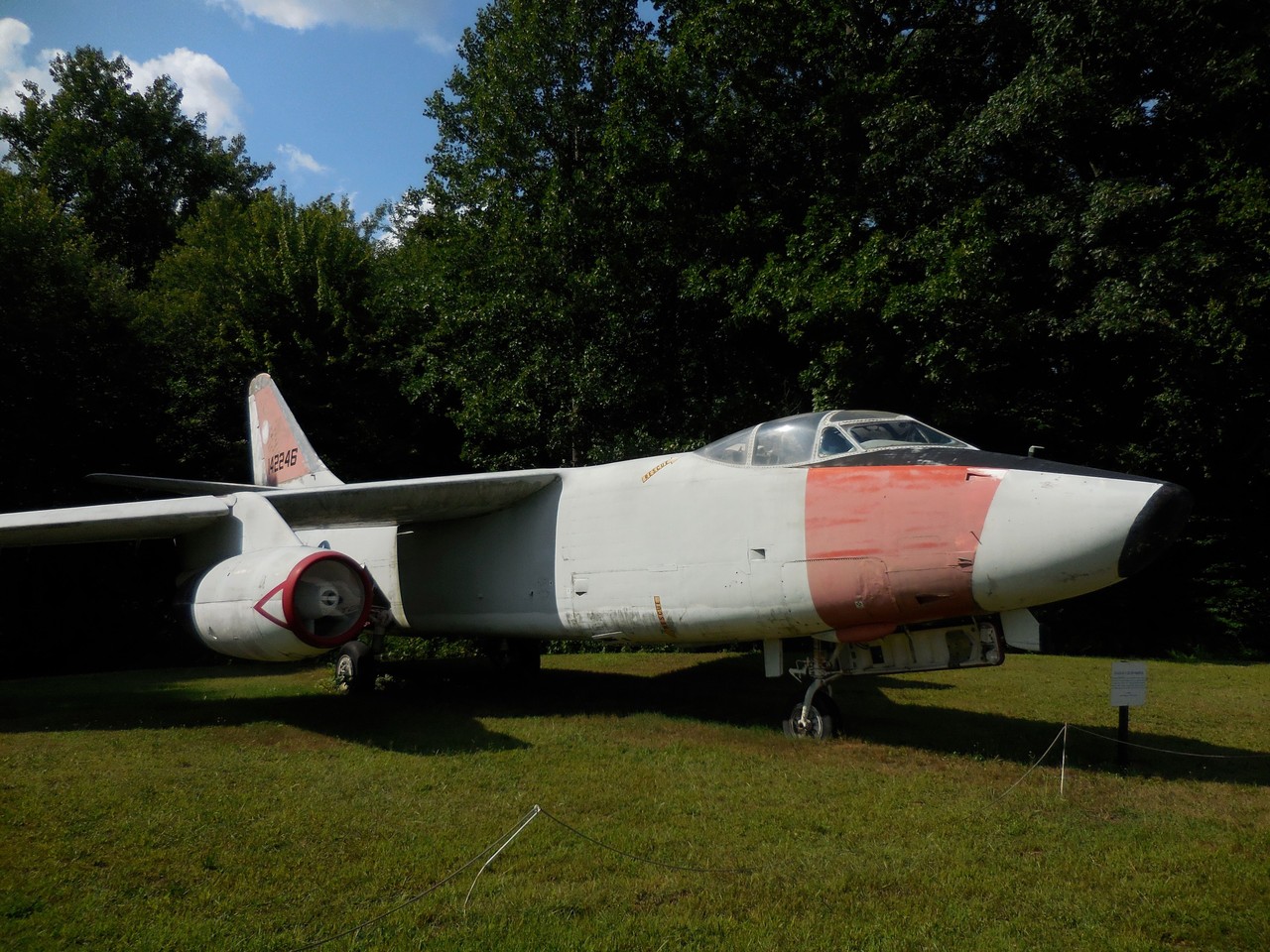
The A-3 Skywarrior achieved operational status in March 1956 when Navy squadron VAH-1 at Naval Air Station Jacksonville received the first aircraft. By its peak deployment, the improved A3D-2 variant equipped eight heavy attack squadrons operating from Essex and Midway-class carriers, providing the Navy with unprecedented nuclear strike capability from the sea. The aircraft's 35-year service life, ending on September 27, 1991, demonstrated remarkable longevity as it evolved far beyond its original strategic bombing role into electronic warfare and reconnaissance platforms that proved essential during the Vietnam War and Gulf War.
Design Innovation and Records
Ed Heinemann's design team achieved what competitors deemed impossible by creating a carrier-capable nuclear bomber weighing approximately 70,000 pounds—two-thirds the weight North American insisted would be required. The Skywarrior quickly established performance records, including a 3,200-mile Hawaii-to-New Mexico flight in 5 hours 40 minutes on July 31, 1956, and a transcontinental New York-to-Los Angeles record of 5 hours 12 minutes set by an A3D-2 on March 21, 1957. The aircraft earned the affectionate nickname "The Whale" for its massive size relative to other carrier aircraft.
The Manufacturer
Douglas Aircraft Company, founded by Donald Douglas, established itself as one of America's premier aircraft manufacturers through designs like the DC-3 airliner and numerous military aircraft. The company produced 282 Skywarriors between 1956 and 1961, with the final aircraft delivered in January 1961. Douglas later merged with McDonnell Aircraft in 1967 to form McDonnell Douglas, which subsequently became part of Boeing in 1997.
Engine and Technical Excellence
The Skywarrior's two Pratt & Whitney J57-P turbojet engines evolved throughout production, with early A3D-1 models producing 9,700 pounds of thrust each while later A3D-2 variants generated 12,400 pounds per engine. This power enabled the aircraft to reach its service ceiling of 39,000 feet and achieve a maximum range of 2,990 miles. The robust design allowed the aircraft to break Mach 1 in a dive, though this capability was discouraged operationally due to control system limitations.
Operational Versatility
While conceived as a nuclear bomber, the Skywarrior's adaptability ensured its survival long after strategic bombing missions ceased. The EA-3B electronic warfare variant became the longest-serving model, providing critical intelligence gathering capabilities that made it indispensable during conflicts from Vietnam through the Gulf War. Air Force variants, designated RB-66B and B-66B, served Tactical Air Command with 145 reconnaissance models and 72 bombers built specifically for land-based operations.
Production Legacy
Douglas manufactured the A-3 in multiple variants: 50 A3D-1 initial production aircraft, 164 improved A3D-2 models with stronger airframes and more powerful engines, and various specialized versions including trainers and electronic warfare platforms. The 1962 military designation consolidation renamed all variants with the A-3 prefix, though many continued using the original A3D designations informally. Total production of 282 aircraft represented a significant manufacturing achievement for such a specialized, large carrier aircraft.
Museums and Preservation
Today, surviving Skywarriors serve as museum displays honoring naval aviation history. The National Naval Aviation Museum preserves two examples: A3D-1 Bureau Number 135418 and NEA-3B Bureau Number 144865. The Patriots Point Naval & Maritime Museum maintains EA-3B Bureau Number 146457, ensuring future generations can appreciate the engineering achievement that proved heavy jets could successfully operate from carrier decks. These preserved aircraft represent the bridge between World War II-era carrier aviation and the modern jet age that followed.