
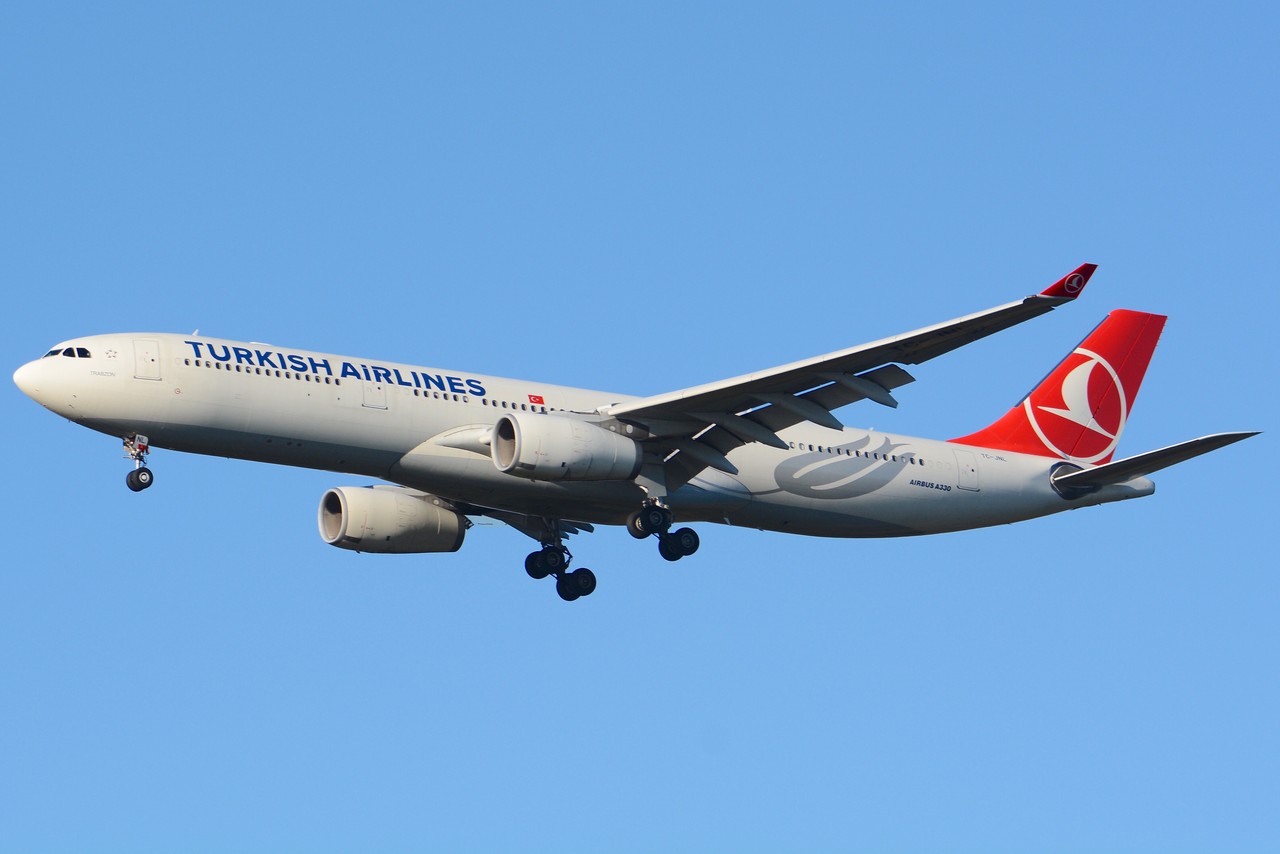
Service Dominance
The A330 achieved remarkable commercial success, becoming the first Airbus twin-aisle aircraft to reach 1,000 deliveries in July 2013 and surpassing 1,500 deliveries by September 2020. With over 1,924 firm orders across all variants and 1,472 A330ceo models delivered by May 2025, it captured significant market share in the long-haul segment. As of December 2019, approximately 1,443 aircraft remained in active service worldwide, demonstrating exceptional operational longevity.
Launch and Early Operations
Air Inter became the launch customer, accepting the first A330 on December 30, 1993, and inaugurating commercial service on January 17, 1994, on the Paris Orly to Marseille Provence route. The initial order came from Air Inter with five firm orders and 15 options, alongside Thai Airways International's four firm and four options, both placed on March 12, 1987. Early thrust reverser delamination issues delayed some deliveries to 1994, but the aircraft quickly gained acceptance among major carriers including Malaysia Airlines, Cathay Pacific, and Northwest Airlines, which became the North American launch customer after firming its order in February 1989.
Military Variants
The A330 MRTT (Multi Role Tanker Transport), designated KC-30B in some air forces, transformed the civilian airliner into a strategic military asset. This variant serves air-to-air refueling, strategic transport, and medical evacuation roles for multiple air forces including the Royal Australian Air Force and French Air Force. Production of military variants continues alongside civilian models, extending the aircraft's operational versatility beyond commercial aviation.
Airbus Industries Legacy
Airbus originated in 1970 as a European consortium combining French Aérospatiale, German Deutsche Airbus, and British Aerospace. The company formally launched the A330 and A340 programs simultaneously in June 1987 following supervisory board approval on January 27, 1986. After restructuring into EADS in 2000-2001 and rebranding to Airbus SE in 2017, the company continues operations from its Toulouse, France headquarters, maintaining A330 production alongside newer programs.
Technical Innovation
The Airbus engineering team designed the A330 as a long-range derivative of the A300, sharing fuselage and systems with the four-engine A340 for cost efficiency. British Aerospace engineers made crucial contributions, resolving critical wing issues discovered during static testing in 1992. The aircraft pioneered several innovations including advanced fly-by-wire controls, extensive composite materials usage, and new wing and stabilizer designs optimized for twin-engine operations.
Powerplant Options
Early prototypes utilized General Electric CF6-80E1 turbofan engines, part of the CF6 family in production since 1971 with over 30 million flight hours across various wide-body aircraft. Production variants offered multiple engine choices including Rolls-Royce Trent 700, Pratt & Whitney PW4000, and GE CF6-80E1 turbofans, all optimized for high-bypass efficiency and ETOPS-180 certification enabling extended twin-engine operations over water.
Performance Capabilities
The A330-300 achieved a maximum speed of Mach 0.86 with a range of 13,400 kilometers and service ceiling of 12,500 meters. The aircraft required a two-pilot crew plus cabin staff, with passenger capacity ranging from 295 to 440 depending on cabin configuration, typically seating 250 in three-class layout. These specifications positioned it as the largest twin-jet until the Boeing 777's introduction.
Certification Milestone
The A330 achieved joint JAA/FAA certification on October 21, 1993, becoming the first aircraft to receive simultaneous European and American approval. This milestone followed 420 test flights totaling 1,100 hours, demonstrating the aircraft's safety and reliability to international standards. The certification enabled immediate global market access and established confidence among international operators.
Production Excellence
Airbus established primary manufacturing at its Toulouse final assembly line, with the A330-300 pioneering integrated production including paintshop and cabin furnishing facilities. The first A330-300 rolled out on October 14, 1992, with the A330-200 variant following later. Production transitioned from A330ceo variants in July 2017 to A330neo models, while specialized variants like the MRTT and BelugaXL continue production into 2025.
Aviation Impact
The A330 fundamentally changed long-haul aviation by proving twin-engine aircraft could efficiently operate routes previously requiring four engines. Its ETOPS certification expanded operational possibilities while reducing fuel costs and maintenance complexity. The aircraft's success validated the European challenge to American aviation dominance and established Airbus as a major wide-body manufacturer, directly competing with Boeing's 767 and 777 series.