
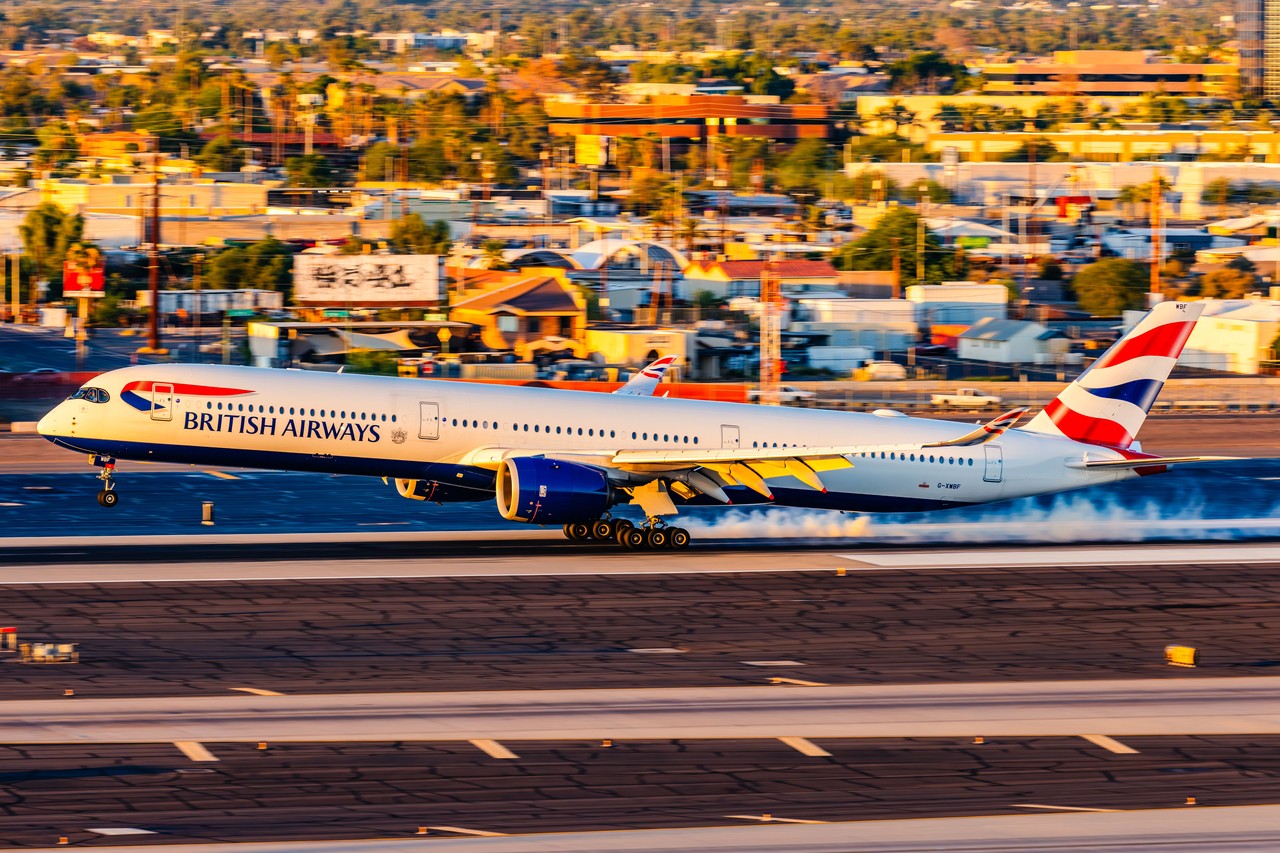
Revolutionary Composite Design
The A350-1000 emerged from Airbus's ambitious response to Boeing's 787 Dreamliner, representing a complete clean-sheet redesign announced on December 1, 2006. After initially proposing an A330 derivative that failed to gain market support, Airbus's engineering team committed to an entirely new "Xtra Wide Body" design utilizing more than 50 percent composite materials. The carbon fiber fuselage construction reduces aircraft weight by 20 percent compared to traditional aluminum structures, while advanced aerodynamics including signature "sharklets" improve fuel efficiency by an additional 4 percent.
Manufacturing Excellence
Airbus SE orchestrates a sophisticated international manufacturing network for the A350-1000, with final assembly occurring at the Toulouse Final Assembly Line in France. The first fuselage major components came together in September 2015, leading to the commencement of final assembly in February 2016. Critical components arrive from specialized facilities worldwide: fuselage barrels from Illescas, Spain, center wingboxes from the United Kingdom, and composite rudders from China. This distributed production model reflects Airbus's evolution from the original 1970 consortium of European aerospace companies into today's integrated multinational corporation.
Rolls-Royce Powerplant Partnership
The A350-1000 exclusively utilizes twin Rolls-Royce Trent XWB high-bypass turbofan engines, each delivering up to 97,000 pounds of thrust. These powerplants represent the world's most efficient large turbofans, achieving 15 percent better fuel burn than predecessor engines through innovative tri-spool design and swept fan blade technology. Development of the Trent XWB began alongside the A350 program in 2006, with Rolls-Royce delivering over 1,000 units by 2020. The engine's exceptional reliability record includes zero uncontained failures in service, establishing new standards for widebody propulsion.
Market Entry and Commercial Success
Qatar Airways assumed launch customer responsibilities, receiving the first A350-1000 on February 20, 2018, and inaugurating commercial service four days later on the prestigious Doha-London Heathrow route. The aircraft's market acceptance accelerated rapidly, with Cathay Pacific converting 16 A350-900 orders to the -1000 variant and adding 10 additional aircraft. Virgin Atlantic's first delivery, registered G-VLUX, arrived in August 2019, while Emirates received its initial two aircraft in December 2024 as part of a substantial 65-aircraft order.
Operational Impact
The A350-1000's exceptional range capability of 8,700 nautical miles enables airlines to operate previously impossible non-stop routes, fundamentally reshaping long-haul network planning. Its maximum cruise speed of Mach 0.89 and service ceiling of 13,100 meters provide operational flexibility across diverse route structures. The aircraft typically accommodates two pilots and between 350 to 410 passengers depending on cabin configuration, with some high-density layouts reaching 480 seats.
Industry Transformation
By late 2024, more than 200 A350-1000s had entered service, contributing to a broader industry shift away from four-engine aircraft. The type's 25 percent reduction in operating costs compared to previous generation widebodies accelerated the retirement of quad-jets including Airbus's own A340 and contributed to the 2021 termination of A380 production. Delta Air Lines' commitment to up to 40 A350-1000s, confirmed in February 2019 and revised in November 2019, demonstrates strong North American market acceptance.
Technical Legacy
The A350-1000's advanced composite construction and systems integration established new benchmarks for passenger comfort, including optimized cabin pressure and humidity levels. Production continues actively as of 2024 with no announced termination date, supported by a robust order book exceeding the current delivery count of 286 tracked aircraft. The program's success validated Airbus's clean-sheet approach and reinforced European capabilities in advanced widebody development, positioning the company competitively against Boeing's long-haul offerings for decades to come.