
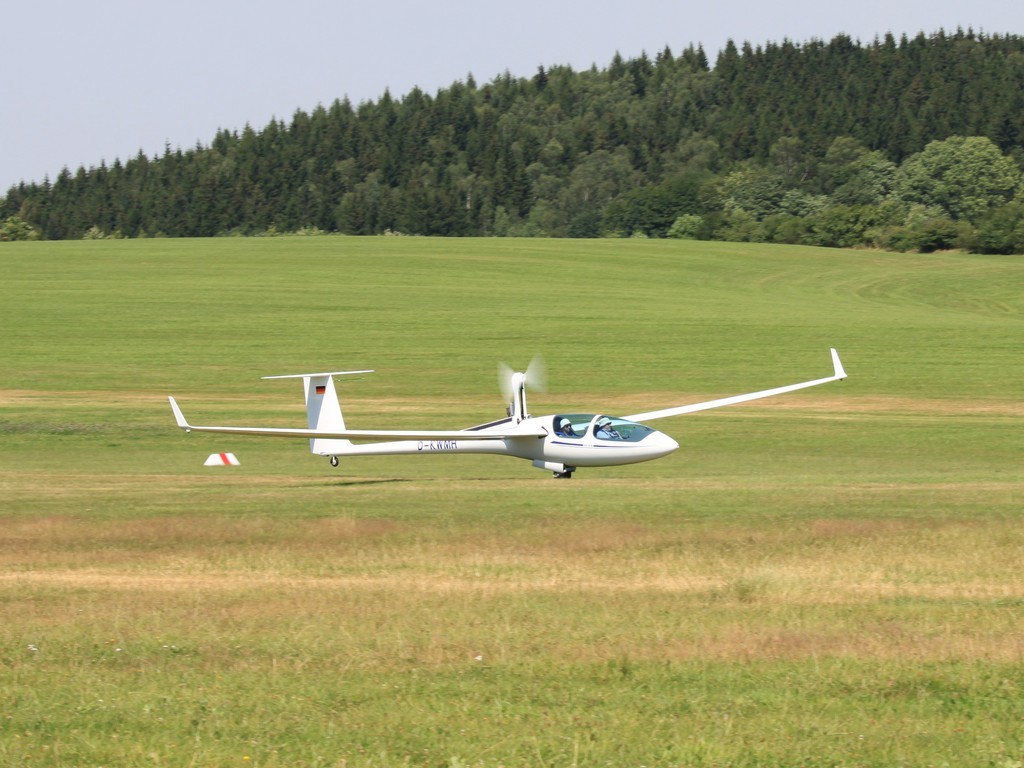
Development and Design Philosophy
Michael Greiner spearheaded the ASG 32 Mi's development to fill a critical market void between Alexander Schleicher's ASK 21 trainer and the high-end ASH 30 Open Class two-seater. The design team targeted competitive pilots, gliding clubs, and touring enthusiasts who demanded superior performance within the FAI 20-meter class restrictions. Prototype construction commenced in 2013, with wing prototypes emerging in February 2014, demonstrating the manufacturer's methodical approach to engineering excellence.
Greiner himself, alongside Alexander Schleicher CEO Peter Kremer, piloted the maiden flight on May 31, 2014, from the company's home base in Poppenhausen, Germany. This collaborative test flight approach reflected the hands-on leadership philosophy that has characterized Alexander Schleicher since resuming operations in 1951 after World War II.
Technical Innovation and Safety Features
The ASG 32 Mi incorporated several groundbreaking features that distinguished it from contemporary motorgliders. The composite construction utilized an advanced T-tail design coupled with fully retractable landing gear, including a steerable tail wheel that retracts completely flush with the fuselage. The aircraft's sophisticated control mixer system delivers exceptional aileron effectiveness while enabling landing flaps to extend up to 50 degrees for precise approach control.
Safety considerations drove many design decisions, most notably the 9g crashworthy cockpit structure that exceeded the standard 6g certification requirements by 50 percent. Pilots benefit from in-flight adjustable rudder pedals, integrated bug wipers for windscreen maintenance during long flights, and LED anti-collision lighting systems. These features reflected the manufacturer's commitment to both competition performance and operational safety.
Powerplant and Performance
The heart of the ASG 32 Mi lies in its Austro Engine IAE 50R-AA powerplant, a single-rotor Wankel rotary engine producing 41 kW (55 horsepower). This proven powerplant had already accumulated over 500 installations across Alexander Schleicher's glider fleet before the ASG 32's introduction, establishing a reliability record that gave early adopters confidence in the design.
The engine drives a specially designed Schleicher AS2F1-1/R153-92-N1 two-bladed propeller measuring 1.53 meters in diameter, which retracts completely to eliminate drag during soaring flight. With the propeller extended, maximum speed reaches 180 kilometers per hour, while the never-exceed speed of 270 kilometers per hour provides substantial safety margins during high-speed flight operations.
Early Operational Success
Serial production began in 2015, with deliveries commencing immediately to eager customers worldwide. The aircraft's potential became evident almost immediately through record-breaking flights that demonstrated its exceptional cross-country capabilities. On November 10, 2015, Roman Michalowski of the United States and Wolfgang Janowitsch of Austria achieved a remarkable 1,066-kilometer flight averaging 136.5 kilometers per hour.
Just nine days later, Fernando Silva from the United States teamed with German pilot Arndt Hovestadt to exceed 1,000 kilometers at an even faster 142 kilometers per hour average speed on November 19, 2015. These achievements marked the first thousand-kilometer flights accomplished in the ASG 32 Mi, establishing the type's credibility in serious cross-country soaring competition.
Alexander Schleicher Legacy
Alexander Schleicher GmbH & Co. brought decades of glider manufacturing expertise to the ASG 32 project, having specialized exclusively in sailplane construction since restarting operations in 1951. The company celebrated its 75th anniversary in November 2002, indicating founding roots extending back to approximately 1927, though World War II interrupted operations for several years.
The manufacturer's Poppenhausen facility continues producing ASG 32 variants today, including the electric-powered ASG 32 El variant featuring a 25-kilowatt synchronous electric motor with approximately 100-kilometer range. This diversification into electric propulsion demonstrates Alexander Schleicher's commitment to emerging technologies while maintaining their core sailplane expertise.
Performance Specifications and Certification
The ASG 32 Mi spans exactly 20 meters with a length of 9.07 meters, achieving a maximum takeoff weight of 850 kilograms. Wing loading ranges from 33.8 kg/m² with a single 70-kilogram pilot to 54.1 kg/m² at maximum capacity with two 120-kilogram pilots. The sailplane achieves a best glide ratio of 52:1 with minimum sink rate of 0.6 meters per second, placing it among the elite performers in the 20-meter class.
Structural load factors of +5.3/-2.65g provide robust safety margins for aggressive thermal flying and turbulent conditions. The European Aviation Safety Agency awarded Type Certificate approval on February 11, 2016, validating both the ASG 32 pure sailplane and Mi motorglider variants for commercial operation throughout Europe and countries recognizing EASA certification.