
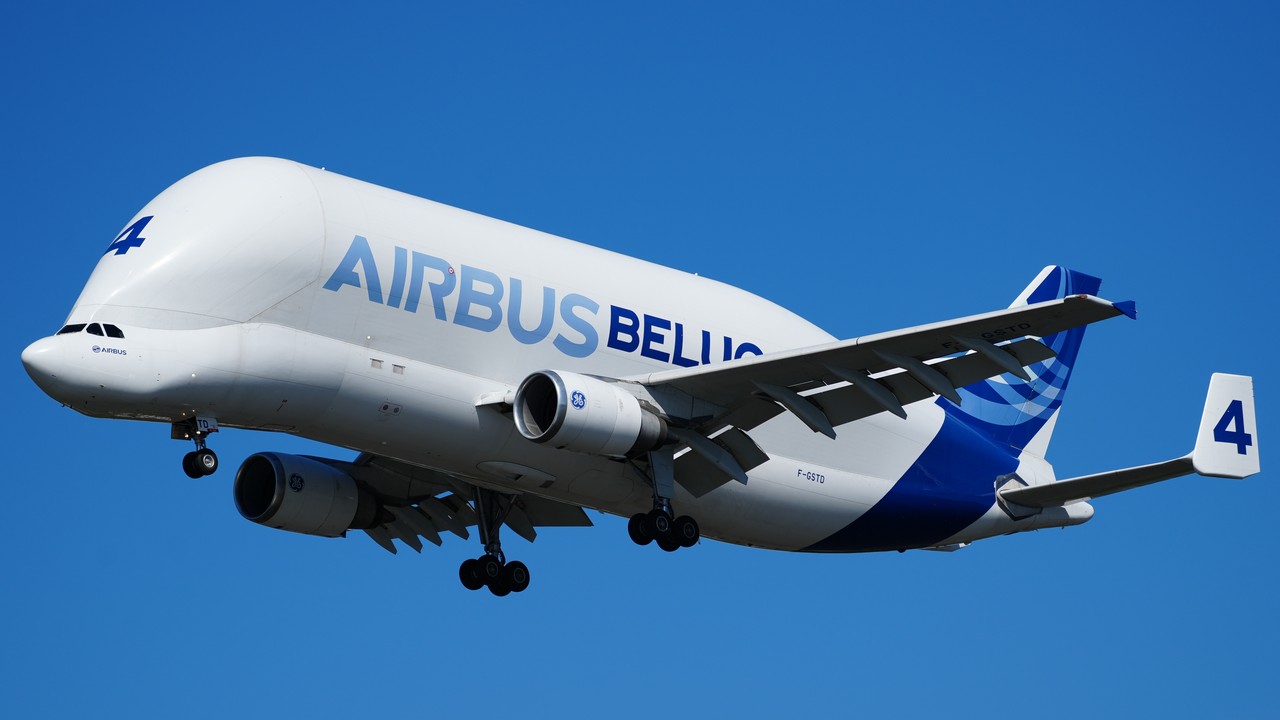
Service History
The Beluga fleet dominated Airbus's internal logistics for over two decades, completely transforming how the company manufactured widebody aircraft. By 1997, the five-aircraft fleet had logged more than 2,500 flight hours across 1,400+ flights, entirely replacing the aging Super Guppy fleet on October 24, 1997. At peak operations around 2012, the Beluga fleet accumulated approximately 5,000 flight hours annually, shuttling fuselage sections, wings, and major components between manufacturing sites in France, Germany, Spain, and the United Kingdom.
Operated exclusively by Airbus Transport International (ATI), founded in 1996 in Toulouse with IATA code 4Y and ICAO code BGA, the Beluga enabled Airbus's revolutionary distributed production model. This system allowed each European partner nation to manufacture specific aircraft sections while maintaining political and economic balance within the consortium. From 2022 to 2024, ATI rebranded as Airbus Beluga Transport (AIBT) and briefly offered external charter services for oversized cargo, though this commercial venture wound down as the fleet transitioned to retirement.
The Manufacturer
Special Aircraft Transport International Company (SATIC) emerged as a specialized joint venture between France's Aérospatiale and Germany's Daimler-Benz Aerospace (DASA) specifically to develop the Beluga program in the early 1990s. This arrangement reflected the complex multinational structure of Airbus Industrie GIE, formed in 1970 to coordinate European aerospace cooperation in response to American dominance in commercial aviation.
SATIC coordinated an intricate manufacturing network spanning multiple countries: EADS Sogerma in France handled final assembly, EADS Elbe Flugzeugwerke in Germany produced fuselage sections, EADS CASA in Spain manufactured the main fuselage and horizontal stabilizers, while Aerostructures Hamble Ltd in the UK and EADS Dornier in Germany collaborated on the massive upper cargo door. Latécoère in France supplied the flight deck components. This distributed approach divided 15 major work packages among European suppliers, investing approximately $1 billion in the complete program including aircraft, cargo handling systems, and operational management.
The parent organization evolved significantly during the Beluga's service life: Airbus Industrie restructured into EADS in 2000, then fully integrated into Airbus SAS by 2001, operating today simply as Airbus.
Engine & Technical Innovation
Each Beluga mounted four General Electric CF6-80C2 turbofan engines, high-bypass powerplants delivering approximately 62,000 pounds of thrust each. These engines, entering production in 1982 with ongoing variants, proved their reliability through extensive service on A300 widebodies and earned ETOPS certification for extended-range operations. The 20 engines across the five-aircraft fleet provided the necessary power to lift the aircraft's massive cargo loads while maintaining cruise speeds around Mach 0.74—significantly faster than the Super Guppy's capabilities.
The Beluga's most striking innovation was its bulbous upper fuselage, earning the aircraft its whale-like appearance and nickname. Derived from the proven A300-600R freighter platform, engineers completely redesigned the upper structure to create unprecedented cargo volume. The main cargo hold measured 30 meters long, 7.7 meters wide, and 7.6 meters high—dimensions exceeding even military strategic airlifters like the C-5 Galaxy, An-124 Condor, and C-17 Globemaster III.
This cavernous hold could accommodate complete A330 or A340 fuselage sections, entire wing assemblies, or multiple smaller components. The aircraft required specialized ground equipment and facilities, limiting operations to specific airports including Hawarden in Wales, with its 1,663-meter runway constraining the Beluga's operational range calculations.
Technical Performance
With its 44.84-meter wingspan and approximately 17.7-meter height, the Beluga operated with a two-pilot crew plus specialized loadmasters trained in handling oversized cargo. The aircraft achieved a service ceiling above 41,000 feet and maintained sufficient range for European routes, though its missions typically involved relatively short hops between manufacturing centers rather than intercontinental flights.
The aircraft's design prioritized cargo volume and operational efficiency over raw performance, reflecting its specialized role within Airbus's production system. Unlike conventional freighters designed for diverse cargo types, every aspect of the Beluga's configuration served the specific mission of transporting aircraft components that could not be accommodated by any other aircraft type.
Production & Legacy
Exactly five Beluga aircraft rolled off production lines between September 1992, when construction began on the first airframe, and 2000, when the final aircraft entered service. Despite SATIC's marketing efforts in the 1990s, no external customers placed orders, leaving the entire production run dedicated to Airbus internal operations. This exclusivity reflected both the aircraft's highly specialized design and the limited market for such extreme outsized cargo capability.
By 2024, the Beluga era had effectively concluded as Airbus completed deployment of five larger BelugaXL aircraft by 2025. The original Beluga fleet transitioned from internal service, with possibly one aircraft remaining active through AIBT for specialized charter missions. While no specific examples have been confirmed for museum preservation, the Beluga achieved iconic status in aviation circles as the "flying whale" that symbolized European aerospace cooperation and enabled the modern era of distributed aircraft manufacturing.
The Beluga's 25-year service record proved the viability of purpose-built oversized airlift and supported Airbus's growth from a struggling consortium into Boeing's primary competitor in the global airliner market.