
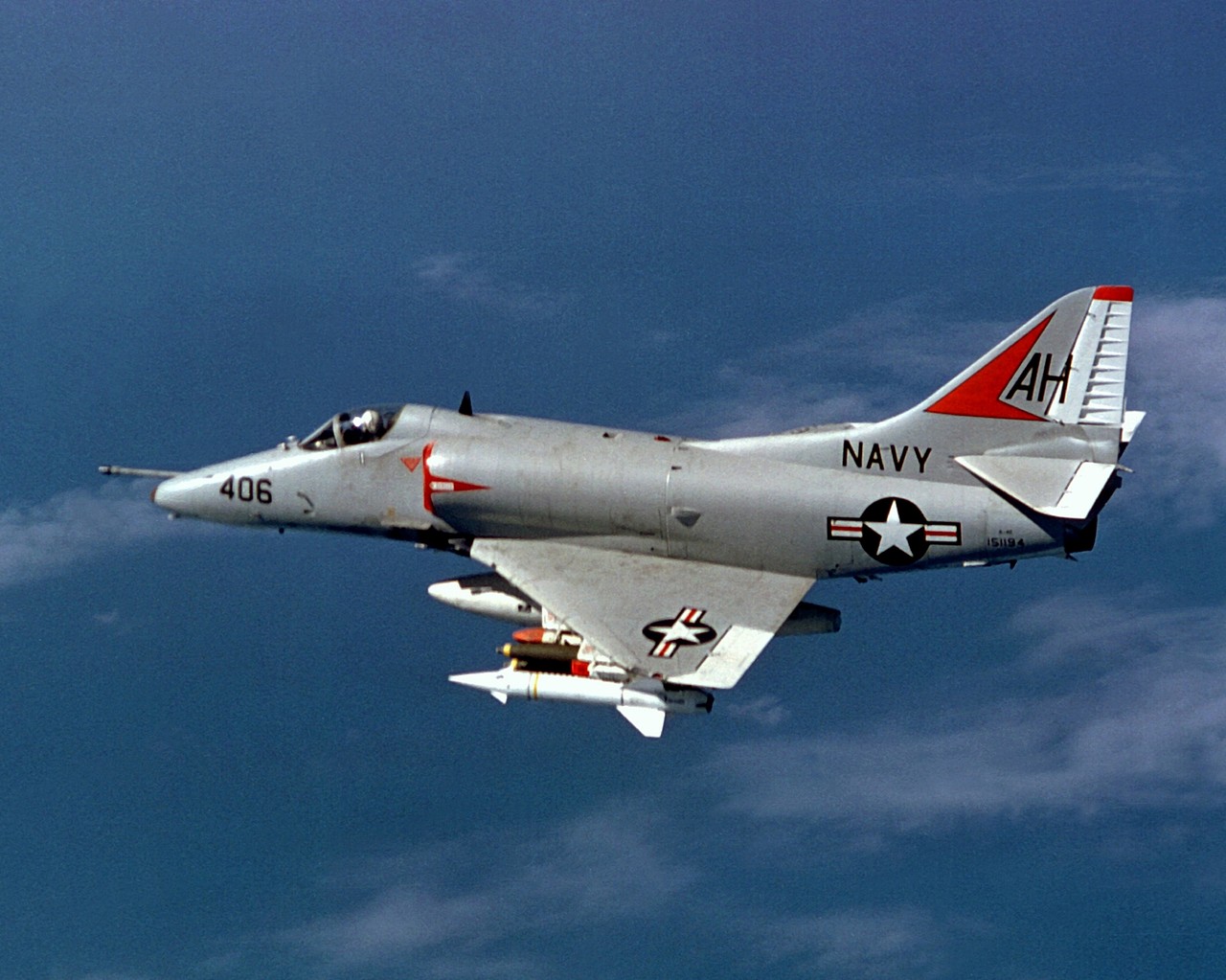
Service Dominance and Global Impact
The A-4 Skyhawk became the standard bearer for carrier-based attack operations, with 2,960 aircraft delivered over a 25-year production run from 1954 to 1979. This represented the longest production span of any American tactical aircraft at the time—27 years of continuous manufacturing. The aircraft's compact dimensions made it ideal for aircraft carrier operations, allowing more Skyhawks to be stored and operated from carriers compared to larger attack aircraft of the era.
Eighteen Navy and Marine squadrons initially received the A4D-1 variant, establishing the Skyhawk as a cornerstone of American naval aviation. The aircraft's export success was equally impressive, with Argentina becoming the first international customer, followed by Israel, Malaysia, Kuwait, Brazil, Singapore, Australia, Indonesia, and New Zealand.
Combat Operations and Wartime Service
The A-4 Skyhawk proved its mettle across multiple major conflicts, beginning with extensive service during the Vietnam War. The aircraft demonstrated remarkable versatility, serving primarily in the attack role while occasionally engaging in air-to-air combat. On May 1, 1967, Lieutenant Commander Ted Swartz achieved a notable victory when his A-4 downed a North Vietnamese MiG-17 using air-to-ground rockets—a testament to both pilot skill and aircraft capability.
Beyond Vietnam, Skyhawks saw action in the 1973 Yom Kippur War and the 1982 Falklands War. Argentina, Israel, and Kuwait all employed their A-4s in combat operations, with the aircraft proving effective in various theaters and operational conditions. The Skyhawk's ability to deliver 6,000 pounds of bombs and missiles made it a formidable ground attack platform, while later variants incorporated air-to-air capabilities including support for the AGM-12 Bullpup missile.
Manufacturing Legacy
Douglas Aircraft Company initiated Skyhawk development following a Navy contract signed on June 12, 1952, for one prototype XA4D-1. After the Navy's favorable review in October 1952, an additional 19 aircraft were ordered, launching what would become one of the most successful military aircraft programs in history. The first factory-to-fleet delivery occurred on September 26, 1956, when VA-72 at NAS Quonset Point, Rhode Island, received their initial aircraft.
Douglas Aircraft Company later merged to become McDonnell Douglas, which continued Skyhawk production until delivering the final A-4M to VMA-331 on February 27, 1979. Today, the McDonnell Douglas name exists only in aviation history, as Boeing acquired the company in 1997. Douglas Aircraft Company had previously produced other notable designs, but none achieved the Skyhawk's combination of longevity and international success.
Technical Innovation and Design
The Skyhawk's delta-wing configuration and single-engine layout represented innovative thinking in 1950s aircraft design. The aircraft achieved a maximum speed exceeding 670 mph with a speed range spanning from 375 mph to 750 mph, providing tactical flexibility across various mission profiles. Its subsonic design prioritized reliability and maintainability over pure speed, proving ideal for sustained carrier operations.
The aircraft's compact dimensions were revolutionary for carrier aviation, allowing more efficient deck operations and storage. This design philosophy influenced subsequent naval aircraft development, demonstrating that smaller could indeed be better in the demanding carrier environment.
Production Variants and Evolution
Skyhawk development progressed through numerous variants, beginning with nine XA4D-1 prototypes. The initial production A4D-1 (later redesignated A-4A) saw 166 examples completed, establishing the basic design framework. The improved A-4B featured a reinforced airframe and enhanced avionics, with 542 aircraft manufactured.
Subsequent variants included the A4D-5 (A-4E) with 499 manufactured, and the final production A-4M with 160 built, including two revised A-4F aircraft. Training requirements led to the TA-4J two-seat variant, with 281 trainers produced. International customers received specialized versions, including the A-4G for Australia, which first flew on July 19, 1967, and the A-4PTM program that saw 40 A-4C/L aircraft converted by Grumman Aerospace for the Royal Malaysian Air Force between 1984 and 1985.
Enduring Legacy
Sixty years after its first flight, the Skyhawk's impact on military aviation remains significant. The final production aircraft, an A-4M delivered to Marine squadron VMA-331, bore the flags of all nations that operated the type painted on its fuselage—a fitting tribute to the aircraft's global service record.
Some of the nearly 3,000 Skyhawks built continue flying today, testament to the design's fundamental soundness and continued utility. The aircraft served the United States Navy and Marine Corps with distinction for decades, while international operators extended its service life well beyond its original design expectations. The A-4 Skyhawk stands as one of the most successful examples of American military aircraft design, combining operational effectiveness with production efficiency to create a truly global aviation success story.