
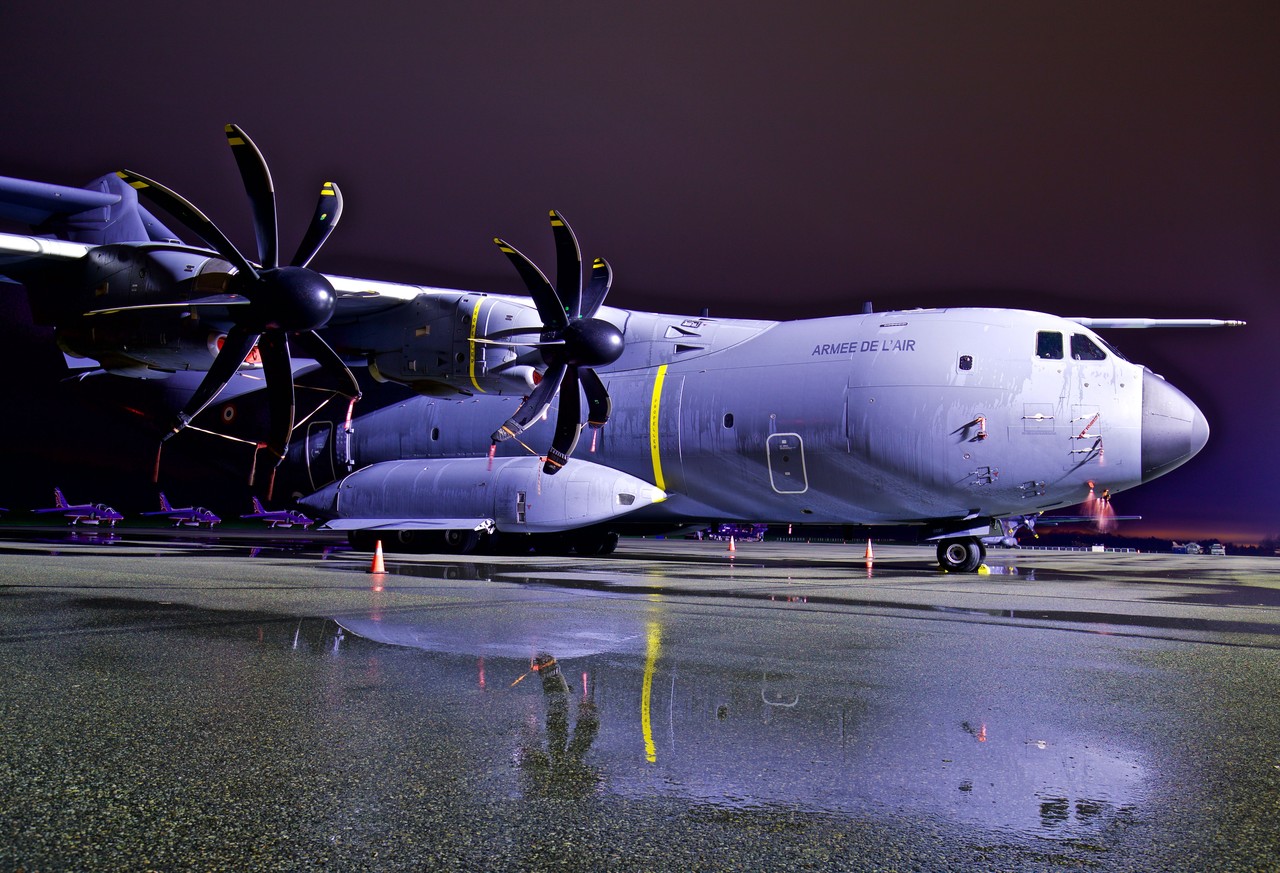
European Military Aviation Revolution
The A400M Atlas represents the most ambitious European military aviation project of the 21st century, designed specifically to replace aging fleets of tactical transports while providing capabilities previously unavailable to European forces. Development began in the early 2000s when eight European nations recognized the need for a new-generation airlifter that could combine the tactical flexibility of the C-130 Hercules with the payload capacity approaching that of strategic transports like the C-17 Globemaster III.
Production and Manufacturing Excellence
Airbus launched full-scale production in 2009, continuing the company's tradition of European aerospace cooperation that began with the A300 programme in the late 1960s. The manufacturing process demonstrates remarkable international collaboration: Filton, Bristol produces the composite wings, German facilities construct the fuselage sections, and final assembly takes place at Airbus facilities in Spain. This distributed production model has delivered 92 aircraft from 174 total orders as of September 2020, with production continuing at steady rates.
The French Air Force received the first production Atlas in August 2013, followed by the Royal Air Force's initial delivery on November 17, 2014. The RAF has since taken delivery of 22 aircraft at Brize Norton, establishing the type as the backbone of British airlift operations.
Revolutionary Powerplant Technology
Four Europrop TP400-D6 turboprop engines power the A400M, each driving eight-bladed Ratier-Figeac FH385 and FH386 variable-pitch propellers with full feathering and reversing capability. This powerplant combination was specifically developed for the Atlas programme, representing the most advanced turboprop technology available. The variable-pitch propellers with thrust reversal provide exceptional short-field performance, enabling operations from semi-prepared strips that would challenge conventional transport aircraft.
The engine configuration delivers remarkable fuel efficiency for long-range missions while maintaining the low-speed handling characteristics essential for tactical operations. This balance proved itself during the RAF's record-breaking 22-hour non-stop flight from Oxfordshire to Guam in July 2023, demonstrating the Atlas's global reach capability when supported by air-to-air refueling.
Operational Versatility and Combat Capability
The A400M excels in multiple mission profiles that previously required different aircraft types. In troop transport configuration, it accommodates 116 fully equipped paratroopers, with airdrop capabilities at speeds ranging from 110 to 300 knots depending on mission requirements. The lower drop speeds significantly reduce paratrooper dispersion patterns, improving tactical effectiveness.
For medical evacuation missions, standard configuration provides eight stretchers, expandable to 66 NATO stretchers plus 25 medical personnel for mass casualty scenarios. The 340 cubic meter cargo hold can transport vehicles, helicopters including the Boeing Chinook, or 37 tonnes of general cargo, providing commanders unprecedented flexibility in mission planning.
The aircraft's autonomous landing systems enable operations on rough, unprepared surfaces under challenging conditions. RAF Atlas aircraft have demonstrated this capability across diverse environments, from Caribbean hurricane relief operations to Middle Eastern deployments and South Atlantic rescue missions.
Air-to-Air Refueling Innovation
The A400M features comprehensive refueling capabilities through wing-mounted hose and drogue pods or centerline systems. This flexibility allows the Atlas to serve as both tanker and receiver, extending its own range while supporting other aircraft operations. The 2023 trans-Pacific flight highlighted these capabilities, maintaining continuous operations across 22 hours without ground contact.
Airbus Defence and Space Legacy
Airbus Defence and Space developed the A400M as part of the broader Airbus consortium that emerged from European cooperation initiatives beginning in the late 1960s. The company's experience with collaborative programmes, established through early successes with the A300 commercial airliner, provided the organizational framework necessary for the complex A400M development and production programme.
This heritage of international cooperation continues through component manufacturing across multiple countries, with each nation contributing specialized expertise to the overall programme. The distributed production model strengthens European aerospace capabilities while ensuring long-term programme sustainability.
Operational Impact and Strategic Significance
The A400M has fundamentally changed European military airlift capabilities since entering service. The RAF describes the Atlas as the backbone of their operations over the first decade of service, enabling mixed cargo and personnel loads that eliminate previous operational constraints. The aircraft operates at full capacity throughout extended duty cycles without aircraft-imposed limitations, providing commanders unprecedented operational flexibility.
Operational deployments have included humanitarian missions throughout the Caribbean, combat support operations in Afghanistan and Sudan, and strategic deterrence missions protecting Europe's Eastern flank. These diverse missions demonstrate the Atlas's capability to excel across the full spectrum of military airlift requirements.
Current Status and Future Operations
The A400M remains in active production with continuing deliveries to European air forces. The aircraft has proven its design objectives, successfully bridging the capability gap between tactical and strategic transport aircraft while providing unique operational advantages unavailable in previous generation airlifters. Its combination of payload capacity, short-field performance, and advanced systems ensures the Atlas will remain central to European military aviation for decades ahead.