
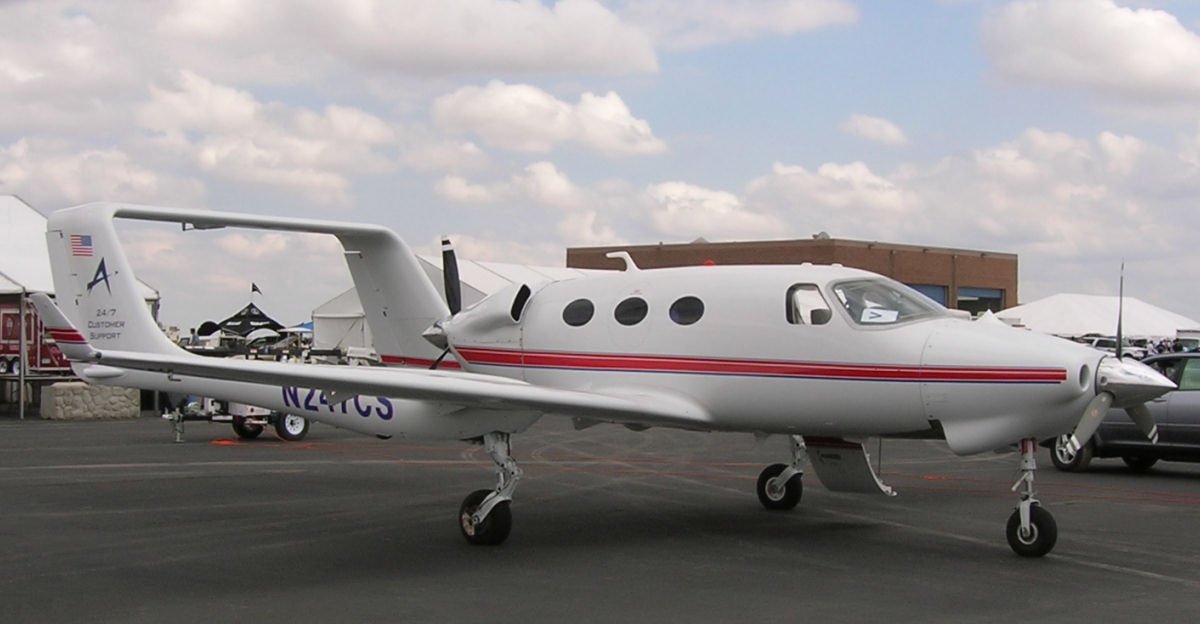
Revolutionary Design Concept
The A-500's origins traced back to legendary designer Burt Rutan, who created the proof-of-concept M-309 in 1999. Scaled Composites built the prototype, designated N309A, which first flew on March 21, 2000, at Mojave, California. By the time it appeared at EAA AirVenture Oshkosh in July 2000, the aircraft had accumulated 80 flight hours, demonstrating the viability of Rutan's innovative twin-boom, centerline-thrust design.
The production prototype N500AX made its maiden flight on July 11, 2002, at Centennial Airport near Denver, followed by the second prototype N501AX on February 18, 2003. This second aircraft was the first to feature the distinctive winglets that would become standard on production models.
Manufacturing Challenges
Adam Aircraft Industries, founded by Rick Adam in 1998, faced significant development hurdles in bringing the A-500 to market. The company's ambitious certification timeline slipped from mid-2003 to 2005 due to weight problems that plagued the program. The production airframes came in more than 1,000 pounds overweight, severely limiting payload capacity and forcing extensive redesign work.
Despite achieving FAA certification in 2005 through the agency's Certification Process Improvement program, production remained painfully slow. The first customer delivery occurred in November 2005 to Mike Leahy, a Colorado Springs chiropractor and former USAF instructor pilot with 3,000 hours in military aircraft including the T-37, T-38, and F-4 Phantom.
Technical Innovation
The A-500's most significant innovation lay in its all-carbon composite construction, utilizing single-cure graphite manufacturing with no secondary bonds or fasteners. The single-piece wing spar represented a breakthrough in composite aircraft design, contributing to the aircraft's smooth flight characteristics while theoretically reducing weight compared to traditional aluminum construction.
Two Teledyne Continental TSIO-550-E flat-six engines powered the aircraft in an unusual push-pull configuration. The front engine drove a three-blade Hartzell FC7663D-2R scimitar propeller in tractor configuration, while the rear engine turned an FLC7663DF-2RX pusher propeller. Each engine produced 350 horsepower, with an optional FADEC system available from TCM/Aerosance. This centerline thrust arrangement eliminated the asymmetric handling problems that traditionally made twin-engine aircraft challenging for pilots transitioning from single-engine planes.
Market Reception and Production
By March 2003, Adam Aircraft had accumulated over 100 orders for the A-500, with 80 firm orders confirmed by 2006. The aircraft attracted attention from diverse operators, including AirScan of Florida, which ordered two aircraft with 30 options for surveillance and security missions. The base price was set at $935,000 in 2003.
However, production never met expectations. Adam Aircraft managed only one delivery per quarter in 2006, far short of their planned six aircraft per month. The company's manufacturing timeline stretched to an unsustainable 15 months per aircraft, which new management attempted to reduce to 14 weeks through streamlined processes.
Performance Capabilities
The A-500 offered impressive performance for a piston twin, with a maximum cruise speed of 230 knots and a range exceeding 800 nautical miles. Its pressurized cabin allowed operations up to 25,000 feet, competing directly with established aircraft like the Beechcraft Baron and Piper Seneca. The approach speed of just 75 knots demonstrated excellent low-speed handling characteristics.
Fuel capacity totaled 250 US gallons, with 231 gallons usable, providing substantial range for cross-country flights. The aircraft featured modern avionics including the Avidyne Entegra system and Garmin GPS navigation.
Corporate Collapse
Founder Rick Adam retired early in 2008 amid mounting production difficulties and financial pressures. Despite new management's efforts to revitalize the company, Adam Aircraft Industries declared bankruptcy and ceased operations in 2008. Only seven A-500s had been completed, leaving more than 100 customers with unfulfilled orders.
Legacy and Museum Preservation
Today, none of the seven A-500s are confirmed to be flying. The Pima Air & Space Museum in Tucson, Arizona, displays N504AX (serial number 4) as part of their collection. The original M-309 proof-of-concept aircraft was donated to Wings Over the Rockies museum, preserving Burt Rutan's innovative design for future generations.
Despite its commercial failure, the A-500 represented a significant milestone as the first all-new certified carbon composite piston twin in more than 20 years. Its advanced manufacturing techniques and innovative design solutions influenced subsequent general aviation development, even though the promised A-700 jet variant never materialized. The aircraft's brief production run stands as a reminder of the challenges facing innovative aerospace startups, even those with revolutionary designs and experienced leadership.