
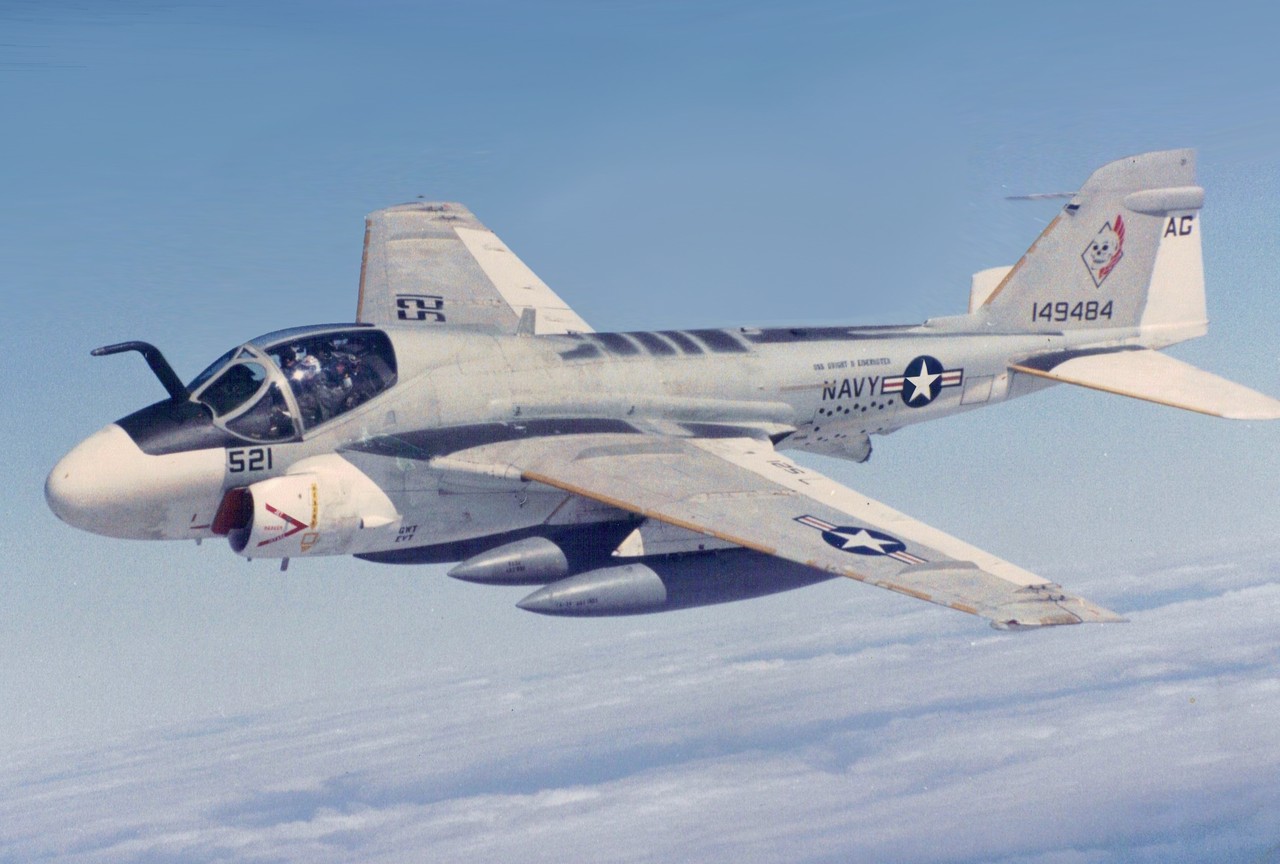
Service Dominance
The A-6 Intruder established itself as the backbone of Navy and Marine Corps strike operations for over three decades, serving from 1963 to 1997. During the Vietnam War, Intruders flew the most dangerous missions—low-level strikes against heavily defended targets in North Vietnam, often as the sole aircraft capable of delivering precision ordnance in monsoon weather and darkness. The aircraft's sophisticated DIANE (Digital Integrated Attack/Navigation Equipment) system allowed crews to navigate and bomb with unprecedented accuracy, making it invaluable for missions where other aircraft were grounded by weather.
Combat Operations
The Intruder entered combat in 1965 during Operation Rolling Thunder, immediately proving its worth in the challenging conditions over North Vietnam. More than 80 A-6s were lost during the Vietnam conflict, testament to both the dangerous nature of their missions and their extensive combat use. The aircraft's low-altitude attack profile made it vulnerable to anti-aircraft artillery and surface-to-air missiles, but also allowed it to deliver ordnance with devastating precision.
During Operation Desert Storm in 1991, aging A-6Es demonstrated their continued relevance by flying deep-strike missions against Iraqi targets. The EA-6A electronic warfare variant provided crucial electronic countermeasures support, while the KA-6D tanker variant—12 aircraft converted from attack configuration—extended the range of carrier air wings throughout the conflict.
Grumman's Naval Legacy
Grumman Aircraft Engineering Corporation, founded in 1929, built its reputation on rugged naval aircraft that could withstand the harsh environment of carrier operations. The company earned the nickname "Grumman's Iron Works" during World War II with fighters like the F4F Wildcat and F6F Hellcat. Beyond military aviation, Grumman designed and built the Lunar Excursion Module that carried Apollo astronauts to the moon's surface. In 1994, Northrop Corporation acquired Grumman to form Northrop Grumman, which continues operations today as a major defense contractor.
The A-6 program originated from a February 1958 Navy contract requiring a replacement for the propeller-driven Douglas A-1 Skyraider. Grumman's design team created an aircraft optimized for high subsonic speed at low altitude, with integrated avionics enabling night and all-weather attacks against small, defended targets. Test pilot Robert Smyth flew the first prototype on April 19, 1960, from Grumman's Bethpage, New York facility.
Technical Innovation
Two Pratt & Whitney J52 turbojet engines powered the Intruder, with early A-6As using J52-P-8A engines producing 10,200 pounds of thrust each. Later variants like the A-6E employed upgraded J52-P-408/409 engines generating 11,200 pounds of thrust each. The J52's reliability and performance at low altitude made it ideal for the Intruder's mission profile, also powering the A-4 Skyhawk and serving in over 1,000 naval aircraft.
The Intruder's side-by-side cockpit configuration was revolutionary for attack aircraft, allowing the pilot and bombardier-navigator to coordinate more effectively than in traditional tandem seating arrangements. This design choice proved crucial for the complex navigation and target acquisition tasks required during low-level penetration missions.
Operational Characteristics
Pilots praised the A-6's stability and handling qualities, particularly during low-level flight in turbulent conditions. The aircraft's swept wings provided good transonic performance while maintaining controllability at the low speeds necessary for precise weapons delivery. With a service ceiling of 37,600 feet and a ferry range of 2,818 miles, the Intruder could reach distant targets and loiter over combat areas.
The aircraft's five external pylons could accommodate a diverse array of weapons, from conventional iron bombs to guided missiles and nuclear weapons in early variants. Later modifications added the M61 Vulcan cannon for close-support missions, though the Intruder's primary role remained precision bombing rather than air-to-air combat.
Production Legacy
Grumman delivered 693 Intruders across multiple variants, with the A-6A accounting for 480 aircraft built between 1962 and 1970. The definitive A-6E variant included 240 newly manufactured aircraft plus 205 conversions from earlier models. Production continued until 1993, making the Intruder one of the longest-produced attack aircraft in U.S. Navy history.
Today, no Intruders remain in flying condition, with the last A-6s retiring in 1997 and the final EA-6B Prowler electronic warfare variant leaving Marine Corps service in 2019. Notable museum examples include aircraft at the National Air and Space Museum in Washington, D.C., the Museum of Flight in Seattle, and the Pacific Coast Air Museum in California. The 1991 film "Flight of the Intruder" immortalized the aircraft in popular culture, cementing its reputation as a symbol of Cold War naval aviation power.