
Design Innovation and Market Position
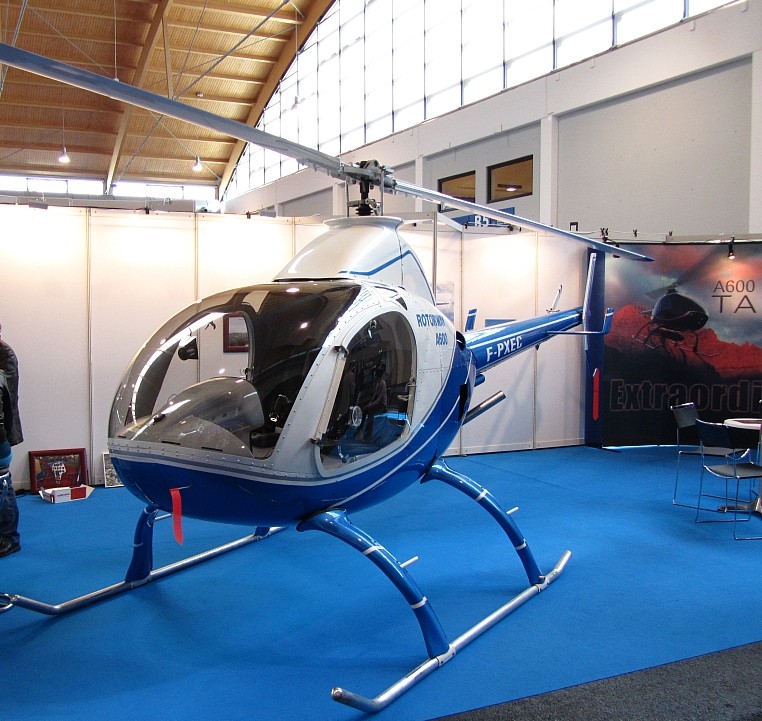
The A-600 Talon emerged from RotorWay International's four decades of kit helicopter manufacturing experience, representing a complete ground-up redesign rather than an evolutionary improvement. CEO Grant Norwitz oversaw the development program, incorporating numerous customer-requested enhancements from the earlier Exec 162F model. The aircraft debuted at AirVenture 2007 on July 5, 2007, marking RotorWay's 40th anniversary as a pioneer in personal rotary-wing aviation.
Unlike its predecessors, the Talon incorporated manufacturing processes and materials designed to meet type-certified aircraft standards while maintaining kit helicopter pricing. This approach allowed amateur builders to construct aircraft meeting the same specifications as factory-certified helicopters, bridging the gap between experimental and commercial aviation standards.
Technical Advancement
The Talon's most significant innovation centered on its all-glass cockpit featuring MGL Avionics systems, replacing traditional analog instruments with modern digital displays. The aircraft incorporated a completely redesigned FADEC (Full Authority Digital Engine Control) system with secondary backup, providing automated engine management previously unavailable in kit helicopters.
Engineering improvements extended beyond avionics. RotorWay replaced the 162F's primary drive chain with a heavy-duty cog belt system, improving maintenance accessibility and operational longevity. The tail rotor power system received comprehensive revision, enhancing control authority and reducing maintenance requirements.
The powerplant represents entirely in-house development, with RotorWay's RI 600S turbocharged four-stroke engine producing 147 horsepower. Each engine undergoes dynamometer testing before shipment, ensuring proper operation parameters. The turbocharged configuration maintains power output at altitude, supporting the aircraft's 11,000-foot service ceiling and 6,000-foot in-ground-effect hover ceiling.
Manufacturing and Production
RotorWay established dedicated manufacturing facilities in Chandler, Arizona, specifically designed for A-600 production. The company moved beyond traditional kit manufacturing by providing substantially pre-assembled components. Engines arrive fully run-in, main rotor blades come factory-balanced, tailbooms are finished except for inspection panels, and fuselage frames are completely welded.
This manufacturing approach positioned builders as assemblers rather than fabricators, reducing construction time and technical skill requirements. The kit price of $97,500 F.O.B. Chandler, Arizona at launch represented significant value in the personal helicopter market, particularly considering the included pre-assembly work and modern avionics.
By February 2013, registration records showed seven A-600 examples in the United States, one in the United Kingdom, and one in Canada, indicating steady but modest adoption among amateur builders.
Company Evolution
RotorWay International's history extends to 1961, when founder B.J. Schram created the first Javelin prototype helicopter. The company achieved another milestone in 1967 as the first production kit helicopter manufacturer with the Scorpion model. By the time of the A-600's introduction, RotorWay had sold more than 1,600 kits across all models, with over 700 aircraft flying worldwide.
In February 2009, RotorWay acquired PMC Machining & Manufacturing to strengthen manufacturing capabilities and pursue certification of a two-seat turbine helicopter powered by a Rolls-Royce RR300 engine. The company promoted itself as "the oldest and largest kit-helicopter company in the world, with kits sold in over 50 countries."
The corporate structure underwent significant change in 2021 when RotorWay's assets transferred to Rotor X, indicating major ownership or operational transitions. Despite this change, the A-600 Talon continued appearing in production listings through 2025.
Performance and Operational Characteristics
The Talon's performance envelope reflects optimization for personal transportation rather than commercial operations. With an empty weight ranging from 965 to 975 pounds and maximum gross weight of 1,500 pounds, the aircraft provides a useful load of 535 pounds. Maximum payload varies from 433 to 619 pounds depending on configuration.
Cruise performance centers on 87 knots indicated airspeed with a range of 164 nautical miles from 17 gallons of fuel capacity. The aircraft maintains a 1,000-foot-per-minute rate of climb and achieves a 4,000-foot out-of-ground-effect hover ceiling. Fuel consumption at 75 percent power averages 9.0 gallons per hour.
The side-by-side seating configuration with windshield-enclosed cockpit provides improved visibility and weather protection compared to open-cockpit designs. Skid-type landing gear simplifies maintenance while supporting operations from unprepared surfaces.
Legacy and Continuing Production
As the eighth generation of RotorWay helicopter designs, the A-600 Talon represents the culmination of 65 years of rotorcraft development experience. The aircraft demonstrates successful integration of modern avionics and engine management systems into affordable kit helicopter design.
The Talon's approach of building kit aircraft to type-certified standards influenced industry practices, showing that amateur-built aircraft could meet commercial manufacturing quality levels. This methodology supported RotorWay's broader goal of advancing personal helicopter accessibility while maintaining safety standards.
Production continues as of 2026, with the aircraft remaining available for amateur construction. The Talon serves as testament to RotorWay's enduring influence in personal rotorcraft development and the viability of advanced kit helicopter designs.