
Service History
The An-74-300 entered service as part of the broader An-72/An-74 family that dominated specialized transport operations in harsh environments. Between 160 and 250 aircraft of the entire series were built, with the majority serving military and civil operators across challenging polar routes. By January 1, 2006, 23 of 30 Russian-registered An-74 aircraft remained airworthy, demonstrating the type's operational longevity. The aircraft proved its worth in critical missions, including the evacuation of the SP-32 Arctic research station crew on March 6, 2004.
Military and Civil Operations
The An-74 series has served with military forces from multiple nations including Russia, Ukraine, Kazakhstan, Egypt, Iran, and Libya since Soviet Air Force deliveries began in 1986. These aircraft operated primarily as tactical transports, leveraging their 10-tonne payload capacity and short-field performance for headquarters units and remote base supply missions. Civil operators utilized the type extensively for Arctic and Antarctic operations, where its specialized cold-weather equipment and robust construction proved invaluable for accessing isolated stations and communities.
The Manufacturer
Antonov Design Bureau was founded in 1946 by Oleg Antonov in Novosibirsk before relocating to Kiev in 1952. The company became renowned throughout the Soviet era for innovative transport aircraft, producing legendary designs from the An-2 biplane in 1947 to the massive An-225 Mriya in 1988. Series production of the An-72/An-74 family began at the Kharkov-based State Aircraft Production Plant (KhGAPP) in 1989, with additional manufacturing at the Omsk Polyot facility starting in 1993. Despite challenges including the 2022 destruction of the unique An-225, Antonov continues operations as State Enterprise Antonov in Ukraine, with plans announced on January 16, 2021, to resume An-74 production for the armed forces.
Engine and Technical Innovation
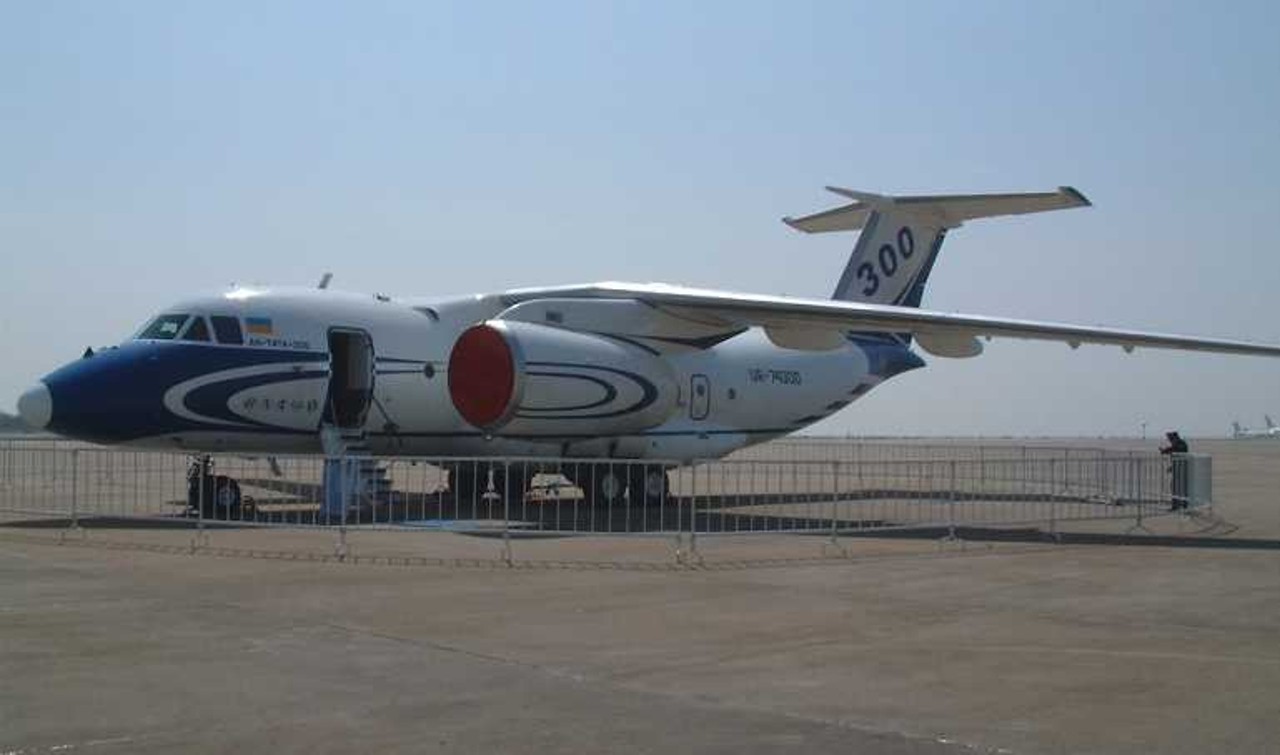
The An-74-300's most significant advancement was its transition from the original D-36 turbofan engines to underwing-mounted ZMKB Progress D-436T1 turbofans. This engine change eliminated the distinctive over-wing exhaust configuration of earlier variants, trading some short-field performance for substantial operational benefits. The D-436T1 powerplants deliver up to 29 percent fuel savings while extending range by 372 nautical miles when carrying a 10-tonne payload. The underwing mounting also simplified maintenance access compared to the earlier high-mounted engine arrangement.
The original An-74 design, which first flew on September 29, 1983, with test pilots Sergey A. Gorbik and V.A. Shlyakov, featured innovative use of the Coanda effect. By directing engine exhaust over the wing's upper surface, designers achieved enhanced lift at low speeds, crucial for operations from unprepared Arctic airstrips. Engineer A.L. Krutsoi and test pilot V.I. Tersky contributed significantly to the early development program that established the foundation for the -300 variant.
Development and Certification
The An-74-300 prototype began development in December 1999, modified from An-72 construction number 1910 at KhGAPP. Following its maiden flight on April 20, 2001, as UR-74300, the aircraft made its international debut at the Paris Air Show in June 2001. Certification trials required 219 test sorties before completion in July 2002, with the AP-25 certificate approved on September 9, 2002. This thorough testing program validated the aircraft's enhanced capabilities and operational improvements over previous variants.
Performance and Capabilities
The An-74-300 accommodates a crew of four to five and can configure for various mission profiles. In passenger configuration, it seats up to 52 travelers, while cargo variants handle 10 tonnes of freight. The aircraft achieves a maximum speed of 500 mph at altitude with a cruising speed of 560 km/h and range extending to 4,600 kilometers. Its high-wing configuration and robust landing gear enable operations from short, unprepared strips in extreme climates where conventional transports cannot venture.
Legacy and Continuing Service
The An-74 family earned the affectionate nickname "Cheburashka" and established itself as an irreplaceable asset for polar operations. Its design innovations influenced subsequent Antonov developments including the An-148 and An-178 aircraft. Small-series production continues at the Kharkiv facility, ensuring spare parts availability and potential new aircraft for specialized operators. The type's combination of payload capacity, cold-weather reliability, and short-field performance remains unmatched in its operational niche, securing its role in remote area transportation for decades to come.