
Development Origins
The MAI-890 emerged from Moscow Aviation Institute's decades-long commitment to light aircraft design, beginning with OSKBES's establishment in 1967. The aircraft evolved from the open-cockpit Junior prototype that appeared in 1987, progressing through the enclosed MAI-89 in 1989 before reaching its production form. Design work commenced in 1989 under Moscow's challenging post-Soviet economic conditions, with engineers creating an aircraft that could serve multiple roles from sport flying to agricultural spraying.
Manufacturing Evolution
Production began in 1991 through a complex web of Russian aerospace organizations. The Moscow Aviation Institute initially partnered with Aviatika joint-stock company around 1990 to facilitate manufacturing, but MAI reclaimed production rights in 1998, marketing the aircraft as the Aviatika-MAI-890. Most significantly, the Federal State Unitary Enterprise Russian Aircraft Corporation MiG—the same organization producing the famous MiG-29 fighter—took over manufacturing through a license agreement signed April 10, 1995. This unusual arrangement placed ultralight aircraft production alongside supersonic military jets.
Commercial Success
By 2006, manufacturers reported sales exceeding 300 aircraft, with approximately 60 configured for agricultural use. The MAI-890's versatility attracted international buyers, with 30 aircraft exported to South Africa and 26 registered across European countries outside Russia by mid-2010. Production continued through at least 2015, despite a mid-1990s interruption during Russia's economic turbulence.
Technical Configuration
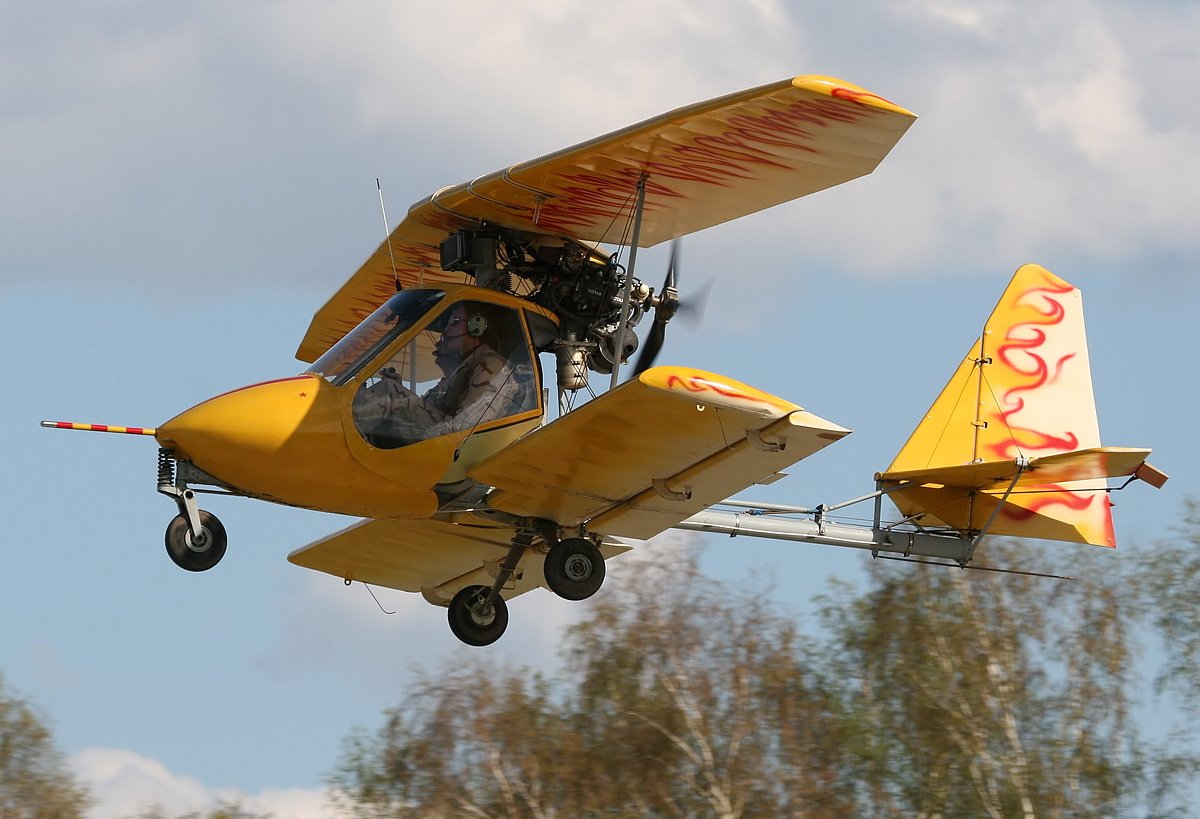
The MAI-890's distinctive pod-and-boom design featured fabric-covered biplane wings with aluminum tube construction throughout the fuselage and wing beams. The pusher configuration mounted Rotax engines beneath the upper wing's trailing edge, driving two-bladed VV-98E-11 propellers. Engineers constructed the cockpit with full enclosure, dual doors, and organic glass glazing, while the nose fairing utilized fiberglass construction.
The fixed tricycle landing gear employed cantilever main legs attached behind the cabin, with a controllable nosewheel for ground handling. Wing design incorporated slight sweepback across all surfaces, with strut-and-wire bracing providing structural support typical of traditional biplane architecture.
Engine Options
All production aircraft utilized Austrian Rotax powerplants, beginning with the 64-horsepower Rotax 582 UL two-stroke engine in early variants. The MAI-890U two-seat version first flew with this engine in August 1991, but engineers soon adopted the more powerful Rotax 912 UL, first flown on September 16, 1992. The standard production engine became the 98.6-horsepower Rotax 912 ULS, providing improved performance for the 750-pound maximum takeoff weight.
Agricultural Applications
The MAI-890 Farmer variant demonstrated the design's adaptability, adding 62 pounds of specialized equipment while maintaining the ability to carry 132 pounds of agricultural chemicals. This configuration proved particularly valuable in Russia's vast agricultural regions, where the aircraft's ability to operate from short, unprepared strips provided access to remote farming areas.
International Recognition
Certification achievements included approval under JAR VLA and FAR-23 regulations, with official recognition in Russia, South Africa, and France. However, international acceptance faced challenges, exemplified by the October 1993 registration of MAI-890 c/n 053 as VH-CLM in Australia. Despite flying from Canberra to Scone, the aircraft failed to meet Civil Aviation Safety Authority requirements and was deregistered in May 1994.
Design Bureau Legacy
OSKBES-MAI's 55-year experience in light aircraft design produced numerous notable aircraft beyond the MAI-890, including the Kvant, MAI-223, Aviatika-MAI-900, Acrobat, and MAI-411. This extensive portfolio demonstrated the organization's sustained capability in developing practical, cost-effective aircraft for civilian markets during Russia's transition from Soviet-era aviation industry structures.
Operational Characteristics
Pilots praised the MAI-890's semi-aerobatic capabilities and rough-air handling, characteristics that expanded its utility beyond basic transportation. The aircraft's forgiving flight characteristics made it suitable for training operations, while its robust construction enabled agricultural spraying in demanding conditions. Some variants found specialized roles in geo-video monitoring and soil parameter definition, demonstrating the design's adaptability to emerging technology applications.