
Development and Design Innovation
The A-9 Quail emerged from a complex lineage of agricultural aircraft development that began with the Call Aircraft Company of Afton, Wyoming. After World War II, Call Aircraft shifted from wartime repair work to producing cabin aircraft before transitioning to agricultural aviation. The breakthrough came in 1962 when Intermountain Manufacturing Company (IMCO) purchased Call Aircraft and designed the A-9 as a purpose-built agricultural aircraft, departing from earlier adaptations of existing designs.
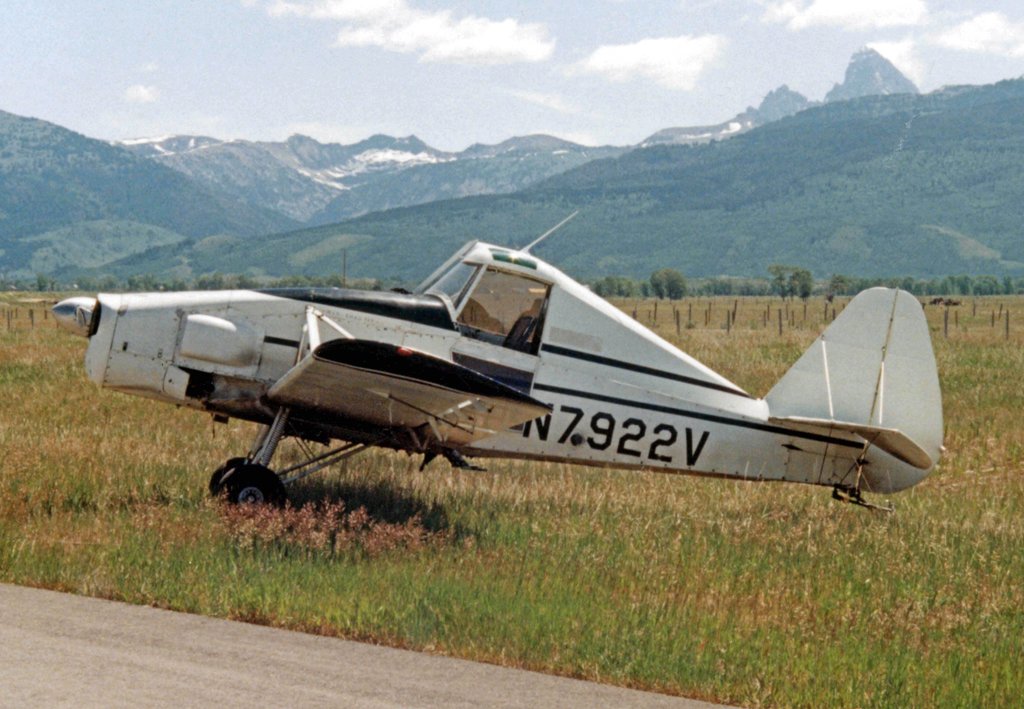
IMCO's engineers solved a critical configuration problem that had plagued earlier agricultural aircraft. Unlike the preceding A-5 model, which awkwardly placed the pilot side-by-side with the chemical hopper, the A-9 employed what became "the now classic and most sensible configuration for an ag-aircraft" - a low-wing design with a tractor engine, spray tank, and cockpit positioned rearward and elevated. This layout provided superior visibility and weight distribution for agricultural operations.
Manufacturing Transitions
Production began in 1963 under IMCO, but the aircraft's manufacturing history reflects the consolidation trends of 1960s aviation. In 1966, Rockwell Standard (later Rockwell International) acquired both IMCO and Aero Commander, continuing A-9 production under the Aero Commander division. Rockwell marketed the aircraft as the "Sparrow Commander" (A-9) and "Quail Commander" (A-9B), but closed the original Afton, Wyoming factory in 1967.
The most significant transition occurred in 1971 when Rockwell transferred manufacturing rights to Aeronáutica Agrícola Mexicana SA (AAMSA), a joint venture established specifically for this purpose in Mexico. AAMSA continued production until 1984, representing the longest manufacturing phase of the aircraft's history.
Technical Specifications and Variants
The AAMSA A-9B featured mixed construction with a fabric-covered steel-tube fuselage and wood-and-fabric wing structure. The single Lycoming IO-540-K1A-5 six-cylinder engine produced 300 horsepower, driving the aircraft to a maximum takeoff weight of 3,800 pounds. The chemical hopper held 210 US gallons, while fuel capacity reached 40 US gallons.
The cockpit design prioritized agricultural operations, with the pilot seated behind the chemical hopper in an enclosed cockpit featuring two removable, bottom-hinged doors that formed the left and right side windows. This configuration provided excellent forward and downward visibility essential for precise crop spraying.
Earlier variants demonstrated the design's evolution: the original CallAir A-9 used a 235-horsepower Lycoming O-540-B2B5 engine, while the A-9B Super employed either a Lycoming IO-540 or TIO-540 producing 290 horsepower. The enlarged B-1 variant featured a 400-horsepower Lycoming IO-720-A1A engine for heavy-duty operations.
International Service and Distribution
The A-9 found markets beyond North America, with approximately 25 examples imported to Australia in the mid-1960s through distributor Aerial Agriculture Pty Ltd of Bankstown, New South Wales. These aircraft served Australia's extensive agricultural aviation sector, demonstrating the design's international appeal and effectiveness in diverse operating conditions.
Later variants expanded beyond pure agricultural roles, with some aircraft adapted for glider towing operations, showcasing the design's versatility and robust construction.
Military Applications
While primarily civilian, the A-9 spawned one military variant: the A9B-M Quail 'Naco,' a two-seat military trainer developed by AAMSA for Mexican military use. This adaptation demonstrated the airframe's suitability for training operations, though production remained limited compared to the agricultural variants.
Production Legacy and Current Status
Total production across all manufacturers and variants reached approximately 118 aircraft, with about 101 A9B aircraft built by AAMSA plus an additional 17 assembled from Mexican-built components at Laredo, Texas. The 22-year production run from 1963 to 1984 reflected sustained market demand and the design's effectiveness in agricultural operations.
AAMSA ceased operations in 1984, marking the end of A-9 production and the company's brief but significant contribution to agricultural aviation. The aircraft's design influence persisted, however, as its low-wing tractor configuration became the standard for subsequent agricultural aircraft development.
Today, one A9B-M Quail 'Naco' military trainer (EPA-1) is preserved at the Museo Militar de Aviación in Mexico City, representing the aircraft's place in Mexican aviation history. The A-9 Quail stands as a successful example of international technology transfer and the evolution of specialized agricultural aircraft design.