
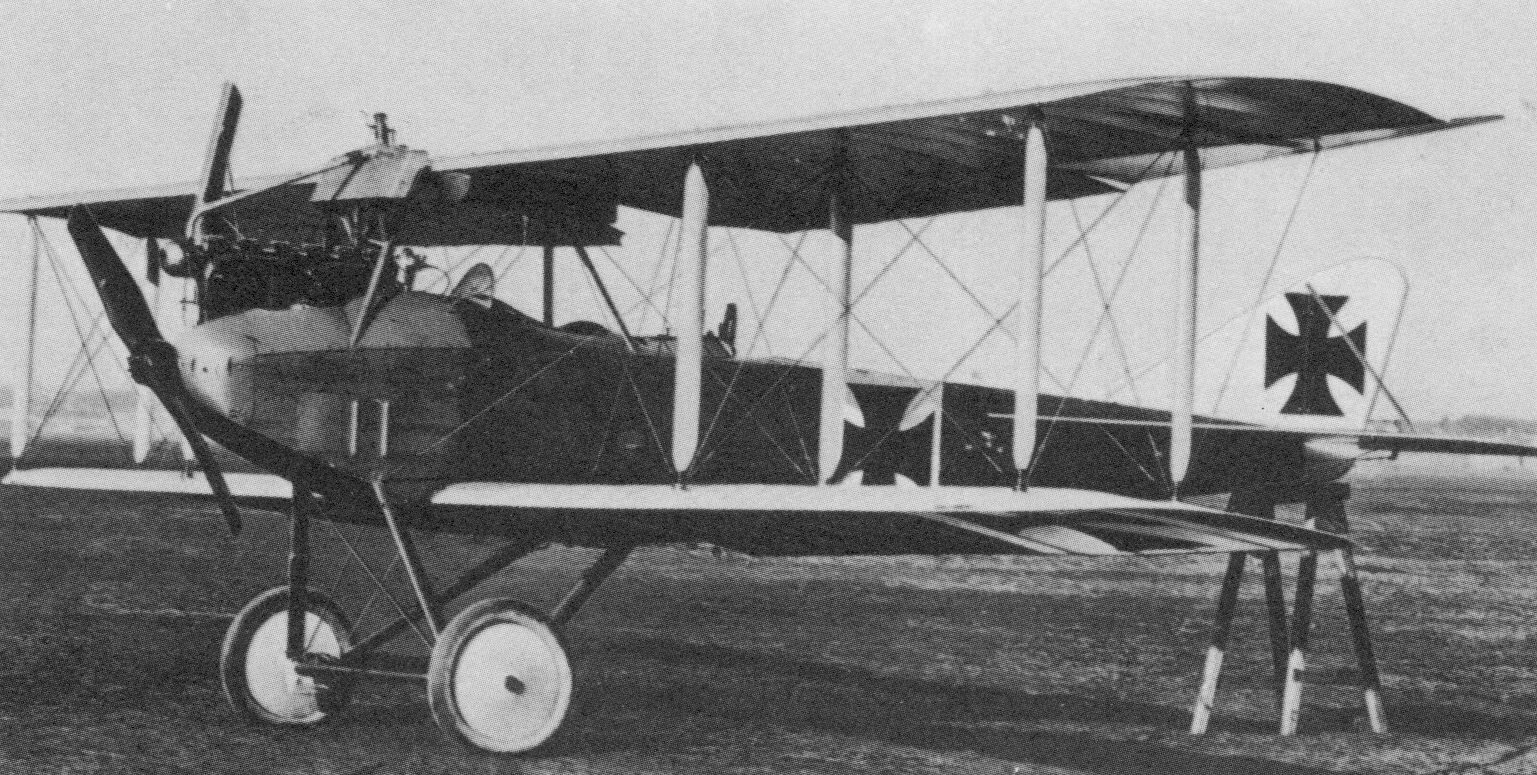
The Albatros C.I was developed by Albatros Flugzeugwerke in response to a late 1914 requirement for an armed two-seat C-type aircraft. Designed by Ernst Heinkel as a modification of the earlier B.II, the C.I introduced a critical change in crew configuration: the observer was moved to the rear cockpit to operate a ring-mounted 7.92 mm Parabellum MG14 machine gun, while the pilot occupied the forward position. This layout provided an effective field of fire for defensive and offensive operations. The aircraft first flew in early 1915 and began reaching front-line units in late April 1915.
Production was carried out by Albatros Flugzeugwerke in Berlin-Johannisthal, as well as several licensed manufacturers, including OAW, BFW, DFW, Hansa-Brandenburg, Siemens-Schuckert-Werke, and LVG. While exact production spans are not fully documented, it is verified that at least 485 units were built. The aircraft was typically powered by a 160 hp Mercedes D.III six-cylinder, water-cooled inline piston engine, though it was designed to accommodate engines of at least 150 hp.
During World War I, the Albatros C.I became a cornerstone of the Imperial German Army Air Service (Luftstreitkräfte). By the end of 1915, 228 C.I aircraft were operational, representing approximately 42% of all German C-type aircraft at the front. Its roles were diverse, encompassing aerial reconnaissance, photographic missions, artillery spotting, and light bombing. Due to its rear armament, it was even employed as a two-seat fighter. Notable aviation figures flew the type early in their careers, including Manfred von Richthofen as an observer and Oswald Boelcke, who achieved his first aerial victory in a C.I with Lt. von Wühlisch.
While replaced on the Western Front by the Albatros C.III during 1916, the C.I continued service on the Eastern Front into 1917. It was also operated by the Ottoman and Bulgarian air forces. Following its combat retirement, the C.I served as a dual-control trainer until the Armistice on November 11, 1918. Post-war, surviving aircraft were operated by the Polish Air Force (which used 49 units), as well as the Lithuanian and Swedish air forces. No original airframes are known to survive in museums today.