
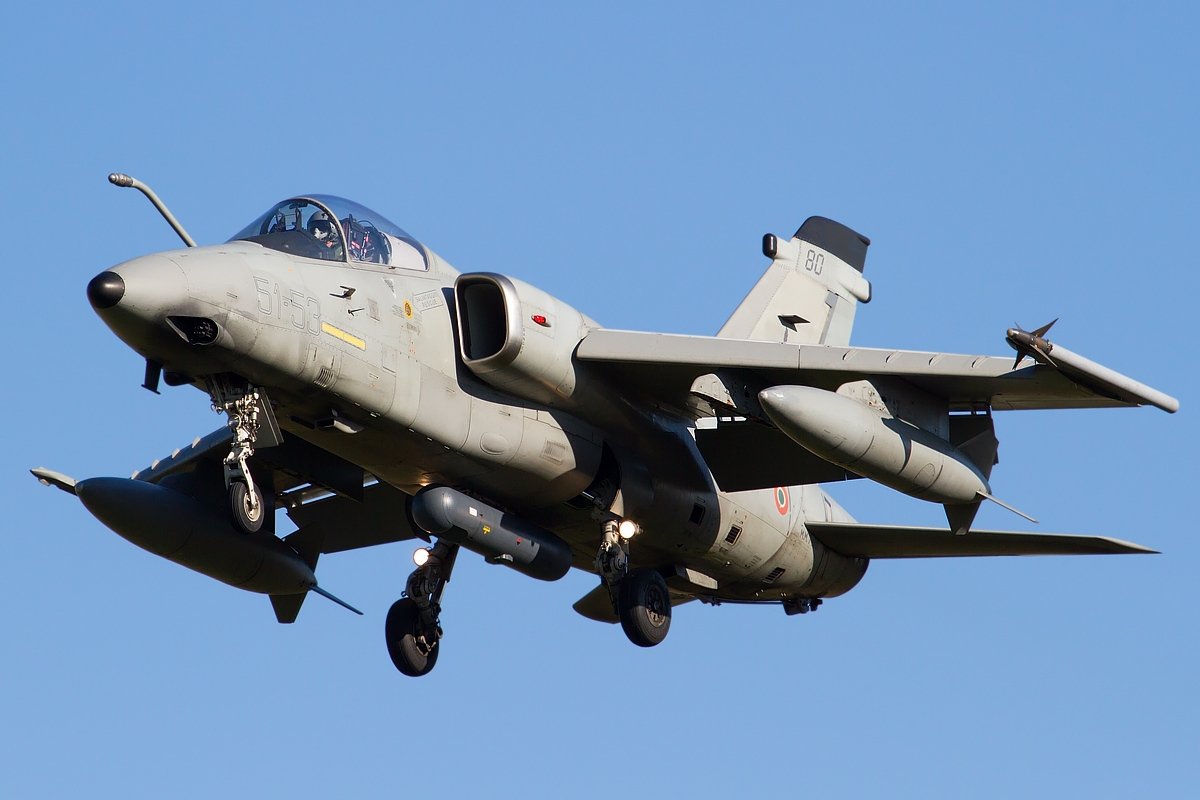
The AMX International AMX (designated the A-11 Ghibli in Italy and the A-1 in Brazil) is a single-engine light attack aircraft developed through a tri-national consortium. The program began in the early 1970s with a design study for a light ground-attack aircraft, internally designated the MB-340 by Aermacchi. In 1981, the Italian Air Force (Aeronautica Militare) and the Brazilian Air Force (Força Aérea Brasileira) issued joint specifications for a tactical strike aircraft to replace Italy's Fiat/Aeritalia G.91Y and provide Brazil with a modern close-support platform to complement its F-5 and Mirage IIIE fleets. A Memorandum of Understanding for joint development was signed in 1982.
Production was managed by AMX International, based in Rome, with a workshare split between Aeritalia/Alenia Aerospazio (46.5%), Embraer (29.7%), and Aermacchi (23.8%). The aircraft's development reached key milestones with the first Italian prototype flying on May 15, 1984, followed by the first Brazilian prototype on October 16, 1985. Production ran from 1986 to 1999, with approximately 230 aircraft built, including prototypes. Deliveries to Italy occurred between 1988 and 1998, while Brazilian deliveries spanned from 1990 to 1999. While some sources mention Venezuela as a customer, operational service there remains uncertain due to reported U.S. export restrictions.
Technically, the AMX is powered by a single Rolls-Royce Spey turbofan (specifically from the Spey 807 family), license-built in Italy by Fiat/Avio. The airframe is optimized for low-altitude, high-subsonic penetration and features seven hardpoints capable of carrying up to 3,800 kg of external stores. Armament varies by operator: Italian models utilize a 20 mm General Electric M61A1 cannon, while Brazilian models are equipped with two 30 mm DEFA 554 cannons. The aircraft is available in single-seat (AMX/A-11/A-1) and two-seat trainer/combat (AMX-T/TA-11/A-1B) configurations.
In military service, the Italian Air Force utilized the AMX extensively in international operations. This includes reconnaissance and strike missions over the Balkans in the late 1990s, strike and reconnaissance sorties during Operation Unified Protector in Libya in 2011, and close air support and armed overwatch in Afghanistan starting in November 2009. By 2012, Italian AMXs had accumulated over 200,000 flight hours. To extend its operational life, Italy implemented the AMX ACOL (Adeguamento delle Capacità Operative e Logistiche) upgrade, which introduced precision-guided munitions like JDAM and modernized the cockpit. While Italy retired the AMX in 2024, Brazil continues to operate the type, with approximately 24 aircraft remaining in service as of 2024.