
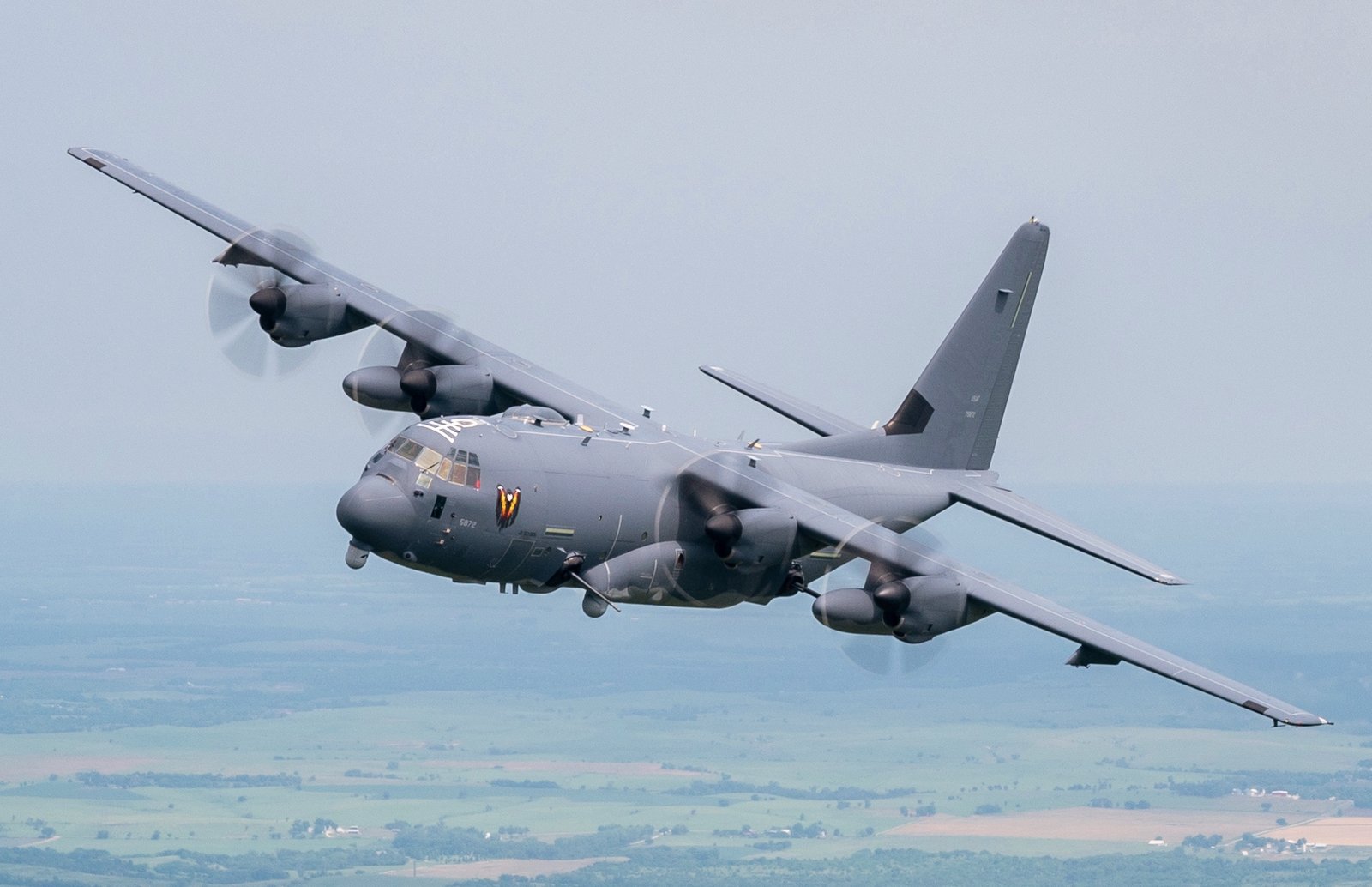
The Lockheed Martin AC-130 is a family of heavily armed gunships derived from the C-130 Hercules transport aircraft. Developed starting in 1967, the AC-130 was created under "Project Gunship II" to replace the Douglas AC-47 Spooky. The aircraft is designed as a side-firing weapon system, utilizing a high-wing configuration and large capacity to allow for extended loiter periods over a battlefield, delivering precision firepower during the night or in adverse weather.
Production of the AC-130 is a collaborative effort; while Lockheed Martin manufactures the base airframes in Marietta, Georgia, Boeing is responsible for the gunship conversion and subsequent aircraft support. The lineage of the AC-130 includes several distinct variants: the AC-130A "Spectre" (introduced 1968), the AC-130H "Spectre" (1969), the AC-130U "Spooky II" (1995), the AC-130W "Stinger II" (2012), and the current AC-130J "Ghostrider," which reached initial operational capability in 2017. While the total number of converted airframes is not publicly documented, the program has seen continuous evolution over five decades.
Technically, the AC-130J Ghostrider represents the fifth generation of the platform. It is powered by four Rolls-Royce AE 2100D3 turboprop engines, each producing 4,700 shaft horsepower for a total of 18,800 shp. This variant has a maximum takeoff weight of 164,000 lb and a range of 3,000 miles. Earlier models, such as the AC-130A, featured a diverse array of side-firing weaponry, including two 7.62 mm GAU-2B/A Miniguns, two 20 mm M61A Vulcan cannons, and two 40 mm Bofors cannons.
Exclusively operated by the United States Air Force—primarily through the Air Force Special Operations Command (AFSOC)—the AC-130 has a storied combat record. It first saw action in the Vietnam War, with the first AC-130A deploying to Nha Trang on September 20, 1967, and flying its first combat mission on September 27, 1967. During the conflict, these gunships destroyed over 10,000 trucks. The platform later played pivotal roles in Operation Urgent Fury in Grenada (1983), Operation Just Cause in Panama (1989–1990), and the Gulf War (1990–1991), where an AC-130H was lost with 14 crewmembers. It has since been deployed to Somalia, Bosnia-Herzegovina, and various hotspots across Africa, Europe, and the Middle East. A notable surviving example is AC-130A S/N 53-3129, the original prototype, which is preserved at the Air Force Armament Museum at Eglin AFB.