
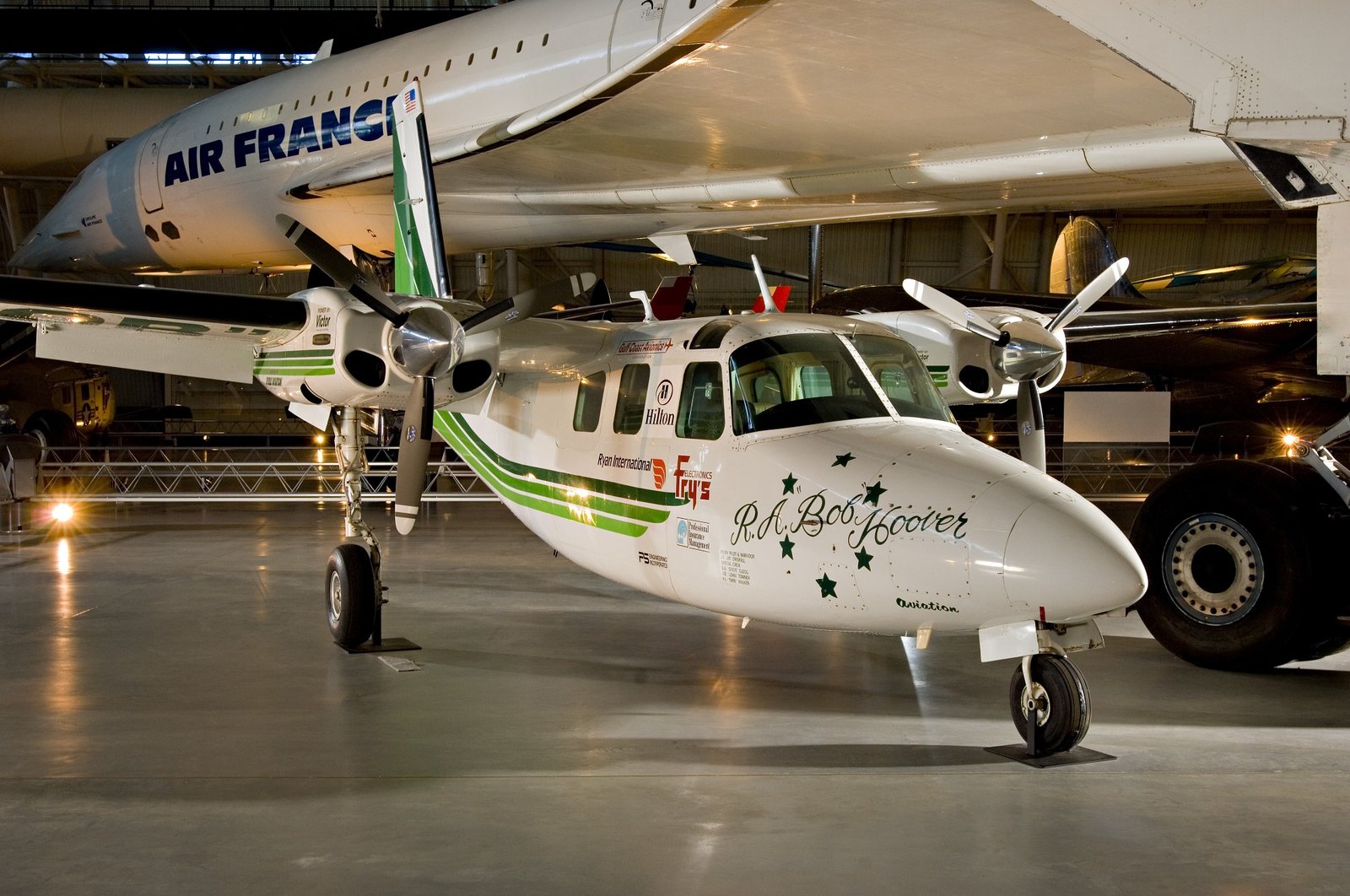
Service History
The Commander 560 series dominated the executive aviation market during the late 1950s, representing a significant advancement in business aircraft capability. Between 1954 and 1960, Aero Commander delivered 373 aircraft across four variants, with the 560A proving most popular at 150 units produced. Corporate operators embraced the type for its larger cabin and increased payload compared to earlier light twins, with the first Model 520 predecessor famously sold to Asahi Shimbun Press Company in Tokyo in October 1952, demonstrating international appeal from the program's inception.
Military Evaluation
While designed as a civilian aircraft, the Commander 560 series underwent limited military evaluation by the United States Air Force. A single Model 560 designated YL-26A was lost in a crash during 1955 testing. The military showed greater interest in the 560A variant, acquiring 15 aircraft as U-4A transports between 1954 and 1956. An additional 14 Model 560As entered service as L-26B aircraft, later redesignated U-4A in 1962, with two specifically assigned to shuttle President Dwight Eisenhower between Washington and his Gettysburg, Pennsylvania retreat. The Army operated one example as the U-9B, though no combat roles were envisioned for any military variants.
The Manufacturer
Aero Design and Engineering Company emerged from post-war aviation entrepreneurship, founded in 1944 and renamed Aero Commander in 1950. Operating from a 26,000 square foot factory in Bethany near Oklahoma City at what is now Wiley Post Airport, the company rolled out its first production Model 520 in August 1951 after nearly 10,000 hours of design refinement. The original prototype had received certification on June 30, 1950, launching what would become a successful business aircraft dynasty.
Rockwell-Standard acquired the thriving company in 1958, recognizing the growing executive aviation market. The operation became Aero Commander Inc. in late 1960, evolved into a Rockwell International division in 1965, and eventually transferred to Gulfstream Aerospace. Commander production continued under various corporate owners until 1986, with Gulfstream Aerospace maintaining operations today as a leading business jet manufacturer.
Engine & Technical Innovation
The 560 series showcased progressive engine development throughout its production run. The initial 1954 Model 560 employed twin Lycoming GO-480-B geared engines producing 280 horsepower each. The 560A retained similar power with GO-480-D1A engines, though an optional GO-480-C1B-6 variant offered 295 horsepower for takeoff. Later variants marked significant power increases: the 560E featured 340-horsepower Lycoming IGO-540 six-cylinder engines, while the final 560F variant achieved 360 horsepower from the same engine family.
Design innovations distinguished the 560 series from competitors. The swept vertical tail surfaces, introduced in 1954, became a Commander trademark. The 560E incorporated 30-inch wingtip extensions for improved performance, while the 560F featured slimmer nacelles reducing noise and drag. Wing fuel tanks held 150 US gallons, providing substantial range for the business aviation role. The 560F could accommodate seven occupants in its enlarged cabin, representing maximum utility in the series.
Production & Legacy
Production figures reflect the series' evolution: 80 original Model 560s in 1954, 150 Model 560As through 1956, between 70 and 93 Model 560Es from 1957-1959, and 73 final Model 560Fs through 1960. Manufacturing transitioned to more advanced variants including the 500, 600, and 680 series, with the latter introducing turboprop power in 1964 as the 680T.
The 560 series established crucial precedents for executive aviation. Its metal construction, twin-engine reliability, and scalable cabin design influenced an entire generation of business aircraft. The swept tail design became synonymous with Commander aircraft through the 1980s. Today, surviving examples remain active in private hands, with at least one 560E (registration VH-CAU, constructor number 726-51) preserved at Goulburn, New South Wales, Australia. The type's legacy lives on through modern business jets that trace their conceptual origins to the pioneering Commander 560's blend of performance, comfort, and operational efficiency.