
Service History
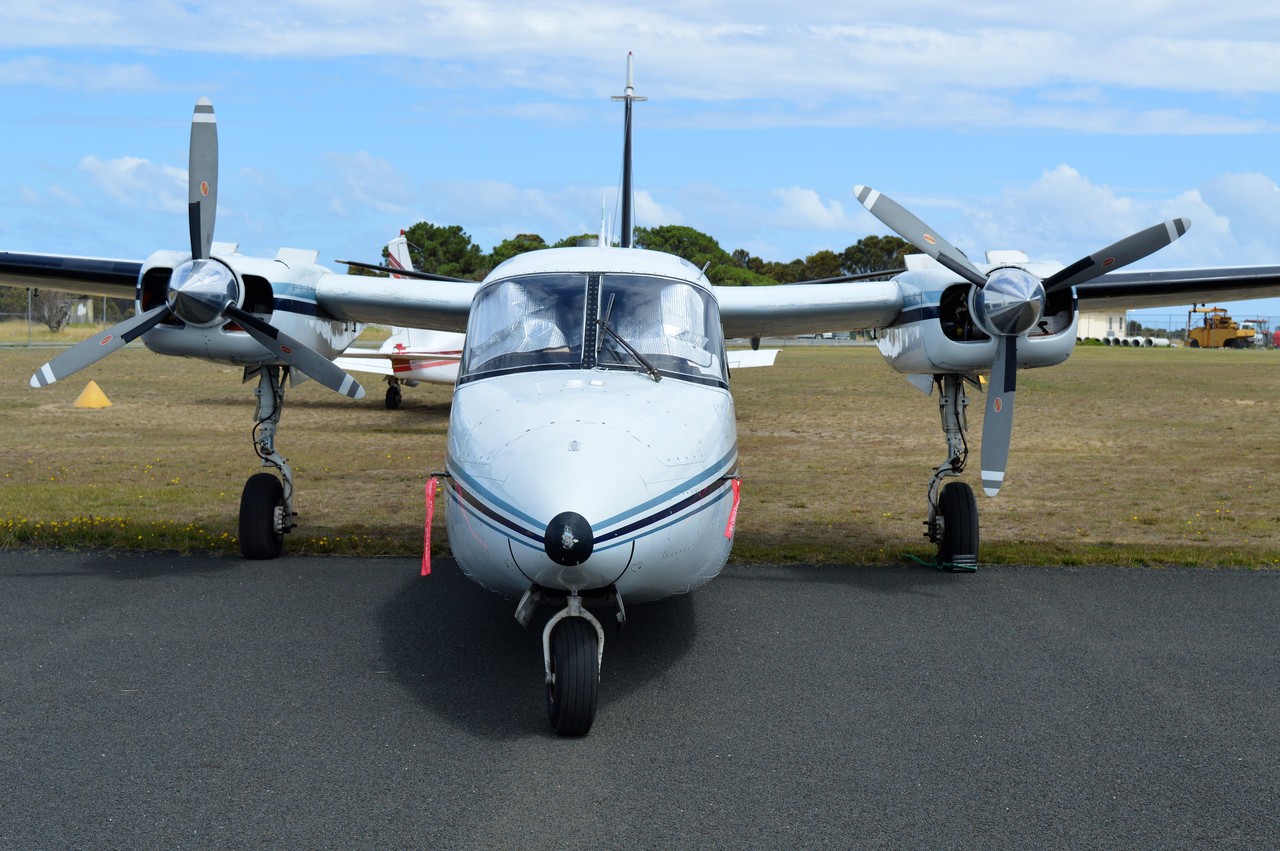
The Commander 680 Super dominated the high-end business aviation market during the 1960s, representing the pinnacle of piston-powered corporate aircraft development. With 254 baseline 680 Supers produced alongside additional variants totaling over 700 aircraft in the 680 series, the type established itself as the preferred choice for companies requiring reliable, high-altitude performance. The aircraft's supercharged engines enabled operations at altitudes previously reserved for larger aircraft, giving business operators unprecedented flexibility in route planning and weather avoidance.
The 680 series variants included the extended-wing 680E with 93 examples built, the aerodynamically refined 680F with 73 produced, and the high-capacity 680FL with 157 manufactured. The pressurized 680FLP Grand Commander, later renamed Courser, saw 37 examples built, while the final 685 model reached 66 units before piston production ended in 1979.
Military Evaluation
While primarily a civilian aircraft, the 680 Super underwent limited military evaluation. The U.S. Navy acquired one RL-9D variant for testing at China Lake, California, though no combat service or large-scale military adoption followed. The aircraft's sophisticated systems and high operating costs made it unsuitable for military training or utility roles compared to simpler alternatives.
The Manufacturer
Aero Design and Engineering Company, founded in 1944 by former Douglas A-20 engineers led by Ted Smith, renamed itself Aero Commander in 1950. Operating from a 26,000 square foot leased facility in Bethany, Oklahoma, the company invested nearly 10,000 hours in redesign work before achieving certification on June 30, 1950, for their original Commander series.
Rockwell International acquired Aero Commander in 1965, continuing production through multiple ownership changes. Gulfstream Aerospace ultimately ended piston production in 1986, though turboprop successors like the 690 continued until that same year. The related Aerostar line, a 680 descendant, was sold to Piper Aircraft Corporation in 1978, which produced 124 additional aircraft including the 600A, 601B, 601P, and 602P Sequoia variants.
Engine and Technical Innovation
The 680 Super's defining feature was its powerplant: two Lycoming GSO-480-A1A-6 engines producing 340 horsepower each. These air-cooled, supercharged, horizontally-opposed six-cylinder engines displaced 479.624 cubic inches and operated at 7.3:1 compression ratio, delivering maximum power at 3,400 rpm at sea level. The supercharging system enabled the aircraft to maintain high power output at altitude, a crucial advantage for business operations.
Later variants adopted even more sophisticated powerplants. The 680FL and pressurized 680FLP, certified on May 24, 1963, and October 8, 1964, respectively, employed Lycoming IGSO-540-B engines producing 380 horsepower each. These turbocharged and geared engines provided exceptional high-altitude performance, with the pressurized variants operating effectively up to 28,000 feet.
Design innovations extended beyond the powerplant. The 680E featured optional 30-inch wing tip extensions, increasing maximum takeoff weight by 400 pounds to 7,500 pounds while improving high-altitude performance. The 680F introduced flatter engine nacelles with sideways-retracting landing gear, reducing drag and improving cruise efficiency.
Performance and Pilot Perspective
Pilots praised the 680 Super's combination of speed, altitude capability, and passenger comfort. With a cruise speed of 223 knots and service ceiling exceeding 22,000 feet in naturally aspirated variants, the aircraft offered airliner-like performance in a much smaller package. The pressurized variants could operate comfortably above most weather, a significant advantage for business travel.
The aircraft typically operated with a crew of one or two pilots and could accommodate between seven and eleven passengers depending on interior configuration. Range exceeded 1,000 nautical miles with standard fuel capacity, making it suitable for transcontinental business travel with minimal fuel stops.
Production Legacy
Production continued until 1979, though the 680 designation was dropped in 1968 in favor of the Courser name for final variants produced from 1968 to 1969. The aircraft represented the technological peak of piston-powered business aviation, appearing just as turboprop engines began to dominate the corporate market.
The 680 Super influenced subsequent designs, particularly the Aerostar series and various Piper developments. NASA utilized a 680F for aerodynamic research, applying tufts to study airflow patterns and contributing to general aviation design knowledge.
Dozens of 680-series aircraft remain airworthy today, though exact numbers fluctuate. The type's robust construction and reliable powerplants have enabled many examples to continue operating more than six decades after the prototype's first flight, testament to Ted Smith's original design philosophy of creating aircraft that could match airline standards in private operation.