
Service History
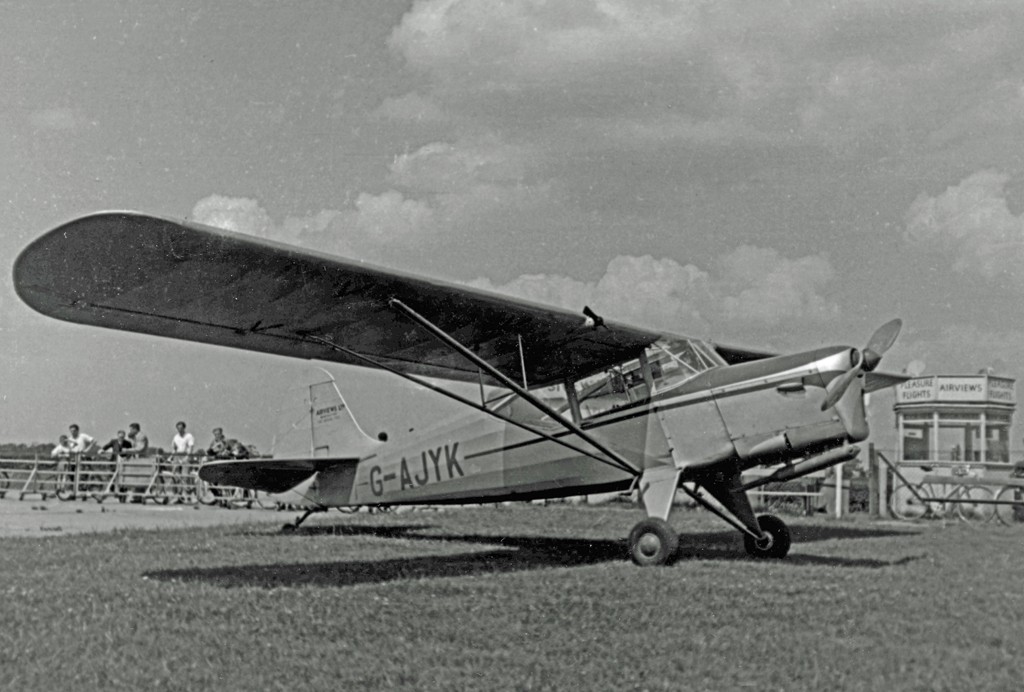
The Auster J/5 Autocar carved out a significant niche in Britain's postwar general aviation market, serving primarily private owners and flying clubs across the United Kingdom and sixteen export countries. The aircraft proved particularly valuable for small charter operations, with firms like Southend Flying School at Southend-on-Sea and Bee's Flight Ltd on the Isle of Wight using Autocars to provide thousands of holidaymakers with scenic pleasure flights during the 1950s tourism boom.
In 1952, Pest Control Ltd demonstrated the aircraft's versatility by taking delivery of five J/5G variants specifically configured for crop spraying operations in Sudan, showcasing the type's adaptability beyond recreational flying. The majority of production aircraft were exported internationally, with many later resold to operators in five additional territories, establishing the Autocar as a truly global aircraft.
The Manufacturer
Auster Aircraft Limited emerged in 1945 when the original Taylorcraft license expired, allowing the company to pursue independent development at their Rearsby, Leicestershire facility. The firm had built its reputation during World War II producing the Auster AOP series for military observation duties, and the J/5 Autocar represented their ambitious entry into the postwar civilian market.
The company's wartime experience with the Model J, designated Auster AOP.V by the Royal Air Force, provided the foundation for the Autocar's design. This lineage gave Auster engineers valuable insights into high-wing aircraft performance and structural requirements that directly benefited the civilian variant.
Engine & Technical Details
Auster offered the J/5 Autocar with five different powerplant options to suit varying customer requirements and market conditions. The J/5B featured the reliable 130-horsepower de Havilland Gipsy Major I, while the J/5E, J/5G, and J/5H variants utilized Blackburn Cirrus Major engines ranging from 145 to 155 horsepower. The J/5P returned to de Havilland power with the 145-horsepower Gipsy Major 10.
The J/5G variant incorporated an innovative inverted engine installation, mounting the Blackburn Cirrus Major 3 upside-down to improve propeller ground clearance and enhance pilot visibility. This 6.3-liter powerplant delivered 155 horsepower and became popular among operators requiring better forward visibility for specialized missions.
Key design improvements over the earlier three-seat J/1 Autocrat included wing-root fuel tanks that increased range and an enlarged cabin providing greater comfort for four occupants. The aircraft's high-wing configuration offered excellent visibility and ground handling characteristics essential for touring operations.
Performance & Operations
With a maximum takeoff weight of 1,085 kilograms and standing 2.5 meters tall, the Autocar delivered respectable performance for its era. The aircraft achieved a maximum cruise speed of 178 km/h, making it competitive with contemporary touring aircraft while maintaining the docile handling characteristics that made it suitable for private pilots.
The Royal Australian Navy recognized the type's utility, purchasing two Autocars in 1949 that arrived aboard the aircraft carrier HMAS Sydney. These aircraft served until late 1963, demonstrating the type's durability and reliability in military support roles.
Australian Developments
Kingsford Smith Aviation Services in Australia developed several specialized variants that extended the Autocar's capabilities well beyond the original British specifications. Their conversions included the J/5GL with Lycoming power, the J/5G Super Autocar featuring a 225-horsepower Continental O-470 engine, and the Kingsford Smith Bushmaster with a 180-horsepower Lycoming O-360 and constant-speed propeller.
Development aircraft J/5T and J/5V tested 185-horsepower Continental and 160-horsepower Lycoming installations respectively, exploring American engine alternatives to British powerplants.
Production & Legacy
Production concluded in 1958 after 180 aircraft were completed, with the prototype G-AJYK making its debut at the September 1949 Farnborough Air Show. While modest by modern standards, this production run established the Autocar as one of Britain's most successful postwar touring aircraft designs.
Today, at least one example remains airworthy: VH-NVY, a J/5G displayed at Australia's HARS Aviation Museum. Owned by a consortium of museum members, this fully operational aircraft was restored to represent the Royal Australian Navy Autocars and serves as a flying testament to the type's enduring appeal among aviation enthusiasts.