
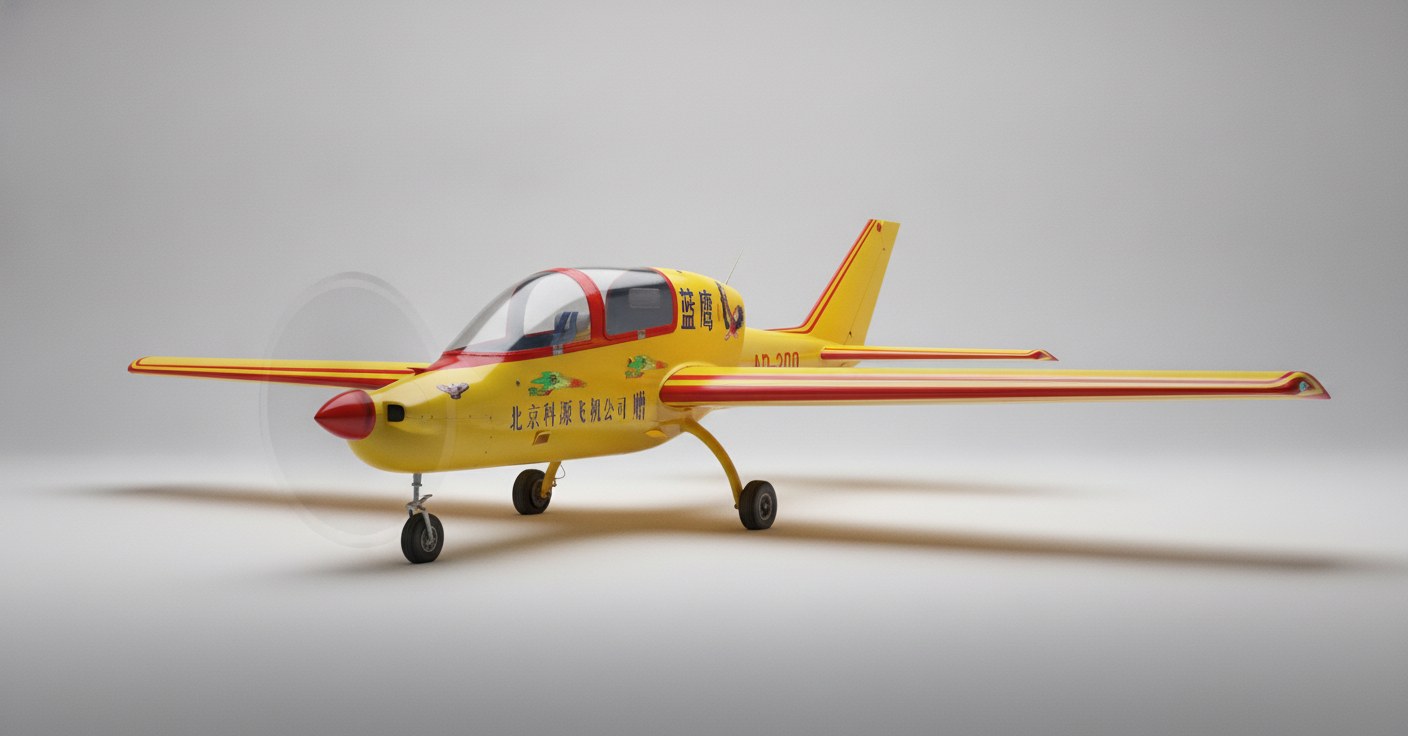
Historical Significance
The AD-200 emerged during a pivotal moment in Chinese aviation history, when the nation began opening its aerospace industry to private enterprise. Beijing Keyuan Light Aircraft Co. broke new ground as China's first private aircraft manufacturer, challenging the decades-long monopoly of state-owned aviation companies. The AD-200's development in the mid-1990s coincided with China's broader economic reforms, making it a symbol of the country's transition toward market-based aviation manufacturing.
The Manufacturer
Beijing Keyuan Light Aircraft Co. (北京科源輕型飛機有限公司) established operations by the mid-1990s as a pioneering venture in Chinese private aviation. The company focused specifically on lightweight aircraft design and manufacturing, filling a niche that state-owned enterprises had largely ignored. Their emphasis on ultralight aircraft reflected the growing demand for recreational flying and specialized civilian applications in China's expanding economy.
Design and Construction
The AD-200 incorporated advanced materials technology that was revolutionary for its era and category. Its fiberglass honeycomb sandwich structure provided exceptional strength-to-weight ratios while maintaining the light weight essential for ultralight aircraft operations. The streamlined fuselage design represented a significant aesthetic and aerodynamic advancement over conventional ultralight aircraft of the period, combining form and function in ways that influenced subsequent Chinese aircraft development.
The aircraft's dimensions reflected careful optimization for its intended roles. At 33.8 meters in length and 14.8 meters in height, the AD-200 provided substantial internal volume while maintaining manageable ground handling characteristics. The 12.6-meter envelope diameter contributed to its 2,600 cubic meter total volume, creating versatile space for various mission configurations.
Performance Characteristics
With a maximum weight of 650 kilograms, the AD-200 delivered impressive performance for its class. Its minimum speed of 25 km/h enabled slow-flight operations crucial for advertising, surveillance, and recreational flying. The aircraft demonstrated climbing capability exceeding 3 meters per second, providing adequate performance for typical ultralight operations. Its turning radius of less than 50 meters made it highly maneuverable in confined airspace, particularly valuable for urban advertising flights and air show performances.
The 220-kilogram payload capacity allowed for significant mission flexibility, accommodating passengers, specialized equipment, or advertising displays depending on operational requirements. This payload-to-weight ratio compared favorably with contemporary ultralight aircraft, demonstrating the effectiveness of Beijing Keyuan's design approach.
The China No. 1 Airship Project
The AD-200 achieved international recognition when its fuselage design was adapted as the gondola for China's first hot-air airship, designated "China No. 1" (中華1號). This thermal airship completed its maiden flight on October 19, 1996, in Beijing, marking a historic milestone in Chinese lighter-than-air aviation. The successful adaptation of the AD-200's cabin demonstrated the versatility of its design and construction methods.
The airship project showcased the AD-200's structural integrity under the unique stresses of lighter-than-air operations. The fiberglass honeycomb construction proved ideally suited for airship applications, where weight savings directly translated to increased lift capacity and operational efficiency. This application established the AD-200 design as internationally significant among thermal airships of its generation.
Commercial Applications
Beijing Keyuan positioned the AD-200 for diverse civilian markets including air sports, competitive flying, tourism, advertising, and aerial performances. The aircraft's low operating costs and versatile configuration made it attractive to emerging Chinese aviation businesses seeking cost-effective platforms for specialized operations. Following the successful demonstration through the China No. 1 airship project, commercial interest increased significantly.
Enterprises purchased AD-200 aircraft for various civilian applications, though specific production numbers and customer details remain limited in available records. The aircraft's suitability for advertising flights proved particularly valuable in China's rapidly growing consumer economy of the late 1990s.
Legacy and Current Status
The AD-200 established Beijing Keyuan as a credible manufacturer in the ultralight aircraft market and demonstrated that Chinese private companies could develop competitive aviation products. The aircraft received international recognition through its ICAO type designator AD20, formally acknowledging its place in global aviation databases.
While production figures and current operational status remain unclear, the AD-200's influence on Chinese private aviation manufacturing extended beyond its direct commercial success. It proved that innovative design and advanced materials could be successfully combined in China's emerging private aerospace sector, paving the way for subsequent developments in the country's general aviation industry.