
Design and Development
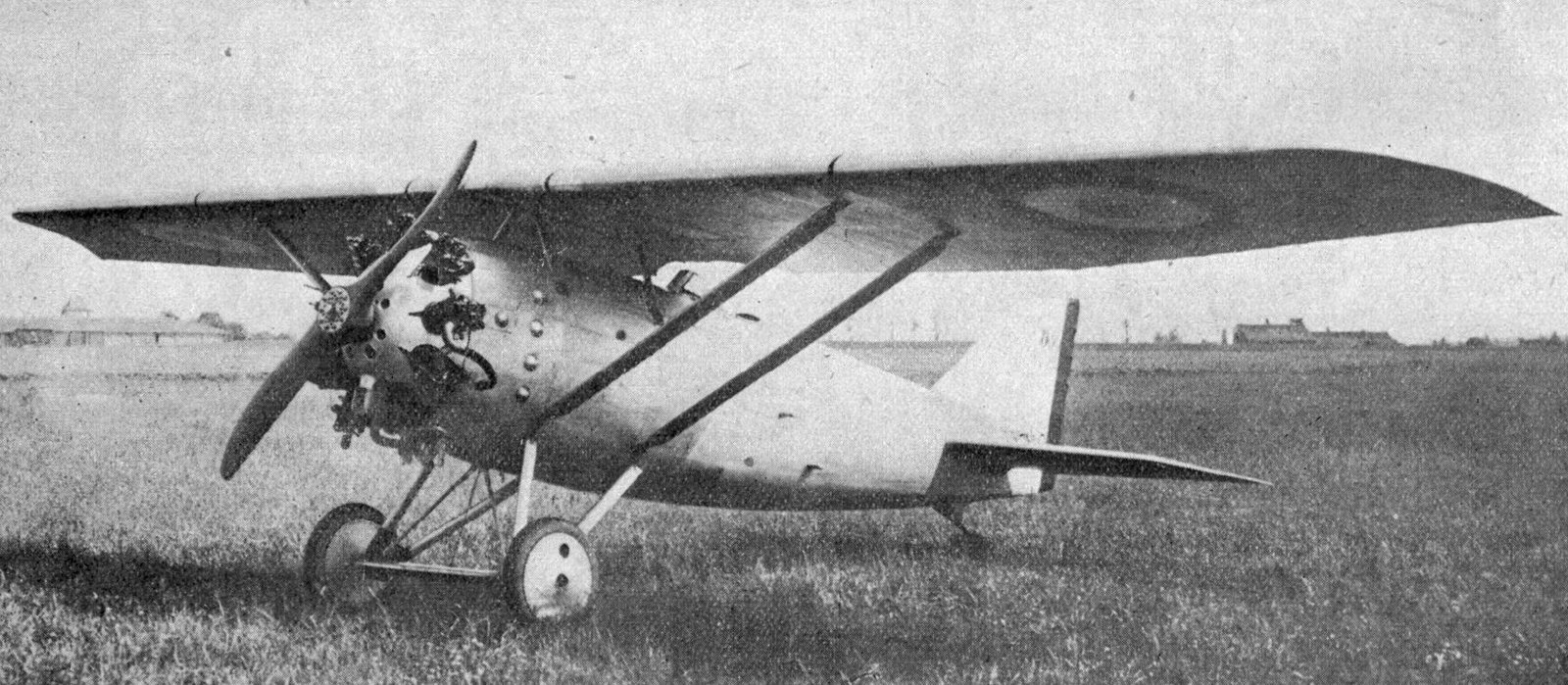
Designed under the leadership of Émile Dewoitine, the D.9 was a single-seat, single-engine fighter developed in the mid-1920s. It was derived from the earlier Dewoitine D.1, but modified specifically to meet the requirements of the 1923/1924 "C1" single-seat fighter specification. The aircraft featured a parasol-wing monoplane configuration, which was a progressive departure from the biplane designs common during the era. Its construction was notably advanced, utilizing an all-metal duralumin structure with metal skinning for the fuselage, while the parasol wing consisted of a metal structure covered in fabric.
Technical Specifications
The D.9 was powered by a Gnome-Rhône 9Ab radial engine, which was a license-built version of the British Bristol Jupiter IV. This nine-cylinder, air-cooled piston engine produced 420 hp (approximately 313 kW). In terms of armament, evaluation airframes such as the one supplied to Belgium were equipped with two fuselage-mounted 7.7 mm Vickers machine guns and two 7.5 mm Darne Modèle 19 guns located on the wing center-section.
Production and Manufacturer History
The original aircraft were manufactured by Constructions Aéronautiques Émile Dewoitine in France. The company, founded by Émile Dewoitine in October 1920, continued producing fighters through the 1930s before its assets were absorbed into the state-owned SNCAM in 1936–1937 during the nationalization of the French aircraft industry. In Italy, the aircraft was produced under license by Gio. Ansaldo & C. as the Ansaldo AC.3. While Ansaldo was a prominent heavy-engineering firm founded in 1853, its aviation activities eventually merged into the broader Italian aeronautical sector.
Service History
The D.9 did not achieve mass production and remained a small-series or prototype-level aircraft. It was tested in France but did not see frontline adoption. Belgium acquired a single D.9 (registered as J.2), which arrived on 6 August 1926 and underwent evaluations at the Nivelles, Evere, and Wevelgem airbases. This specific aircraft was later sold at a public auction on 15 October 1935 and entered the Belgian civil register as OO-ARD. In Italy, the AC.3 was produced, though there is no documented evidence of substantial operational use by the Regia Aeronautica. The aircraft never saw combat in any major conflict.
Legacy
Though it disappeared from service, the D.9 is significant as an evolutionary link in the development of all-metal fighters. Its combination of a radial engine and a monoplane layout anticipated future aviation trends. Today, no physical airframes are known to survive, though archival records of the type exist in the Smithsonian collections.