
Commercial Success and Market Impact
The Model K Scout achieved immediate commercial success upon its January 1937 debut at the New York Aircraft Show. By November 1937, just ten months after introduction, Aeronca was manufacturing three aircraft daily at their Cincinnati facility, shipping complete airframes in boxcars with six aircraft per railcar. This rapid production ramp-up demonstrated the strong market demand for affordable, modern light aircraft that met contemporary safety standards.
Dealers nationwide filed orders immediately following the aircraft's introduction, recognizing the Scout's potential to capture the growing private aviation market. The simultaneous west coast debut at the March 1937 Los Angeles Air Show ensured national exposure and helped establish distribution networks across the United States.
Design Revolution
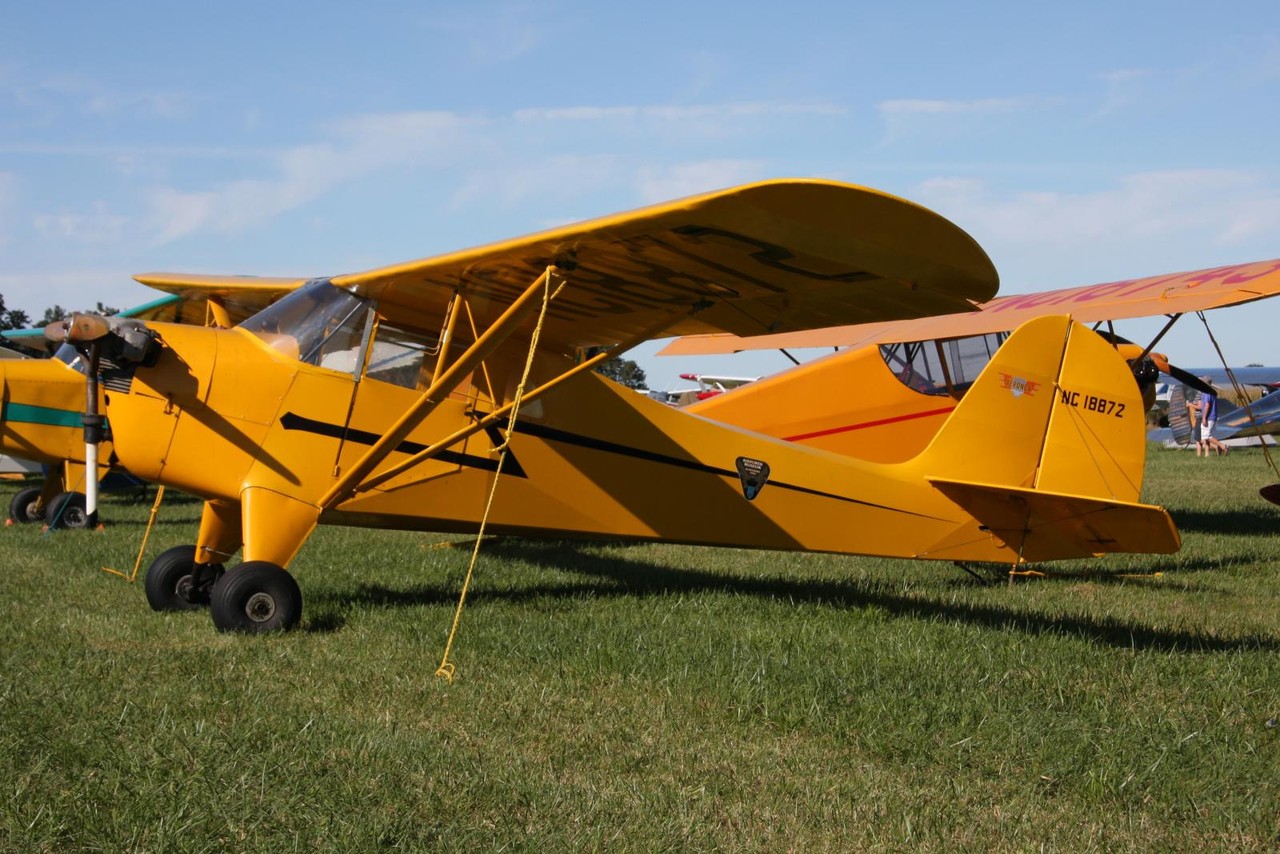
The K Scout represented a fundamental departure from Aeronca's earlier designs, specifically addressing the limitations of the popular but outdated C-3 model. Engineers eliminated the C-3's distinctive "bathtub" fuselage configuration, replacing it with conventional streamlined construction that appealed to modern pilots and met evolving certification requirements.
Key structural improvements included steel tube braced wings that replaced the older wire bracing and king-post systems. This strut-braced wing design provided greater structural integrity while reducing maintenance requirements. The fully enclosed cockpit accommodated two occupants in side-by-side seating, a significant comfort improvement over earlier tandem configurations.
The powerplant upgrade proved equally important. The dual-ignition Aeronca E-113C engine provided enhanced reliability compared to the C-3's single-ignition system, while delivering 42 horsepower in standard configuration. Higher-powered variants included the E-113CDB producing 45 horsepower, giving pilots improved performance margins.
Engine Options and Variants
Aeronca offered multiple powerplant options to meet diverse customer requirements. Beyond the standard E-113C two-cylinder engine, the KC variant featured the Continental A-40 four-cylinder engine producing 40 horsepower. The KCA variant utilized the Continental A-50 generating 50 horsepower for operators requiring additional performance.
Specialty variants included the KM model with the Menasco M-50 flat-four engine and the KF variant powered by Franklin engines. The CF variant incorporated the Franklin 4AC-150 four-cylinder powerplant. This engine flexibility allowed customers to select configurations matching their specific mission requirements and budget constraints.
The Manufacturer's Legacy
The Aeronautical Corporation of America operated for 23 years, producing 17,408 aircraft across 55 different models before ceasing light aircraft production in March 1951. The company's Cincinnati operations at Lunken Airport became synonymous with affordable, reliable general aviation aircraft that democratized flying for thousands of pilots.
When Aeronca exited the light aircraft market, they sold the Champion design rights to Champion Aircraft Company of Osceola, Wisconsin. This transfer ensured continuity for the successful designs that evolved from the K Scout's fundamental architecture. The Scout's influence extended well beyond its own production run, establishing design principles that guided American light aircraft development for decades.
Wartime Connections
While the K Scout itself did not serve in military roles, its design legacy proved crucial during World War II. The larger Aeronca 65C Chief, developed from the Scout's basic architecture, became the USAAF's O-58 and later L-3 Grasshopper. More than 1,400 of these military variants served in all theaters, performing liaison, artillery spotting, and medical evacuation missions.
This military success validated the fundamental soundness of the Scout's design approach, demonstrating that civilian aircraft could be readily adapted for military service when required. The steel tube construction and reliable powerplants that characterized the Scout proved ideal for military operations requiring dependable, easily maintained aircraft.
Surviving Examples and Museums
As of May 2009, 73 Model K aircraft remained on the U.S. civil aircraft register, testament to the type's structural durability and continued appeal to vintage aircraft enthusiasts. The EAA AirVenture Museum in Oshkosh, Wisconsin, displays an example at their Pioneer Airport exhibit, where visitors can examine the aircraft's construction techniques and historical significance.
The Yanks Air Museum in Chino, California, preserves aircraft N18877 as part of their comprehensive aviation collection. Additional examples are maintained in flying condition by private owners who appreciate the Scout's gentle handling characteristics and historical importance.
Historical Significance
The Aeronca K Scout's true legacy lies in its role as a bridge between aviation's pioneering era and the modern general aviation industry. By successfully adapting traditional light aircraft design to meet contemporary airworthiness standards, the Scout demonstrated that small manufacturers could compete effectively in an increasingly regulated environment. Its commercial success encouraged continued innovation in the light aircraft segment, ultimately benefiting generations of pilots who learned to fly in affordable, reliable aircraft descended from the Scout's proven design philosophy.