
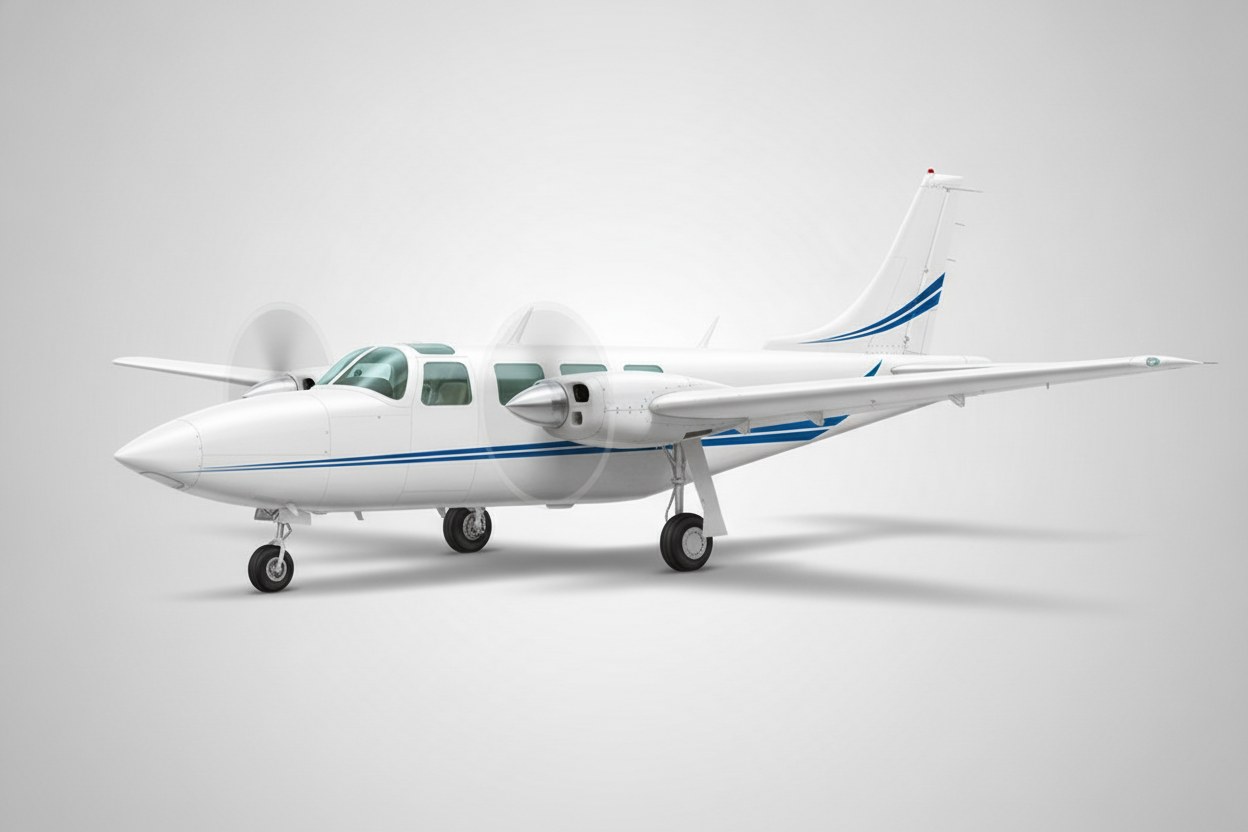
Design Innovation and Development
Ted Smith began development of the Aerostar 600 in November 1964, drawing upon four decades of aviation experience to create what would become the fastest twin-piston general aviation aircraft of its time. Smith's design philosophy emphasized light construction and exceptionally low drag, resulting in superior climb rates, high operating altitudes, and class-leading fuel efficiency that distinguished the Aerostar from contemporary twin-engine aircraft.
The first prototype took flight in October 1967, with the Model 600 receiving Federal Aviation Administration certification in March 1968. Smith's innovative rectangular-section fuselage design would later prove adaptable for pressurization in subsequent variants, demonstrating the forward-thinking nature of the original concept.
Corporate Turbulence and Ownership Changes
The Aerostar's corporate history proved as dynamic as its performance capabilities. Ted Smith Aircraft Company, initially operating as a subsidiary of American Cement Corporation, began production at Van Nuys, California airport in 1967. However, after certification in 1968, American Cement sold controlling interest, followed by another sale to Butler Aviation International in 1970.
In a remarkable turn of events, Ted Smith regained control of his design in 1972, establishing Ted R. Smith and Associates Inc. in Santa Maria, California, where production resumed in 1973. This period marked some of the most refined production of the 600 series, particularly with the introduction of the improved 600A variant.
Following Ted Smith's death in 1978, Piper Aircraft Corporation acquired the Aerostar rights from Smith's son Ron and widow, relocating production to Vero Beach, Florida. This acquisition brought stability to the program and enabled continued development of pressurized variants.
Production Numbers and Variants
The original Aerostar 600 achieved modest but respectable production numbers, with 59 examples built during its initial production run. The improved 600A variant proved more successful, with 206 aircraft manufactured over a ten-year production period, making it the longest-running unpressurized Aerostar model.
Subsequent developments included the turbocharged 601 series, with the 601 producing 68 units, the 601A achieving 48 units, and the 601B reaching 44 units. The pressurized 601P became the most successful Aerostar variant, with 492 aircraft built, representing the longest production run and most numerous model existing today. The later 602P contributed 124 units, while the high-performance 700P concluded the series with 26 examples.
Engine and Performance Specifications
The Aerostar 600's performance capabilities stemmed from its twin 290-horsepower Lycoming IO-540-K engines, normally aspirated inline piston powerplants that provided exceptional reliability in the general aviation market. Originally certified with a 1,400-hour time between overhaul, the improved 600A variant featured enhanced crankcases and crankshafts that extended engine life to 2,000 hours.
With a maximum takeoff weight of 5,500 pounds, the 600 achieved cruise speeds of 220 knots (250 mph), establishing its reputation as the speed leader among twin-piston aircraft. The aircraft's service ceiling reached 25,000 feet in pressurized variants, with the 601P maintaining cabin altitudes of 11,000 feet at maximum differential pressure of 4.25 pounds per square inch.
Executive Transport Role
Marketed specifically as an executive transport rather than a commercial airliner, the Aerostar 600 filled a crucial niche in business aviation during the late 1960s and 1970s. Its combination of speed, efficiency, and relatively compact size made it attractive to business owners requiring fast point-to-point transportation without the operating costs of larger aircraft.
The aircraft's rectangular fuselage provided comfortable accommodations for up to six passengers, while its speed capabilities enabled transcontinental flights competitive with airline schedules when considering ground transportation time to major airports.
Legacy and Current Operations
The Aerostar 600's influence extended beyond its production numbers, establishing performance benchmarks that influenced subsequent twin-engine general aviation designs. The success of the pressurized 601P, which remains the most numerous Aerostar variant in current operation, validated Smith's original design concepts and demonstrated the viability of high-performance pressurized twins in the general aviation market.
Today, many Aerostar 600 series aircraft continue operating in private ownership, with their speed and efficiency maintaining strong resale values in the used aircraft market. The design's adaptation from the original 600's 34.2-foot wingspan to the stretched 36.7-foot span of later variants illustrated the flexibility inherent in Smith's original concept, creating a family of aircraft that served diverse mission requirements while maintaining the fundamental performance characteristics that established the Aerostar's reputation.