
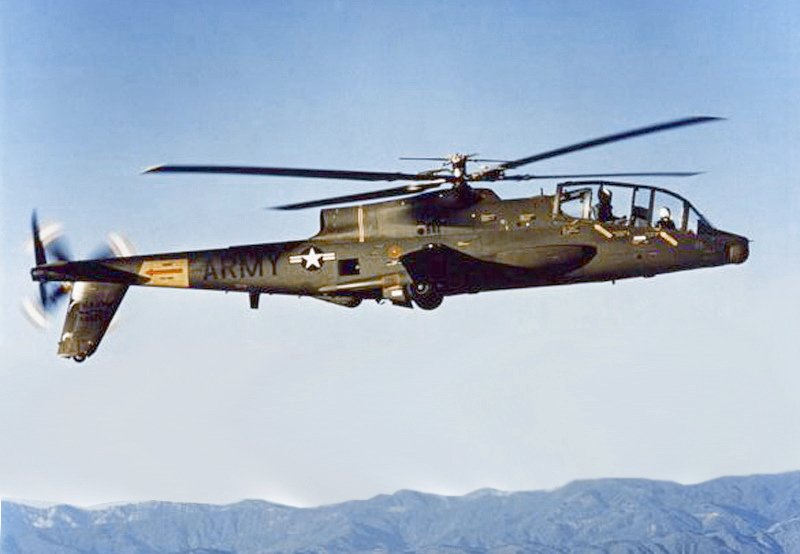
The Lockheed AH-56 Cheyenne was developed in the late 1960s as part of the U.S. Army's Advanced Aerial Fire Support System (AAFSS) program, which began in 1964. The Army sought a dedicated, high-speed attack helicopter for close air support and escort missions, specifically for use during the Vietnam War era. On November 3, 1965, Lockheed's CL-840 design won the competition over a proposal from Sikorsky. A contract for 10 prototypes was subsequently signed on March 23, 1966. All ten aircraft were manufactured by the Lockheed-California Company at Plant A, Building 901, located at Van Nuys Airport in California. The first airframe rolled off the production line on April 16, 1967, and the official first flight took place on September 21, 1967.
Technically, the Cheyenne was an advanced compound helicopter. It was powered by a single General Electric T64-GE-16 turboshaft engine producing 3,435 shaft horsepower. This engine drove a four-bladed rigid main rotor and a three-bladed variable-pitch pusher propeller at the tail, which provided significant forward thrust. A separate four-bladed tail rotor handled anti-torque. This configuration allowed the AH-56 to reach a maximum level speed of approximately 253 mph, with a maximum cruising speed of 242 mph. Other performance metrics included a service ceiling of 26,000 feet, a rate of climb of 3,420 ft/min, and a range of 875 miles with maximum standard fuel.
The aircraft featured sophisticated armament for its time, including a belly turret housing a 30 mm automatic cannon and a chin turret capable of mounting either a 7.62 mm Minigun or a 40 mm grenade launcher. It also possessed hardpoints for 2.75-inch rocket pods and Hughes BGM-71 TOW anti-tank missiles. Targeting was managed via the XM112 swiveling gunner's station, which integrated a fire-control computer and a laser rangefinder.
Despite its potential, the program was plagued by technical issues and costs. On March 12, 1969, prototype serial 66-8828 crashed near Carpinteria, California, killing test pilot David A. Beil; an investigation revealed that rotor blade oscillations at 190 knots caused the blades to strike the fuselage. Due to these stability problems, rising costs (exceeding $400 million), and inter-service disputes with the U.S. Air Force over the CAS mission, the Secretary of the Army cancelled the program on August 9, 1972. While it never entered operational service, the Cheyenne's legacy lived on through the AH-64 Apache, which inherited many of its conceptual goals for anti-armor and fire-control integration. Four prototypes survive today as static exhibits at Fort Novosel, Fort Johnson, and Fort Campbell.