
Development and Design
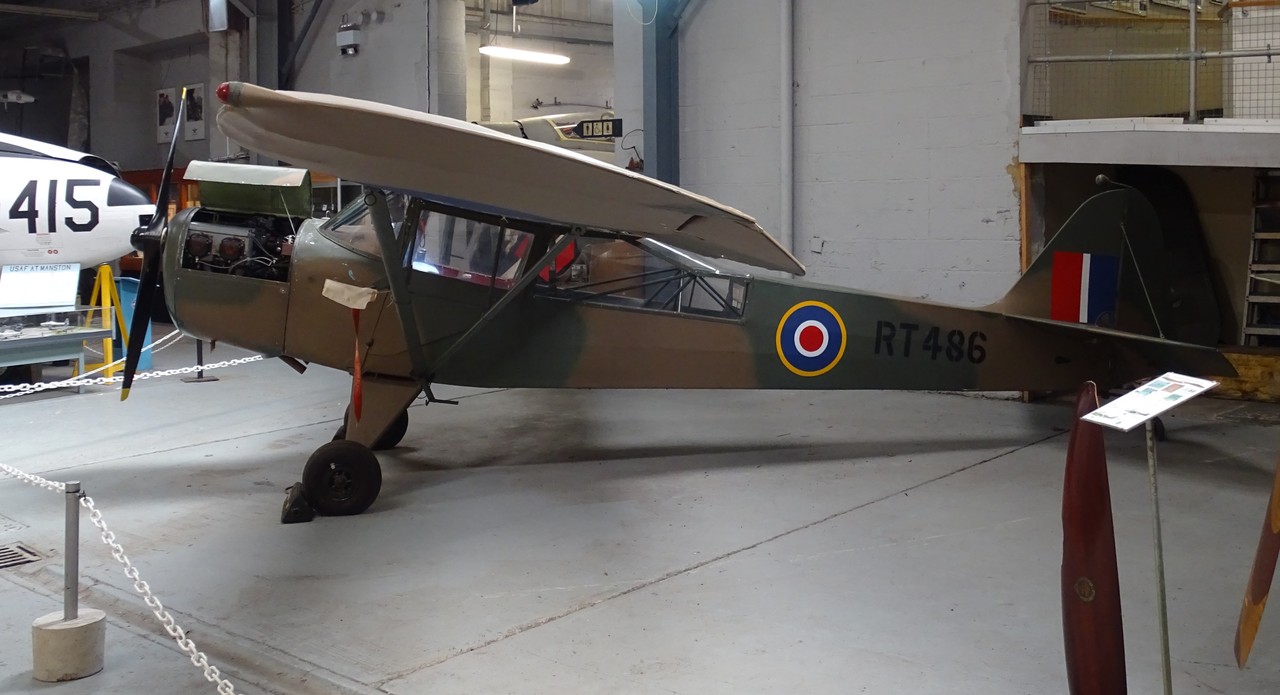
The Aiglet Trainer emerged from Auster Aircraft Limited's desire to create a fully aerobatic training aircraft that could address the limitations of earlier models in hot climates. The design team evolved the proven J/5 Autocar fuselage, widening and strengthening it to handle the stresses of aerobatic flight while incorporating shorter wings, an enlarged fin, and strengthened bracing struts. The prototype took to the air on June 2, 1951, followed by the first production aircraft on September 26, 1952.
Unique among Auster's lineup, the J-5F featured wing-root fuel tanks holding 32 gallons, a free-castoring tailwheel with heel brakes, and certification for full aerobatic operations. The welded steel-tube fuselage was fabric-clad, while the wings employed traditional spruce-plank spars with VEE-struts and wire bracing.
Service with Military Organizations
While designed primarily for civilian use, the Aiglet Trainer found customers among international air forces seeking modern training aircraft. The Pakistan Air Force acquired 17 examples, utilizing them for pilot instruction programs. The Iranian National Aviation Club purchased 15 aircraft in 1958, specifically the J-5L variant equipped with the more powerful Gipsy Major 10 engine. The Lebanese Air Force operated a small number of Aiglet Trainers, though exact quantities remain unclear.
These military operators valued the aircraft's docile handling characteristics combined with its aerobatic capabilities, making it ideal for advanced pilot training without the complexity of larger military trainers.
The Manufacturer's Legacy
Auster Aircraft Limited traced its origins to Taylorcraft Aeroplanes (England) Limited, established in 1938. The company gained prominence during World War II producing Air Observation Post aircraft, including 469 examples of the Auster Mk. III through December 1943. Renamed Auster Aircraft in 1946, the company operated from its Rearsby facility through the 1950s.
By the late 1950s, Gribble Holdings acquired Auster, leading to a series of mergers that eventually resulted in the company's dissolution. The Aiglet Trainer represented one of Auster's final production aircraft before the company ceased operations, marking the end of a manufacturer that had successfully transitioned from wartime military production to peacetime civilian aircraft.
Powerplant and Performance
The standard J-5F utilized the de Havilland Gipsy Major 1 or 1F, a four-cylinder inline air-cooled engine producing 130 horsepower. This reliable powerplant had served the aviation industry since the 1930s, proving particularly suitable for training and light touring aircraft. Alternative variants employed different engines: the J-5E and J-5K featured the more powerful 155-horsepower Blackburn Cirrus Major 3, while the J-5L could be equipped with either the 145-horsepower Gipsy Major 10 or the standard Gipsy Major 1.
One specially prepared J-5E racer demonstrated the type's performance potential by achieving 165 mph, though standard training versions operated at more modest speeds appropriate for instruction duties.
Notable Operations and Records
The Aiglet Trainer gained recognition beyond routine training operations through record-setting flights. Aircraft G-AMOS, nicknamed "Liege Lady" and piloted by T. Hayhow, established 24 Class C.1b point-to-point records across Europe in 1953. Equipped with a special 218-liter long-range fuel system, the aircraft demonstrated the type's potential for extended cross-country flying before force-landing in the Austrian Alps on April 10, 1953.
Civilian operators included prominent British aviation organizations: Airways Aero Association at Croydon received five aircraft, Air Service Training at Hamble incorporated the type into their curriculum, and the College of Aeronautics at Cranfield utilized Aiglet Trainers for instruction. The aircraft also found homes in Australia and New Zealand, with registrations including VH-BYF, VH-WKY, and ZK-BLW.
Market Challenges and Legacy
Despite its technical merits as the only fully aerobatic Auster design, the Aiglet Trainer faced significant market challenges. Sales were undercut by surplus Royal Air Force de Havilland Chipmunks, which offered similar capabilities at lower prices. This competition limited production to approximately 70 aircraft over the seven-year production run.
Surviving Aircraft
Several Aiglet Trainers remain airworthy today, testament to their robust construction. G-AMMS, used as a company demonstration aircraft, continues flying in Britain. Australian examples include VH-RIE, which was rebuilt following a 1980 crash, and VH-BYF, photographed as recently as 2010. VH-WKY was exported in 1978 and remains active.
The type's safety record included notable accidents: VH-AFS crashed on December 17, 1964, near Hughenden, Victoria, while other variants experienced losses including J-5R VH-KCK on December 7, 1961, and J-5Q VH-UED on March 6, 1966. Despite these incidents, the Aiglet Trainer's contribution to post-war aviation training and its distinction as Britain's only fully aerobatic light aircraft of the era secured its place in aviation history.