
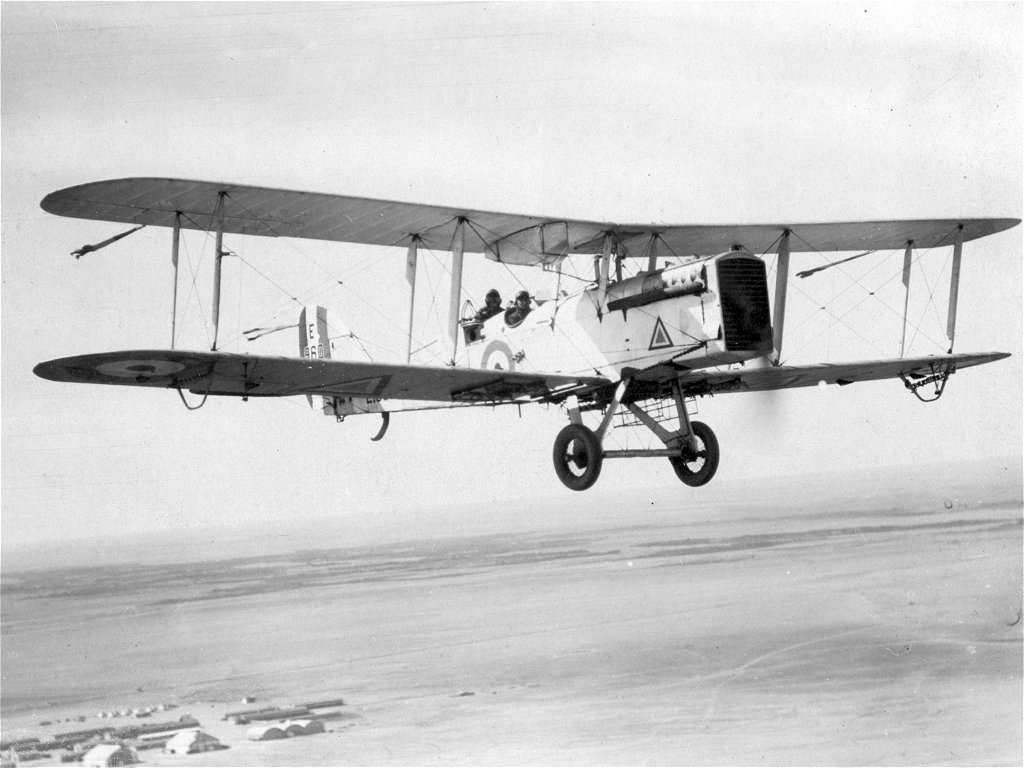
Design and Development
The Airco DH.9A, colloquially known as the "Ninak," was developed as a corrective to the DH.9. While the original DH-series bombers were designed by Geoffrey de Havilland for the Aircraft Manufacturing Company (Airco), the DH.9A redesign was carried out by Westland Aircraft. The primary objective was to integrate the 400 hp (300 kW) American Liberty L-12 engine, a liquid-cooled V-12 piston engine, to replace the unreliable Siddeley Puma. To accommodate this more powerful powerplant, Westland implemented a strengthened airframe and slightly larger wings, which significantly improved the aircraft's load-carrying capabilities and overall performance.
Production History
The DH.9A first flew in March 1918. British production was extensive, with approximately 2,300 airframes built by ten different British companies, including Airco and Westland Aircraft. Beyond the UK, nine USD-9A versions were manufactured by Curtiss in the United States for the U.S. Army's Engineering Division. The design also had a significant impact in the Soviet Union, where it was produced as a direct copy known as the Polikarpov R-1. Under the supervision of N. N. Polikarpov, over 2,400 R-1 aircraft were built between 1922 and 1932, most of which utilized the M-5 engine, a Soviet copy of the Liberty.
Operational Service
The aircraft entered RAF service in July or August 1918. No. 110 Squadron RAF was the first operational unit to utilize the type, deploying to France on August 31, 1918, as part of the RAF Independent Air Force for strategic bombing missions. Following World War I, the DH.9A transitioned into a general-purpose role, becoming a staple for colonial policing in the Middle East and other imperial territories until its retirement in 1931. Other military operators included the Imperial Iranian Air Force. In the Soviet Union, the R-1 served as the standard reconnaissance and light bomber aircraft throughout the 1920s.
Civil Derivatives and Legacy
While primarily a military platform, the DH.9A served as the basis for early civil aviation. The DH.16 was a transport variant featuring a widened fuselage and a glazed cabin for four passengers, powered by either Napier Lion or Rolls-Royce Eagle engines. Other civil conversions included the three-seat DH.9B and four-seat DH.9C. The DH.9A's legacy is defined by its role in bridging the gap between WWI bombers and the multi-purpose aircraft of the inter-war era, proving that a targeted redesign of engine and structure could dramatically extend an airframe's operational utility.