
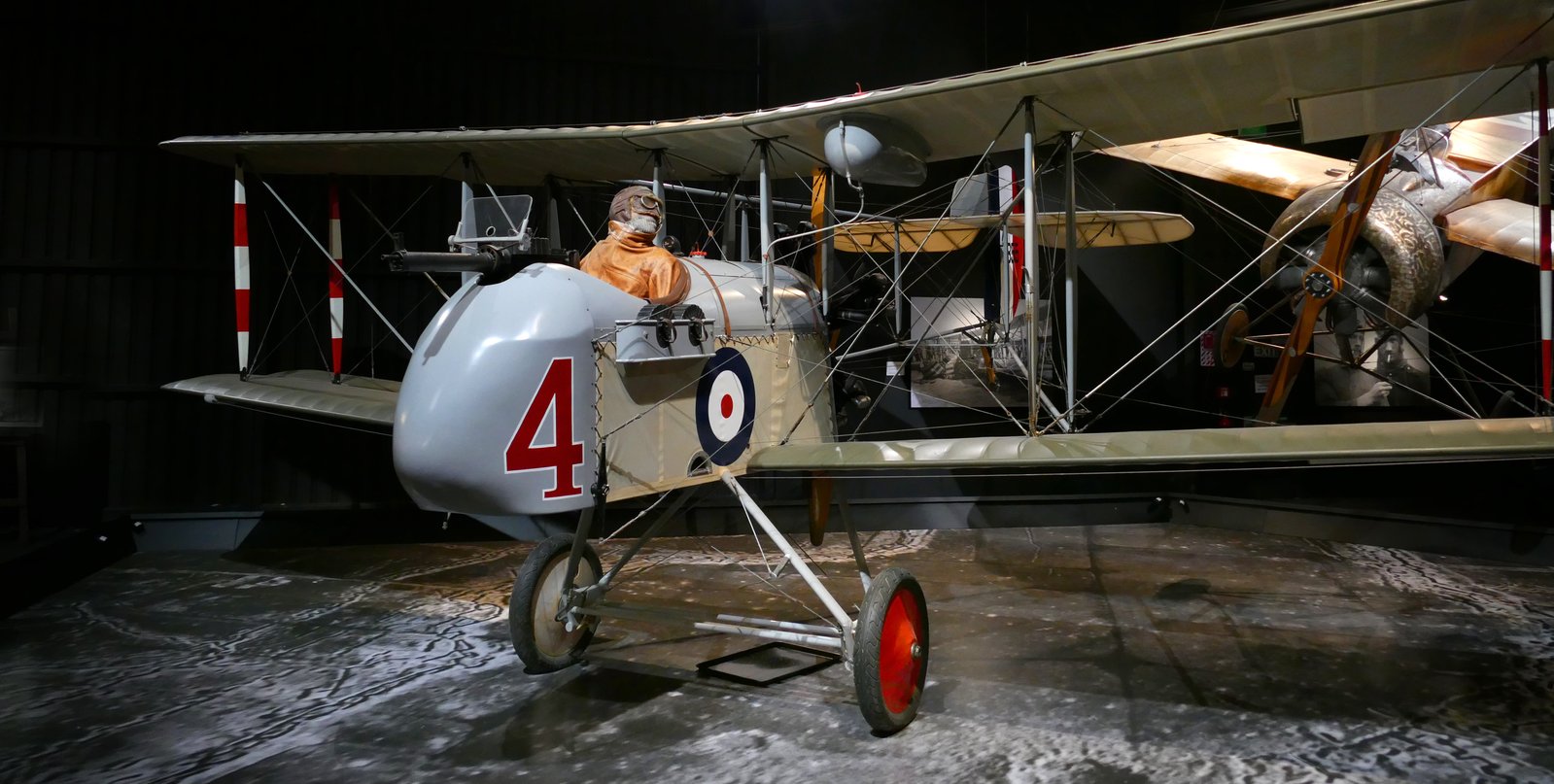
Designed by Geoffrey de Havilland in early 1915, the Airco DH.2 was a compact two-bay pusher biplane developed as a scaled-down version of the two-seat DH.1. The aircraft was specifically engineered to allow a nose-mounted Lewis gun to fire forward without the need for a synchronization gear, which was then unavailable or unreliable for British tractor aircraft. This configuration provided the pilot with excellent forward visibility and a clear field of fire, making it a critical tool in countering the "Fokker Scourge" of German Eindecker monoplanes. The prototype, serial 4732, first flew on June 1, 1915, from Hendon. Although the prototype was lost in August 1915 during operational trials in France, quantity production proceeded at the Aircraft Manufacturing Company (Airco) facility at The Hyde, Hendon.
Production occurred primarily between 1915 and early 1917, with approximately 453 aircraft built. The DH.2 was powered by a 100 hp nine-cylinder air-cooled Gnôme Monosoupape rotary engine, though some later aircraft utilized the improved 110 hp Le Rhône 9J. These rotary engines rotated with the propeller, requiring pilots to use "blipping" for power control. The aircraft's performance included a maximum sea-level speed of 93 mph, a service ceiling of 14,000 feet, and a gross weight of approximately 1,441 lb. While agile and capable of strong climbs, the design left the pilot exposed in an open framework and suffered from the torque and reliability issues inherent to early rotary engines.
In military service, the DH.2 equipped the first Royal Flying Corps (RFC) squadron dedicated entirely to single-seat fighters, No. 24 Squadron, which arrived in France in February 1916. The squadron was initially commanded by Major Lanoe Hawker, who contributed to improvements in gun mounting and sighting. Other notable pilots included Lionel Rees of No. 32 Squadron, who earned the Victoria Cross on July 1, 1916, for a solo attack against ten German aircraft. Fourteen aces scored five or more victories using the DH.2, including James McCudden and Patrick Anthony Langan-Byrne. However, by late 1916, the DH.2 was outclassed by more powerful German tractor fighters such as the Albatros D-series.
No original DH.2 airframes survived the war, but the type lives on through various replicas. A prominent example is the Redfern DH.2, built in 1970 and displayed at the Omaka Aviation Heritage Centre in New Zealand. Other reproductions exist globally, including an 80% scale replica at the Combat Air Museum in Kansas. The legacy of the DH.2 is cemented by its role in shifting aerial combat tactics toward aiming the entire aircraft to fire fixed guns, a precursor to modern fighter operations.