
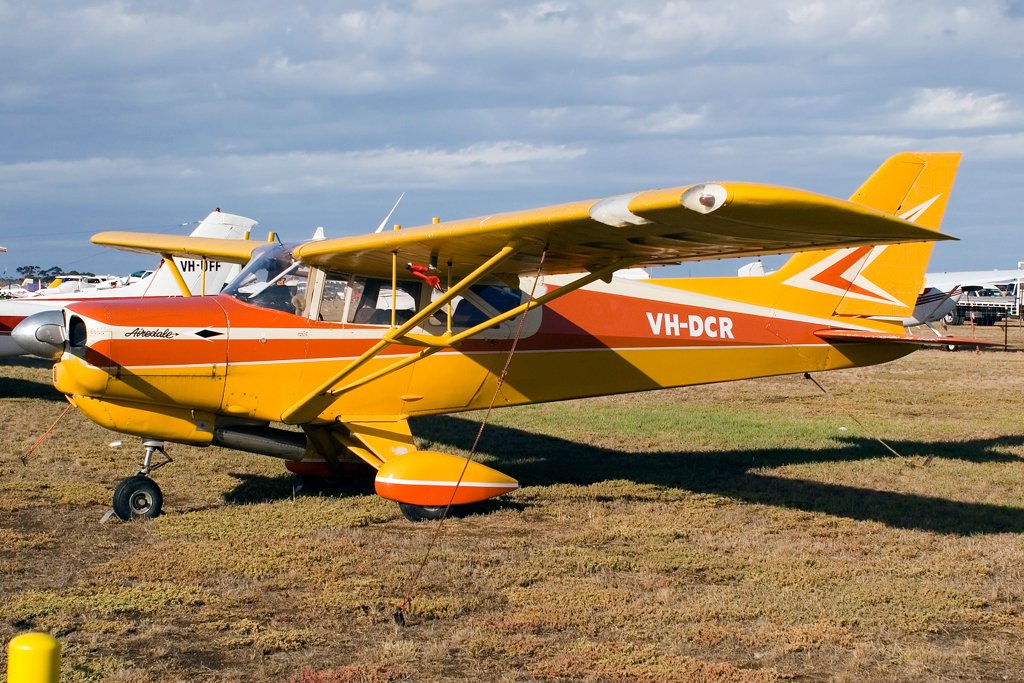
Development and Design
The Airedale emerged from Beagle Aircraft's need for a quick market entry following the 1960 merger of Auster Aircraft, Miles Aircraft, and Pressed Steel Company into British Executive and General Aviation Limited. The aircraft evolved from the earlier Auster D.6, initially conceived as the Auster D.8 with tricycle landing gear modifications. Beagle's engineering team accomplished the remarkable feat of taking the design from drawing board to first flight in just 4.5 months, with prototype G-ARKE taking to the skies on April 16, 1961.
The design incorporated several modifications over its Auster predecessor, including a pilot door relocated aft, a second right-side door, widened rear cabin, lengthened fuselage, and a swept vertical stabilizer. However, the aircraft retained the outdated steel-tube and fabric construction that would ultimately doom its commercial prospects. The fuselage featured steel tube framework with light alloy sections forward and fabric covering aft, while the wings used metal spars with fabric covering and fiberglass wingtips.
Engine and Performance
The production Airedale was powered by the 180-horsepower Lycoming O-360-A1A, a four-cylinder horizontally-opposed engine that had proven reliable in American light aircraft. A variant designated A.111 was tested with the 180-horsepower Continental GO-300-E engine, which reduced aircraft weight by 120 pounds but paradoxically delivered worse performance. The prototype was also fitted with a 175-horsepower Continental GO-300 for evaluation purposes.
Despite the modern tricycle landing gear and control wheel configuration, the Airedale's performance proved lackluster compared to its American competitors. While faster than the tailwheel Auster D.6 it replaced, the aircraft's excessive weight penalty prevented it from matching the performance of contemporary all-metal designs like the Piper Cherokee and Cessna 172.
The Manufacturer
Beagle Aircraft represented Britain's ambitious attempt to consolidate its light aircraft industry. Formed in 1960, the company inherited Auster's rich heritage dating back to 1939, when the firm began producing Taylorcraft derivatives at Thurmaston. During World War II, Auster had distinguished itself manufacturing Air Observation Post aircraft, building 469 examples of the Mk. III by December 1943 and introducing the Mk. IV with its first flight on May 3, 1943.
The company utilized existing jigs and tooling from Auster's wartime production, adapting them for civilian aircraft manufacture. However, this legacy equipment contributed to the Airedale's production inefficiencies, requiring 6,900 man-hours and £2,037 in labor costs per aircraft. Beagle's financial struggles mounted throughout the 1960s, and the company declared bankruptcy in 1970, ending Britain's last major attempt at indigenous light aircraft production.
Production and Market Reception
Production began in earnest on February 24, 1962, when the first production Airedale took flight. Manufactured at the former Auster facility in Rearsby, Leicestershire, the aircraft was marketed as Britain's most affordable four-seater, targeting private owners and flying clubs seeking economical transportation.
Despite promotional efforts, including demonstrations at the 1961 Farnborough Airshow and coverage in British Pathé newsreels, the Airedale failed to capture significant market share. The aircraft's price exceeded £5,000, making it uncompetitive against imported American alternatives. By 1963, twenty unsold aircraft remained in inventory, and Beagle had accumulated losses of approximately £500,000 on the program.
The company had optimistically projected break-even at 675 units, but production ceased in 1963 after completing just 43 aircraft. Early exports included two examples imported to Australia by Aviation Services (SA) Ltd, but international sales remained minimal throughout the production run.
Legacy and Survival
The Airedale's failure illustrated the challenges facing European light aircraft manufacturers in competing against established American producers. The aircraft's outdated construction methods and high production costs highlighted the need for modern manufacturing techniques and all-metal designs to remain competitive in the global market.
Today, approximately thirty Airedales survive from the original production run of 43, though the airworthy status of these aircraft varies. The type serves as a reminder of Britain's post-war aviation ambitions and the practical difficulties of challenging established market leaders with limited resources and outdated manufacturing methods. The Airedale's brief production run marked one of the final chapters in Britain's independent light aircraft industry before foreign manufacturers came to dominate the civilian aviation market.