
Development and Corporate Evolution
The ARJ-21 program emerged from China's ambitious "10th Five-Year Plan" in March 2002, initially undertaken by the AVIC I Commercial Aircraft Company (ACAC), a state-owned aerospace consortium. The project aimed to break China's dependence on foreign regional aircraft manufacturers and establish a foothold in the competitive commercial aviation market. In 2009, ACAC underwent significant restructuring and merged with the newly formed Commercial Aircraft Corporation of China (COMAC), which assumed responsibility for the program and China's broader commercial aircraft development initiatives.
Development proved far more challenging than anticipated. The original timeline called for first flight in 2005 and commercial service beginning in 2006, but the program encountered an eight-year delay. The design phase consumed more time than expected, with final trial manufacturing not commencing until June 2006. The first prototype, designated serial number 101, finally rolled out on December 21, 2007, from Shanghai's Dachang Airfield.
First Flight and Testing Program
On November 28, 2008, the ARJ-21 achieved its maiden flight, marking a historic moment for Chinese aviation. The aircraft demonstrated its capabilities during a long-distance test flight on July 15, 2009, completing the 1,300-kilometer journey from Shanghai to Xi'an in 2 hours and 19 minutes. The comprehensive testing program required extensive validation across multiple aircraft and years of operations.
By August 2011, engineers had completed static, flutter, and crosswind flight tests. Aircraft AC104 accumulated 711 flights totaling 1,442 hours and 23 minutes by November 2014. During October 2014, prototype AC105 completed an intensive route-proving program with 83 flights between ten different airports, accumulating 173 hours and 55 minutes of flight time. The certification program ultimately required 5,000 hours of testing, including stall, high-speed, noise, and both simulated and natural icing tests.
Technical Design and Controversy
The ARJ-21 incorporated several advanced features, most notably its 25-degree swept, supercritical wing manufactured by Ukraine's Antonov design bureau. Twin General Electric CF34 turbofan engines mounted on the rear fuselage provided propulsion, similar to the configuration used on McDonnell Douglas MD-80 and MD-90 aircraft. This similarity sparked controversy within the aviation community, as observers noted the fuselage design bore striking resemblance to the MD-80/MD-90 series, both of which had been produced in China under license agreements.
COMAC consistently maintained that the ARJ-21 represented a completely indigenous design with independent intellectual property rights, despite the visual similarities to existing Western aircraft. The configuration proved effective for regional operations, offering seating for 78-97 passengers depending on interior layout and providing range capabilities between 2,225 and 3,700 kilometers.
Certification and Production Launch
The Civil Aviation Administration of China (CAAC) awarded Type Certification to the ARJ-21-700 on December 30, 2014, following the extensive testing program. COMAC established dual production lines to meet anticipated demand, with the original facility joined by a second production line in Pudong, co-located with C919 assembly operations. The first aircraft from the Pudong facility completed its production test flight on March 6, 2020.
CAAC granted mass production certification in early July 2017, enabling COMAC to begin delivering aircraft to commercial operators. The company established annual production capacity of 30 aircraft across both manufacturing lines.
Commercial Service and Market Reception
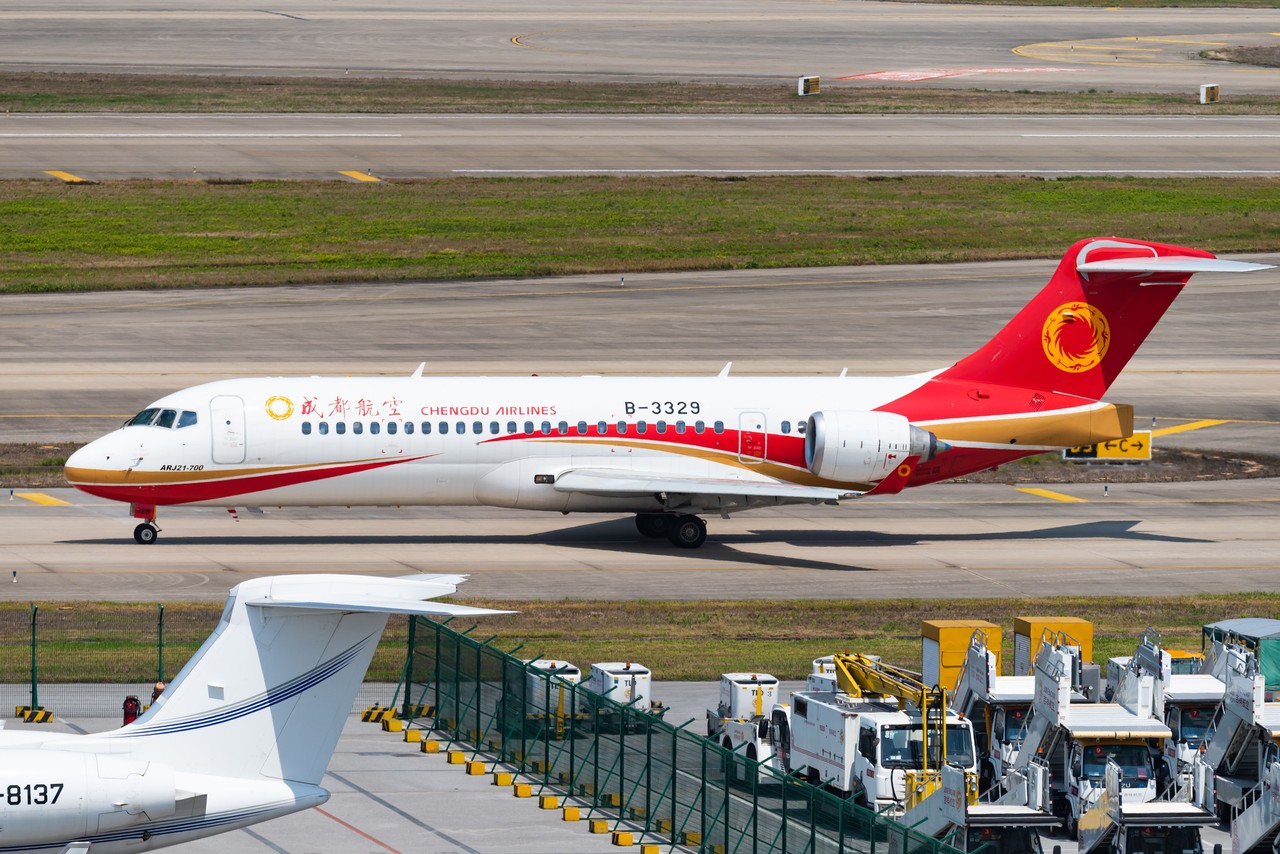
Chengdu Airlines received the first production ARJ-21-700 on November 29, 2015, becoming the launch customer for China's new regional jet. The aircraft entered commercial service on June 28, 2016, with its inaugural passenger flight departing Chengdu Shuangliu Airport and arriving in Shanghai two hours later.
Initial market reception proved cautious, with airlines hesitant to commit to the unproven design. However, confidence grew significantly by 2019 when China's three major carriers - Air China, China Southern, and China Eastern - each placed orders for 35 ARJ-21 aircraft. International interest materialized at the 2016 Farnborough Airshow, where leasing companies placed 90 orders, including 60 from China Aircraft Leasing Ltd.
Legacy and Transformation
By the time comprehensive delivery data became available, COMAC had delivered 79 ARJ-21 aircraft to Chinese carriers, revitalizing the nation's previously dormant regional jet market. The program's success provided crucial experience and credibility that enabled development of the larger C919 narrowbody airliner, which began deliveries in late 2022.
In November 2024, COMAC rebranded the aircraft as the C909, integrating it into the company's unified product lineup alongside the C919. Conversion programs began for existing aircraft, while production continued under the new designation. The transformation from ARJ-21 to C909 represented the maturation of China's commercial aviation ambitions and the establishment of COMAC as a legitimate competitor in global aircraft markets.