
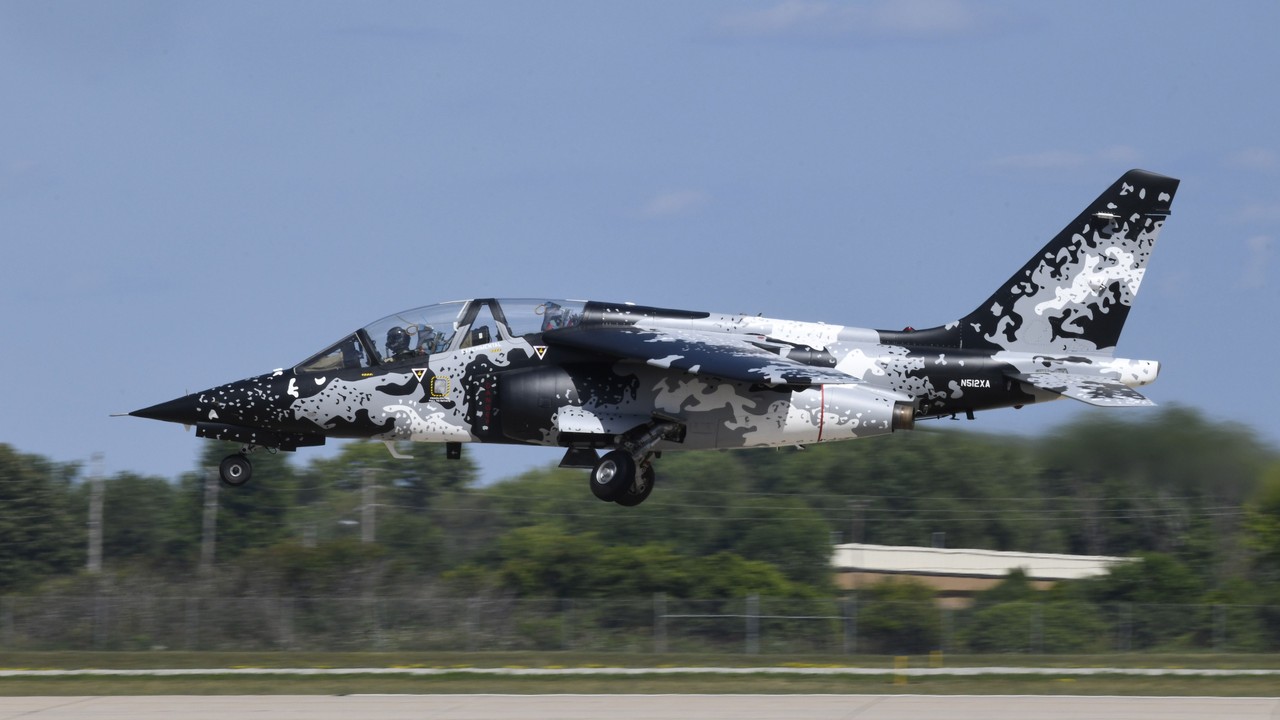
Service History
The Alpha Jet established itself as Europe's premier advanced jet trainer, entering French Air Force service in May 1979 where it replaced both the aging Lockheed T-33 Silver Star trainers and Dassault Mystère IVA aircraft. The French operated 176 Alpha Jet E variants through 1985, though this fell short of their original requirement for 200 aircraft. In Germany, the Luftwaffe received 175 Alpha Jet A attack variants by 1983, utilizing them to replace 300 Fiat G.91R light attack aircraft that had served in tactical support roles.
The aircraft's most visible role came through the renowned Patrouille de France aerobatic team, which adopted 12 Alpha Jets in 1981 and continues operating them today. This high-profile assignment demonstrated the aircraft's precision handling characteristics and reliability in demanding flight operations.
International Production Success
Egypt became a significant operator through a landmark licensing agreement signed with Dassault and the Arab Organization for Industrialization on September 17, 1978. The initial contract covered 30 Alpha Jet MS1 trainers, with four aircraft delivered complete from France while 26 were assembled domestically from knockdown kits. Egypt later acquired improved MS2 attack variants featuring enhanced avionics systems.
The Franco-German Partnership
The Alpha Jet originated from an unprecedented international collaboration initiated by a Franco-German cooperative agreement on July 10, 1969. The initial design team comprised Breguet Aviation, Dassault Aviation, and Dornier Flugzeugwerke, submitting their TA501 proposal which won the joint competition on July 23, 1970. An integrated design team established at Saint-Cloud, Paris, completed the project definition phase by February 1971.
Dassault-Breguet operated the primary production line at Colomiers near Toulouse, maintaining an impressive output of 13 aircraft monthly with capacity for 15. Dornier's German facility averaged 6 aircraft per month before closing its line in 1982 after three years of production. The manufacturing arrangement eliminated component duplication through specialized geographic responsibilities: Dassault-Breguet produced front and center fuselage sections, Dornier handled wings, tails, and rear fuselage components, while Belgium's SABCA manufactured nose sections and flaps.
Engine Innovation
Powering the Alpha Jet were two Larzac turbofan engines, themselves products of international cooperation between French companies Turbomecca and SNECMA alongside German firms MTU and KHD. This engine represented significant advancement in small turbofan technology, with the four Alpha Jet prototypes serving as testbeds for progressive engine improvements during the development program.
Flight Testing and Development
The development program proceeded methodically with the first French prototype flying on October 26, 1973, from Istres near Marseille. Germany's first prototype followed on January 9, 1974, departing Oberpfaffenhofen in Bavaria. Third and fourth prototypes completed maiden flights in May and October 1974 respectively, leading to the first production aircraft's flight on November 4, 1977.
Variant Development
The Alpha Jet family encompassed several specialized versions addressing different operational requirements. The Alpha Jet E served French training needs while the Alpha Jet A fulfilled German light attack missions. Egyptian MS1 and MS2 variants incorporated progressively advanced avionics, and later Alpha Jet E+ models offered enhanced training capabilities through improved electronic systems.
Manufacturing Legacy
Total production reached 512 aircraft by the program's conclusion in 1985, with 329 exported to international customers. The manufacturing effort employed approximately 4,500 workers across French and German facilities, representing one of Europe's largest aerospace cooperation programs of its era.
Dassault Aviation continues as a major French aerospace manufacturer today, while Dornier's aircraft division eventually ceased independent operations. The Alpha Jet program demonstrated that complex multinational military aircraft development could succeed through careful coordination and specialized manufacturing assignments, establishing precedents for future European collaborative programs including the Tornado and Eurofighter Typhoon.
Operational Impact
The Alpha Jet's dual trainer-attack capability proved its fundamental design concept, providing air forces with versatile platforms capable of pilot training progression from basic jet familiarization through advanced weapons delivery techniques. This efficiency made the aircraft attractive to nations seeking comprehensive training solutions within single aircraft types, contributing significantly to its export success across multiple continents.