
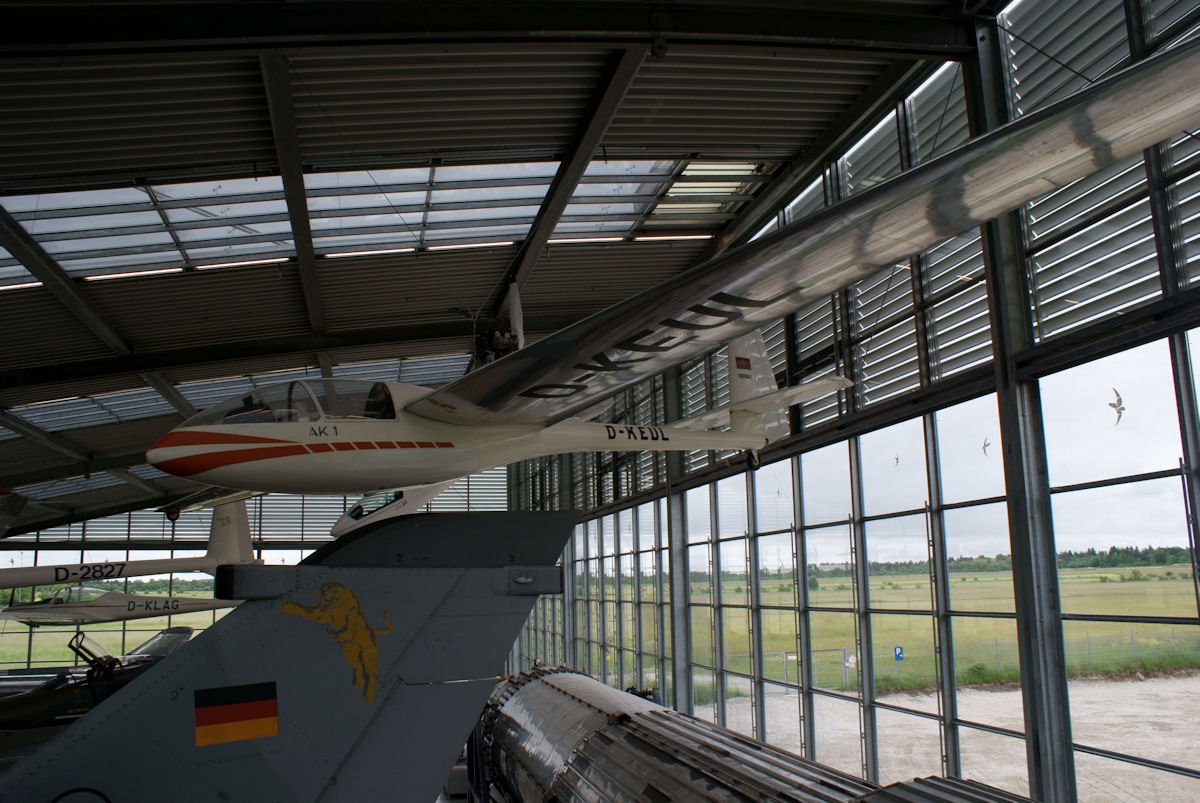
Innovation in Motor Glider Design
The AK-1 Mischl represented a revolutionary approach to motor glider technology that solved fundamental problems plaguing earlier designs. When Akaflieg Karlsruhe began development in 1965, existing motor gliders suffered from cooling difficulties and power transmission issues with their fixed engines. The AK-1's innovative solution extended both engine and propeller together as a single retractable unit, eliminating these problems while maintaining aerodynamic efficiency during gliding flight.
Academic Engineering Excellence
The Akademische Fliegergruppe Karlsruhe, founded as a student research organization at Karlsruhe University, pursued motor glider development as early as 1955. Their initial project using an American 40-horsepower four-cylinder two-stroke engine was abandoned in 1959 when production ceased. The availability of the Hirth F10A engine in 1965 enabled the team to proceed with the AK-1 design, which took six years to complete from conception to first flight.
The design team established ambitious objectives: self-launch capability without ground crew assistance, gliding performance matching standard sailplanes like the Ka6, minimal maintenance requirements, and weather-resistant construction. These goals drove innovative engineering solutions that would influence motor glider design for decades.
Construction and Certification
The AK-1's mixed construction combined modern materials with traditional techniques. The fuselage featured steel-tube lattice work enclosed in a fiberglass-reinforced plastic shell, while wings and tail used metal structure. Control surfaces employed conventional wooden construction for the rudder, with other surfaces manufactured using the same principles as the wings.
The aircraft's cruciform tail configuration, rather than the more common T-tail design, specifically addressed vibration problems from propeller wash. This attention to detail characterized the entire project, which achieved German LBA certification after extensive flight testing.
Operational Service
Following certification, the AK-1 served Akaflieg Karlsruhe for 37 years as both research platform and training aircraft. All organization pilots holding motor glider licenses flew the unique prototype, gaining experience with retractable engine technology that few other aircraft offered. The single-seat aircraft weighed 300 kilograms empty and achieved a maximum speed of 100 kilometers per hour.
Professor Diem christened the aircraft "Mischl" on July 7, 1973, choosing a hybrid name that expressed its character as a cross between powered aircraft and glider. This designation perfectly captured the AK-1's dual nature and pioneering role in motor glider evolution.
Engine and Performance
The Hirth F10A engine produced 19 kilowatts (26 horsepower) at 5,000 revolutions per minute, driving a 1.3-meter diameter propeller. This four-cylinder two-stroke powerplant provided sufficient thrust for self-launching while remaining light enough to preserve gliding performance. The engine's complete retraction eliminated drag during soaring flight, a crucial advantage over fixed-engine designs.
The 15-meter wingspan provided excellent gliding characteristics, meeting the design objective of matching dedicated sailplane performance. This combination of powered self-launch capability with pure glider efficiency represented a significant advancement in motor glider technology.
Legacy and Museum Preservation
The AK-1's final flight occurred on October 18, 2008, ending nearly four decades of service. Rather than scrapping this historically significant aircraft, Akaflieg Karlsruhe donated it to the Deutsches Museum in 2011, where it joined the collection at Flugwerft Schleißheim near Munich.
The prototype's influence extended far beyond its operational life. The proliferation of motor gliders with retractable engines since the 1980s validates the AK-1 concept developed in the early 1960s. Modern self-launching gliders universally employ hinged propulsion units that trace their lineage directly to the AK-1's innovative design.
Continuing Innovation
The success of the AK-1 program established Akaflieg Karlsruhe's reputation for innovative aircraft development. Subsequent projects included the AK-5, which first flew in the early 1990s, followed by the AK-5b on May 26, 1996, and the AK-8, which flew in 2003 after construction began in 1996. Each project built upon lessons learned from the AK-1's pioneering development.
Today, the organization continues as part of the Karlsruhe Institute of Technology (KIT), maintaining its tradition of student-led aircraft research and development. The AK-1 Mischl remains their most influential achievement, having established fundamental technologies that transformed motor glider design worldwide.