
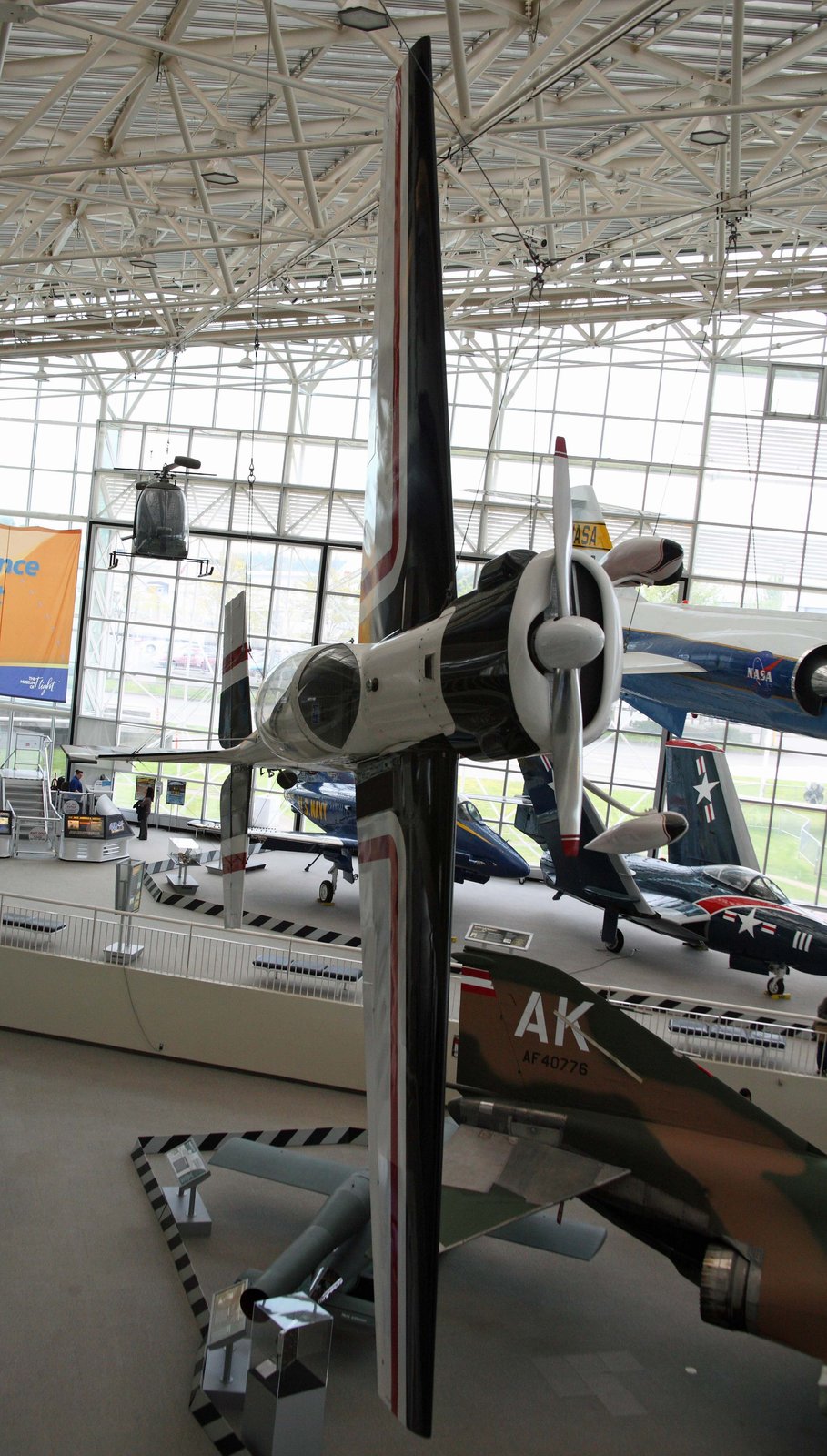
Competition Dominance
The Stephens Akro achieved unprecedented success in aerobatic competition through Leo Loudenslager's extensively modified variant, the Akro Laser 200. Between 1975 and 1982, Loudenslager won the U.S. Aerobatic Championship seven consecutive times flying his 200-horsepower Lycoming IO-360-powered aircraft. The ultimate validation came in 1980 when he captured the World Aerobatic Championships, proving that a homebuilt design could outperform factory-built competition aircraft on the global stage.
Loudenslager's success stemmed from continuous refinement of the basic Akro design. His aircraft featured a different wing airfoil than the original NACA 23012, a lightened fuselage, and a revised lowered canopy with raised decking that improved both aerodynamics and pilot visibility during complex maneuvers.
The Designer and Original Vision
Clayton L. Stephens conceived the Akro in July 1966 as a purpose-built aerobatic machine for Margaret Ritchie, winner of the 1966 U.S. Women's Aerobatic Championship. Working with Ed Allenbaugh, who created the preliminary drawings, Stephens scaled up the basic airframe from a 190-cubic-inch racer called Miss San Bernardino by one-third. The team retained the NACA 23012 airfoil that had served Ritchie well in her Taylorcraft.
The revolutionary aspect of the Akro lay in its design methodology. Unlike previous aerobatic aircraft that were adapted from existing designs, the Akro was the first U.S. aircraft engineered specifically around the Aresti Catalog of maneuvers used in international aerobatic competition. This approach resulted in an aircraft optimized for the precise demands of unlimited aerobatic flying.
Engineering Innovation
The Akro's structural design reflected its demanding mission requirements. The cantilever mid-wing configuration featured a wooden, two-spar mahogany-skinned wing built as a single unit, with the forward spar passing unbroken through the fuselage for maximum structural integrity. This design choice enabled the aircraft to absorb the extreme stresses of +12/-11g loading during aggressive maneuvers.
Notable engineering features included ailerons constructed as torque tubes with wood ribs, aluminum leading edges, and Dacron covering. Hidden fittings provided uninterrupted airflow over control surfaces, while the fixed-screen cockpit with rearward-sliding bubble canopy optimized pilot visibility. The fuselage fuel tank positioned between cockpit and engine held 32 gallons, providing adequate range for competition flying.
Manufacturing and Production
Stephens Aircraft began manufacturing the Akro in Rubidoux, California, starting in 1972, though plans became available to homebuilders earlier. The company produced approximately 13 factory-built examples, but the design's real impact came through amateur construction. Plans were released in series: Series A (basic airframe, landing gear, tail section) became available immediately, Series B (complete fuselage) on May 1, 1968, and Series C (wings and ailerons) shortly thereafter.
From 1977 to 1980, Garry M. Zimmerman of Arvada, Colorado, distributed plans only, extending the design's availability to builders nationwide. Two factory models emerged: the original Model A and the Model B, which first flew on July 9, 1969. The Model B featured six percent larger wing area, bigger ailerons, fuselage side windows below the wings, but 16 percent less fuel capacity and eight percent greater weight.
Test Flight and Early Performance
Flavio Madariaga of Flabob Airport in Riverside, California, conducted the prototype's first flight on July 27, 1967. Subsequent testing by renowned aerobatic pilots including Art Scholl, Bob Herendeen, and John Paul Jones validated the design's exceptional capabilities. Scholl, who performed flutter tests, praised the aircraft's "phenomenal" vertical performance and noted substantial performance margins even after executing demanding aerobatic sequences.
Margaret Ritchie became famous for dramatic takeoffs in the prototype, often standing the Akro on its tail and climbing nearly vertically. This demonstration of raw performance capability helped establish the aircraft's reputation in the aerobatic community.
International Legacy
The Akro's influence extended far beyond American homebuilt aviation. Walter Extra of Extra Flugzeugbau in Germany developed the Extra EA-230 and EA-300 derivatives, producing over 200 examples and making these the most successful commercial adaptations of the Akro design. These aircraft became among the most respected aerobatic machines worldwide, validating Stephens' original engineering concepts on a global scale.
Current Status
The National Air and Space Museum houses Loudenslager's championship-winning Laser 200, preserving this pivotal aircraft for future generations. While exact numbers remain uncertain, several Akros and Laser variants continue flying in private hands. FAA records indicate at least one Stephens Akro remains registered through 2031, testimony to the design's enduring appeal and structural integrity nearly six decades after its creation.