
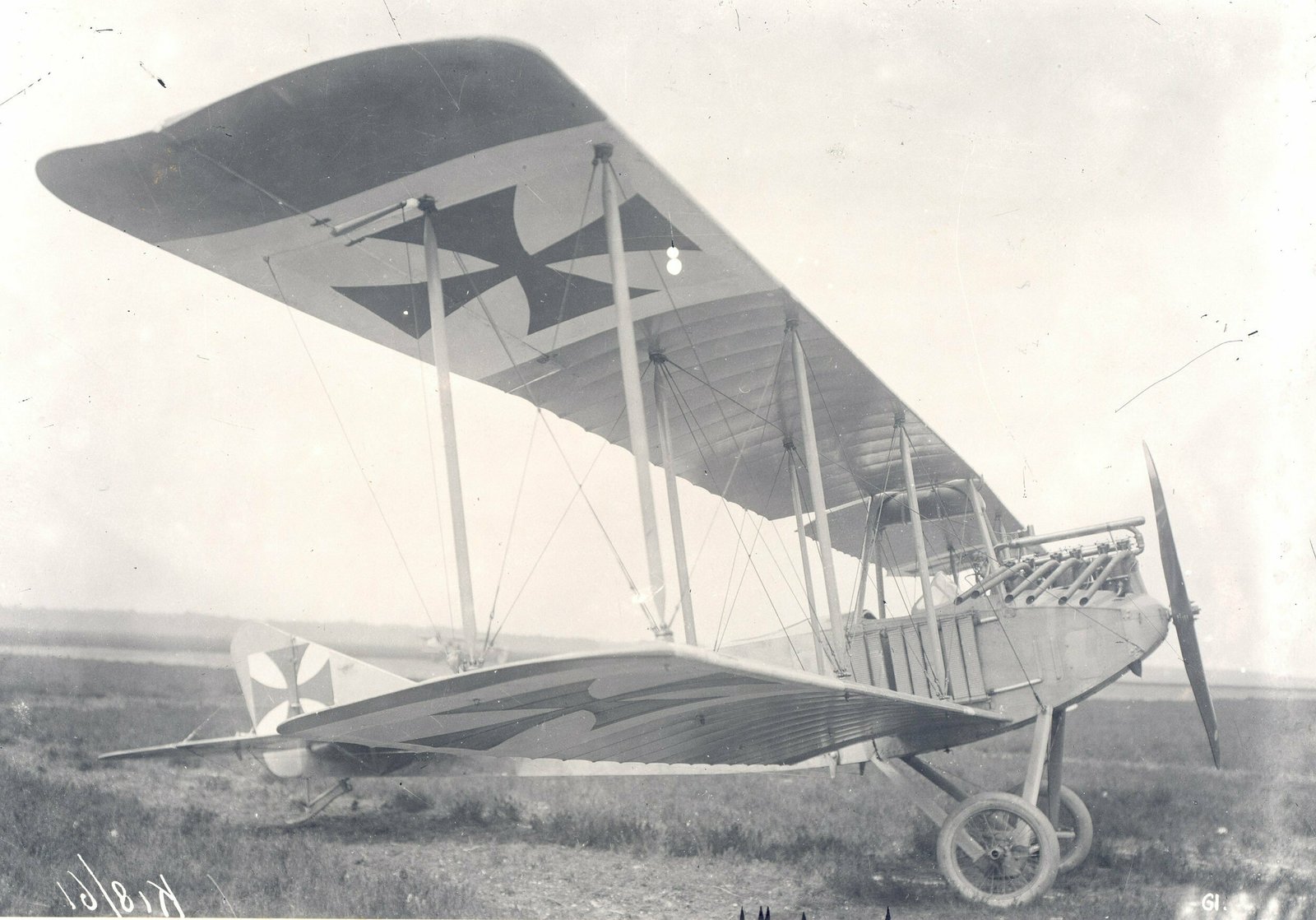
Designed in 1913, the Albatros B.I was a critical component of Germany's first generation of systematic military reconnaissance aircraft. The design was produced by the engineering team at Albatros Flugzeugwerke, with contributions from Ernst Heinkel. A defining characteristic of the B.I was its tandem open cockpit arrangement; unlike many contemporary designs, the observer was seated in the front cockpit to provide an unobstructed field of view for visual and photographic observation, while the pilot sat behind. This layout became a standard for German reconnaissance aircraft of the era.
Production took place at the Albatros Flugzeugwerke main factory in Johannisthal, Berlin. While exact production totals are unknown, the type was built in small numbers starting in late 1913. A licensed derivative, the Albatros B.I(Ph), was produced by Phönix Flugzeugwerke in Aspern, Vienna, for Austria-Hungary. This specific prototype, designated Phönix 20.01, was test-flown in late 1914 and utilized a 145 hp Hiero engine.
Technically, the standard German B.I was powered by a 100 hp (75 kW) Mercedes D.I six-cylinder, water-cooled inline piston engine manufactured by Daimler-Motoren-Gesellschaft. The aircraft featured a wooden structure with fabric-covered wings and a fixed tailskid undercarriage. It achieved a maximum speed of 105 km/h and a range of 650 km, with an endurance of approximately four hours. Its climb rate allowed it to reach 800 meters in 10 minutes.
During World War I, the B.I served primarily with the Luftstreitkräfte as an unarmed scout for artillery spotting and intelligence gathering on both the Western and Eastern Fronts between 1914 and 1915. By 1915, the B.I was withdrawn from front-line service as it was replaced by armed C-class aircraft. However, the B.I remained in use as a trainer for pilots and observers until the end of the war in 1918. Beyond Germany, the Romanian Air Corps acquired one B.I in 1913, and the Polish Air Force operated the type postwar.
Albatros Flugzeugwerke, founded by Enno Walther Huth in 1909, became a premier producer of WWI aircraft but ceased aviation activities following the restrictions of the Treaty of Versailles, becoming defunct by the mid-1920s. Today, the Phönix 20.01 prototype is preserved at the Heeresgeschichtliches Museum in Vienna, though no original German-built B.I airframes are known to survive.