
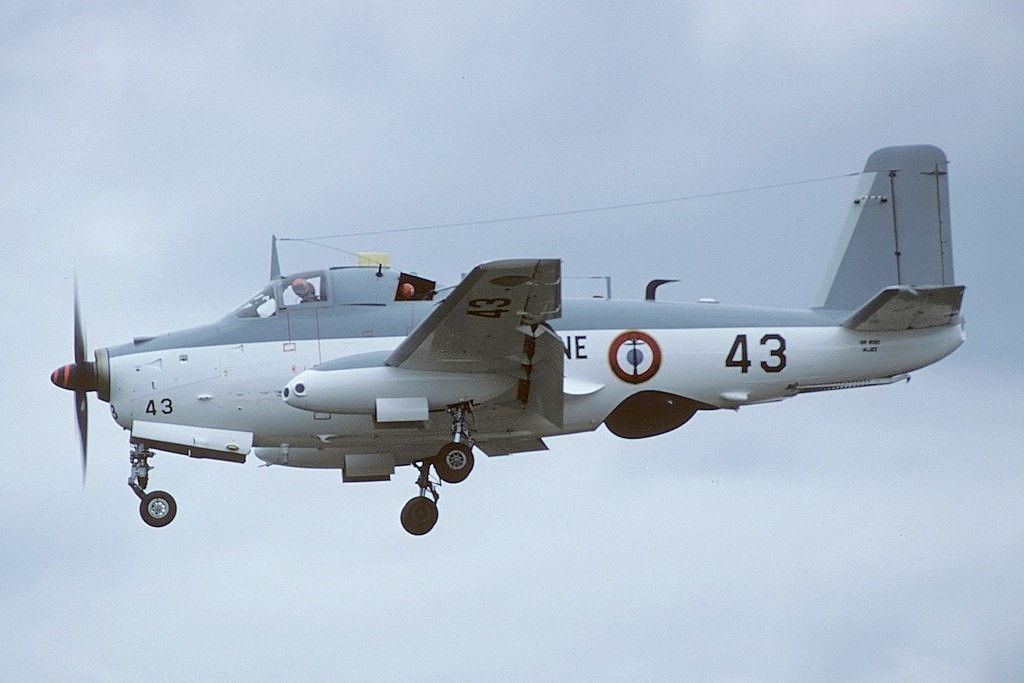
Service History
The Alizé dominated carrier-based anti-submarine operations for over four decades, providing the backbone of French naval aviation's ASW capability. Of the 89 aircraft produced, 75 served with the French Aéronavale from March 1959 until September 2000, making it one of the longest-serving military aircraft of the jet age. The remaining 12 aircraft equipped the Indian Navy's Naval Air Squadron 306 "White Cobras" from 1961 to 1991, operating from both the aircraft carrier INS Vikrant and the shore base INS Garuda near Cochin, Kerala.
Operational History
The Alizé proved its combat worth during the Indo-Pakistani War of 1971, where Indian aircraft conducted anti-submarine patrols and reconnaissance missions from INS Vikrant. The type saw extended combat service during India's intervention in Sri Lanka from February to October 1988, conducting operations against the LTTE. Indian Alizés were again deployed in 1988 to counter an attempted coup in the Maldives, demonstrating the aircraft's versatility beyond pure ASW missions.
French Alizés operated extensively from the aircraft carriers Clemenceau and Foch throughout the Cold War, maintaining continuous anti-submarine surveillance in the Mediterranean and Atlantic. The aircraft underwent several modernization programs during its service life, with French examples receiving ALM and ALH standard upgrades that kept them technologically current through the 1990s.
The Manufacturer
Breguet (Société Anonyme des Ateliers d'Aviation Louis Breguet) was founded in the early 20th century and became one of France's premier aircraft manufacturers. The company produced the Alizé at its Biarritz facility, with components manufactured at Toulouse-Montaudran and other locations. Breguet's expertise in naval aviation stemmed from decades of experience designing carrier-capable aircraft for the French Navy.
The Alizé emerged from Breguet's unsuccessful Br 960 Vultur attack aircraft project, which was limited to three prototypes. Engineers extensively redesigned the Vultur's basic configuration, transforming it into a dedicated anti-submarine platform that would become far more successful than its predecessor.
Engine & Technical Innovation
The single Rolls-Royce Dart R.Da.21 turboprop engine provided the Alizé with exceptional loitering capability essential for submarine hunting. The British-built powerplant enabled the aircraft to achieve a maximum speed of 435 km/h while maintaining the fuel efficiency necessary for extended patrols over vast ocean areas.
The Alizé's most distinctive feature was its retractable ventral radome mounted in the rear fuselage, which could be extended during flight for radar operations and retracted for takeoff and landing. This innovative design protected the sensitive radar equipment while maintaining the aircraft's carrier landing capabilities. The three-person crew consisted of a pilot, radar operator, and observer, with the latter two stationed in the rear cabin to operate the submarine detection equipment.
The aircraft carried an array of sonobuoys that could be dropped into the water to create acoustic detection networks, allowing crews to track submerged submarines across large areas. This capability made the Alizé particularly effective in the confined waters of the Mediterranean and the strategic sea lanes of the Indian Ocean.
Performance Characteristics
With an empty weight of 5.7 tonnes and maximum takeoff weight of 8.2 tonnes, the Alizé possessed excellent carrier handling characteristics. Its 2,500-kilometer range allowed for extended maritime patrols, while the service ceiling and cruising speed provided optimal conditions for anti-submarine surveillance. The aircraft's relatively low approach speed and robust landing gear made it well-suited for carrier operations in rough seas.
Production Legacy
The Alizé's 89-aircraft production run represented a modest but highly successful program that equipped two major naval air arms with a sophisticated ASW capability. The first production aircraft was delivered on March 20, 1959, with deliveries continuing through 1962. The Indian Navy's initial order of 12 aircraft was delivered between June and September 1961, with the maiden flight of an Indian Alizé occurring on October 21, 1960.
By 1977, India operated only six aircraft due to attrition, prompting France to deliver two additional aircraft to maintain squadron strength. Unlike their French counterparts, Indian Alizés were never upgraded to modern standards, contributing to their earlier retirement in 1991.
Museum Preservation
Today, preserved examples commemorate the Alizé's four decades of naval service. Aircraft IN202 is displayed at the Bogmalo Naval Aviation Museum near Goa, India, representing the type's service with the Indian Navy. In France, serial number 5, an early production aircraft that served with Aéronavale squadrons 2S, 4F, and 6F from 1959 to 1977, was preserved as a gate guardian at Nîmes before being relocated for restoration in 2012. These museum aircraft preserve the legacy of one of the Cold War's most specialized and long-serving naval aircraft.