
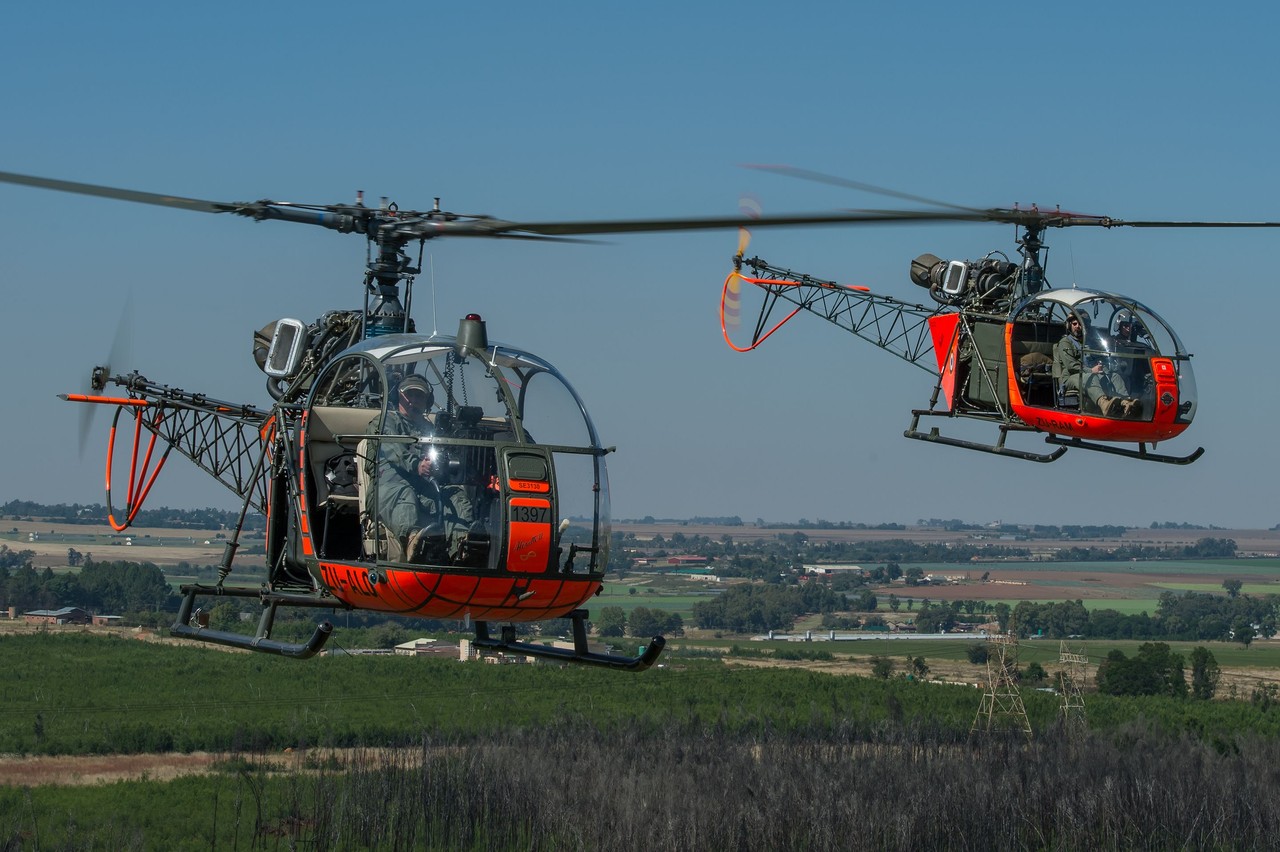
Revolutionary Turbine Design
The Alouette 2 emerged from Sud-Est's recognition that turboshaft engines offered superior power-to-weight ratios compared to piston engines. Chief test pilot Jean Boulet piloted the first prototype, registered F-WHHE, from Buc airfield near Paris, demonstrating the aircraft's capabilities immediately. On June 6, 1955, just three months after first flight, Boulet established a world helicopter altitude record of 26,932 feet, proving the turbine powerplant's high-altitude performance.
Widespread Military Adoption
The Alouette 2 achieved remarkable international success, serving with 47 armed forces across more than 80 nations. The German Army became the largest military operator, fielding 226 SA-315B Lama variants and 54 SA-318C models for transport and reconnaissance missions. French, German, and Belgian armed forces together purchased nearly half of total production, with the French Navy employing the type for transport, communications, and rescue operations until retiring their last aircraft on December 31, 1997.
Military variants proved exceptionally versatile, performing roles ranging from troop transport to medical evacuation and forward observation. The helicopter's compact size and reliable turbine engine made it ideal for operations in challenging terrain where larger aircraft could not operate effectively.
Manufacturing Evolution
Production began in 1956 under Sud-Est, transitioning to Sud Aviation following corporate mergers, and finally to Aérospatiale after 1970. The manufacturing program spanned 19 years from 1956 to spring 1975, producing 1,303 aircraft with serial numbers from 1001 to 2680. International license production expanded the program's reach, with S.A.B.C.A. in Belgium and SAAB in Sweden assembling aircraft for local markets. SAAB completed approximately ten of the 29 units purchased by Swedish armed forces.
Two primary variants dominated production: 923 SA 3130/313B aircraft and 382 SA 3180/318B/318C models. The later SA-318C variant introduced the more powerful Astazou IIA engine with higher operating temperatures and increased maximum takeoff weight to 1,650 kg.
Powerplant Innovation
The Turbomeca Artouste I turboshaft engine, producing 360 shaft horsepower, represented a quantum leap in helicopter propulsion. Weighing just 160 kg with accessories, the engine consumed 125-150 kg of fuel per hour while delivering superior reliability compared to piston alternatives. The upgraded Astazou IIA/IIA2 engine, introduced in 1961, featured higher continuous operating temperatures of 490°C versus 460°C in earlier versions.
This powerplant choice proved prescient, as virtually all subsequent helicopter designs adopted turbine engines. The Alouette 2's success demonstrated that turboshaft power was not merely feasible but essential for competitive helicopter performance.
Flight Characteristics and Performance
Pilots praised the Alouette 2's predictable handling and robust construction. The helicopter achieved a maximum speed of 115 mph and cruise speed of 106 mph, with four-hour endurance providing operational flexibility. Its 7,545-foot service ceiling enabled operations in mountainous terrain where many competitors struggled.
The aircraft's load-carrying capability impressed operators, accommodating pilot plus four passengers or equivalent cargo weight. This combination of performance and payload made the Alouette 2 economically viable for commercial operators while meeting military transport requirements.
Enduring Legacy
The Alouette 2's design success spawned the SA 315B Lama variant, combining the proven airframe with Alouette III powerplant and transmission components. On June 21, 1972, Jean Boulet piloted a specially modified Lama to 40,820 feet, establishing another helicopter altitude record that demonstrated the design's fundamental soundness.
License production continues today through Hindustan Aeronautics Limited in India, which manufactures the type as the "Cheetah" for military service. This ongoing production, more than 65 years after first flight, testifies to the design's enduring relevance.
Historic Achievement
The program's most remarkable demonstration occurred on July 14, 2007, when Alouette 2 F-GIJE, serial number 1003 from 1956, completed a transatlantic crossing. Pilots Pascal Petigenet and David Dahdi flew the 51-year-old aircraft from Lognes, France to Oshkosh, Wisconsin via England, Scotland, the Faroe Islands, Greenland, and Canada in approximately 65 hours of flight time, proving the design's exceptional durability and reliability.