
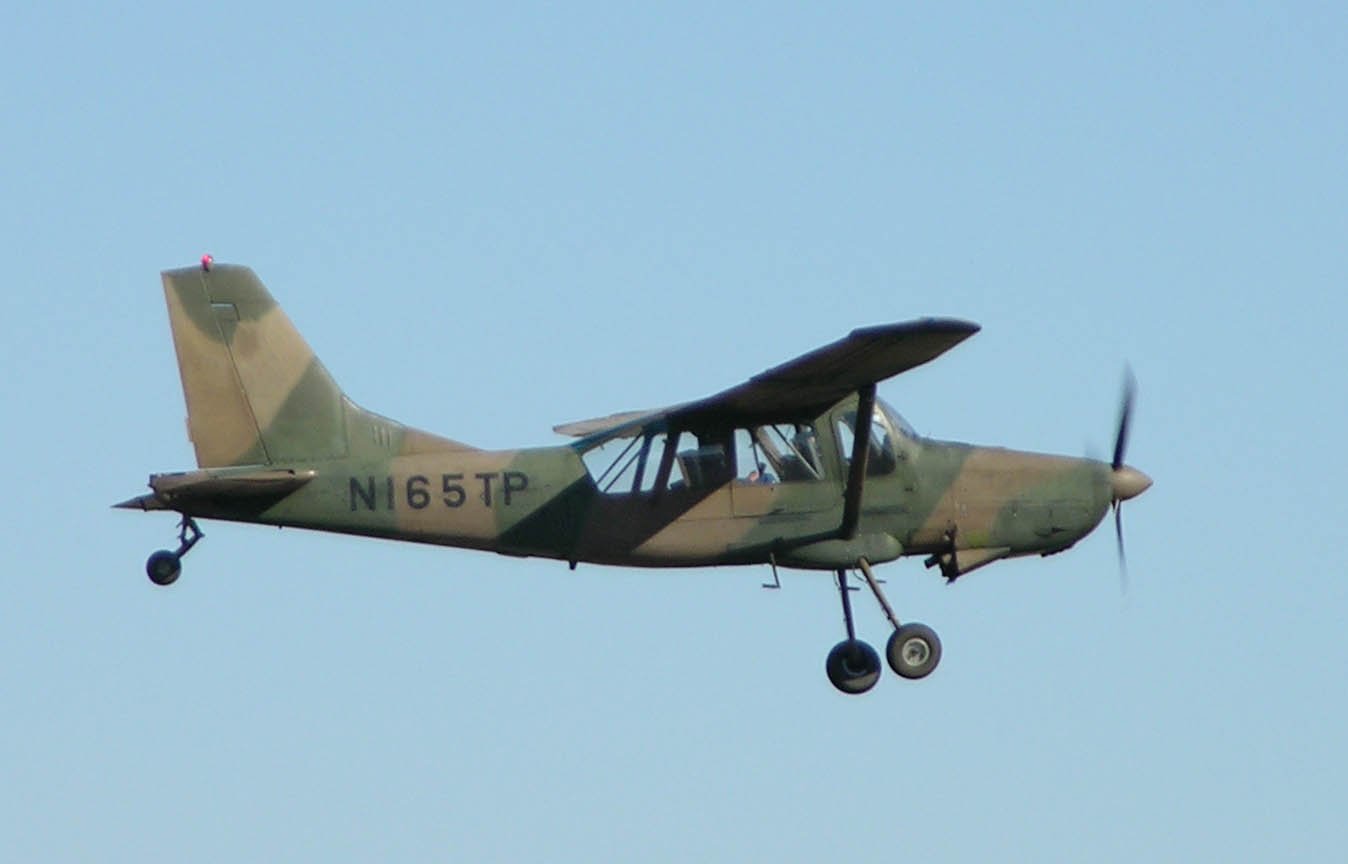
Development and Design
The AM-3 emerged from the Italian military's need to replace the aging Cessna L-19 aircraft serving with the Esercito Italiano (Italian Army). The collaborative design effort between Aermacchi and Aerfer (later Aeritalia) began in the mid-1960s, building upon the proven wing design of the successful Aermacchi AL-60. The engineering teams strengthened this wing structure and added two hardpoints capable of carrying 350 kilograms of external loads, including machine gun pods, light bombs, or rocket pods.
The aircraft featured tandem seating for pilot and observer with dual controls, while the rear cabin could accommodate two stretchers for casualty evacuation or additional passengers and freight. This versatility made the AM-3 suitable for multiple mission profiles including forward air control, artillery spotting, liaison duties, and tactical ground support.
Manufacturing Partnership
Aermacchi, founded in 1912 and renowned for military trainers and light aircraft, partnered with Aerfer Industrie Aerospaziali Meridionali for the AM-3 project. Aermacchi constructed the first prototype, while Aerfer built the second. The corporate landscape shifted during development when Aermacchi merged into Aeritalia in 1969, with the project continuing under the combined Aeritalia-Aermacchi designation.
Aeritalia operated through the 1970s and 1980s before evolving into Alenia Aeronautica and eventually becoming part of Leonardo S.p.A. in 2016, which remains active today as a major aerospace manufacturer.
Production and Export Success
Production commenced in 1973 after prototype testing revealed the need for more power than the initial Continental engines provided. The production aircraft received the Piaggio-built Lycoming GSO-480-B1B6 engine, a six-cylinder air-cooled horizontally opposed powerplant producing 340 horsepower and driving a three-bladed constant-speed Piaggio propeller.
While the Italian Army ordered 20 AM-3C aircraft that served from 1970 to 1977, the type found greater success in export markets. The South African Air Force became the largest operator, acquiring 40 AM-3CM aircraft designated "Bosbok." These were delivered between March 1973 and December 1975, with the final 32 examples assembled under license by Atlas Aircraft Corporation in South Africa.
Operational Service
The South African Air Force deployed Bosboks with 41 and 42 Squadrons, utilizing the aircraft extensively during the South African Border War of the late 1970s and 1980s. The AM-3's robust construction and reliable powerplant proved well-suited to the demanding conditions of forward air control missions, observation flights, artillery spotting, and casualty evacuation operations in the challenging African environment.
Rwanda also acquired three AM-3 aircraft for its air force, though details of their operational service remain limited. The aircraft's ability to operate from rough airstrips while carrying meaningful external loads made it valuable for air forces requiring versatile utility aircraft.
Technical Specifications and Performance
The production AM-3 measured 28 feet 8 inches in length with a maximum takeoff weight of 3,750 pounds. Performance included a maximum speed of 173 miles per hour at 8,000 feet altitude and a range of 615 miles. The strengthened wing design incorporated four hardpoints capable of mounting various weapons systems or external fuel tanks, giving the aircraft light attack capability when required.
The tandem cockpit arrangement provided excellent visibility for both crew members, essential for observation and forward air control missions. The high-wing configuration enhanced ground visibility while providing inherent stability characteristics valued by military pilots.
Legacy and Survivors
Total production reached at least 63 aircraft across all variants, including the three prototypes, 20 Italian AM-3C models, 40 South African Bosboks, and three aircraft for Rwanda. The AM-3 represented an important bridge between traditional piston-engine liaison aircraft and the emerging helicopter technology that would eventually dominate many of its mission roles.
Today, at least one AM-3 remains airworthy: former South African Air Force Bosbok 959, now registered as ZU-CXA and operated by the SAAF Historic Flight. This aircraft serves as a flying memorial to the type's contribution to military aviation history and the successful Italian aerospace industry collaboration that produced it.
The AM-3 stands as an example of specialized military aircraft development during the Cold War era, when air forces worldwide sought purpose-built solutions for evolving tactical requirements. While production numbers remained modest, the aircraft successfully fulfilled its design objectives and provided reliable service across multiple continents.