
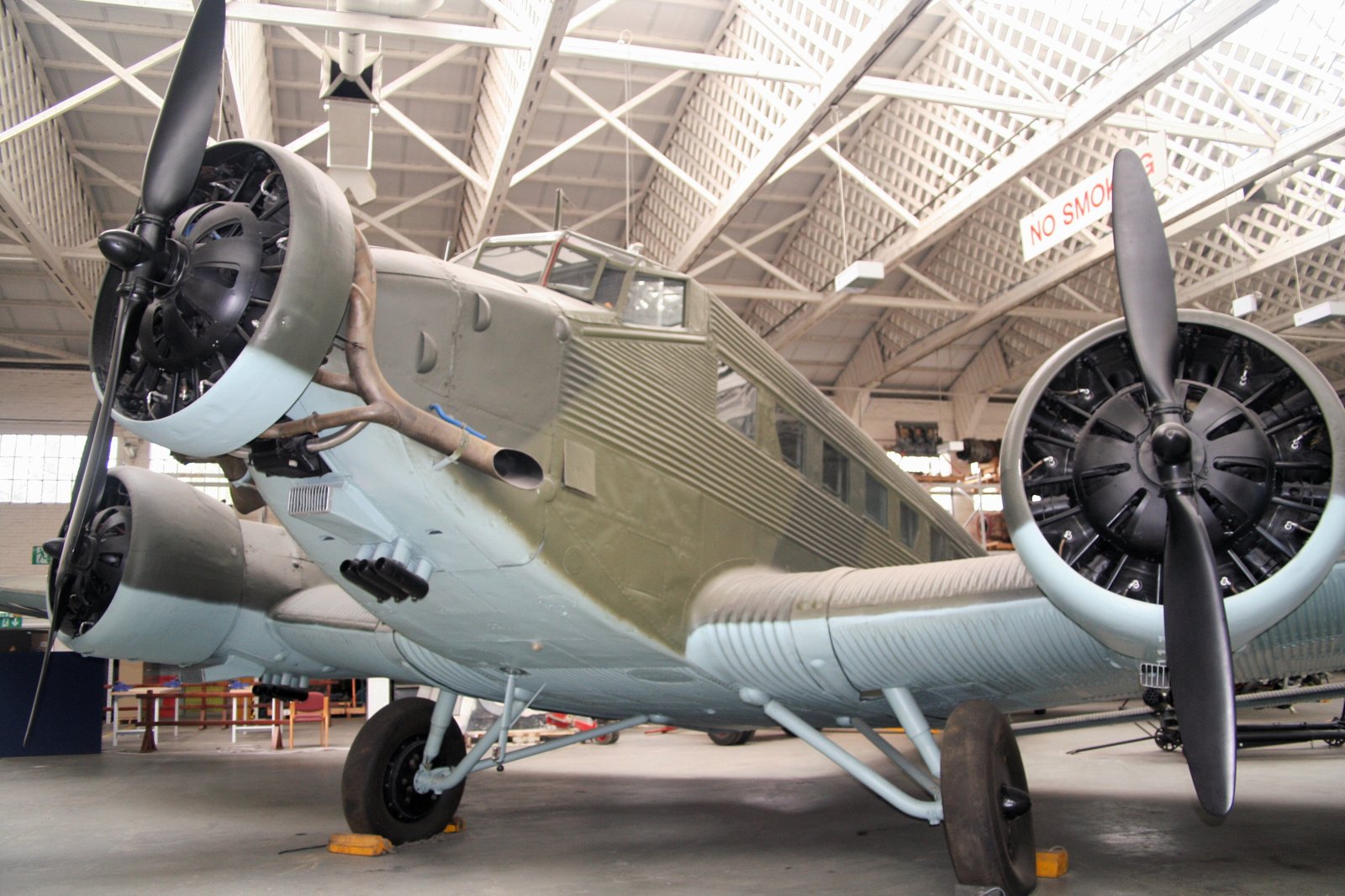
The Amiot AAC.1 Toucan was developed as a fast-tracked solution to re-equip the French military and civil aviation sectors following the conclusion of World War II. Rather than designing a new aircraft, France utilized a license-built version of the proven Junkers Ju 52/3m. Production took place at the former Amiot works in Colombes, a suburb of Paris. While the original company, Avions Amiot, had been founded in 1916 by Félix Amiot and had acted as a subcontractor for Junkers during the German occupation, the postwar facility was reorganized as the Ateliers Aéronautiques de Colombes (AAC) to produce the Toucan.
Production of the AAC.1 began in August 1945 and continued until 1948. While some sources estimate approximately 400 aircraft were manufactured between late 1944 and 1948, the most specific production figure is 415 units, though some records suggest a total of 443 when accounting for all French-built airframes. The aircraft featured a trimotor configuration powered by three 9-cylinder air-cooled radial piston engines, each producing 720 hp.
In military service, the Toucan was operated by both the French Air Force (Armée de l’Air) and the French Naval Air Arm (Aéronautique Navale). The Armée de l’Air utilized at least 216 aircraft, deploying them in various roles including transport, medevac, and paratroop operations. The French Navy operated approximately 51 aircraft, eventually retiring the type in 1962. The Toucan saw significant action in colonial conflicts; in 1947, roughly 20 aircraft were deployed to Madagascar, where some were modified as makeshift bombers capable of carrying a one-ton payload. The type also served in the First Indochina War with units such as GM III/64 “Tonkin,” GT II/52 “Franche-Comté,” and GT I/64 “Béarn,” as well as during the Algerian War with Saharan reconnaissance groups GSRA 76 and 78. In mainland France, transport units GT III/15 “Maine” and GT IV/15 “Poitou” also utilized the type.
Civilian operations were led by Air France, which began using the AAC.1 in 1946 for routes connecting Paris to London and Brussels, as well as flights between Toulon and Algiers and various African destinations. Air France phased out the aircraft in the early 1950s, flying its final scheduled route in 1953. Other civil operators included Air Ocean, Aero Cargo, Société Auxiliaire de Navigation Aérienne, and CTA Languedoc Roussillon. Today, the legacy of the Toucan is preserved at the Polish Aviation Museum in Kraków, which houses a 1946-built example that served with the French Air Force until 1960.