
Service History
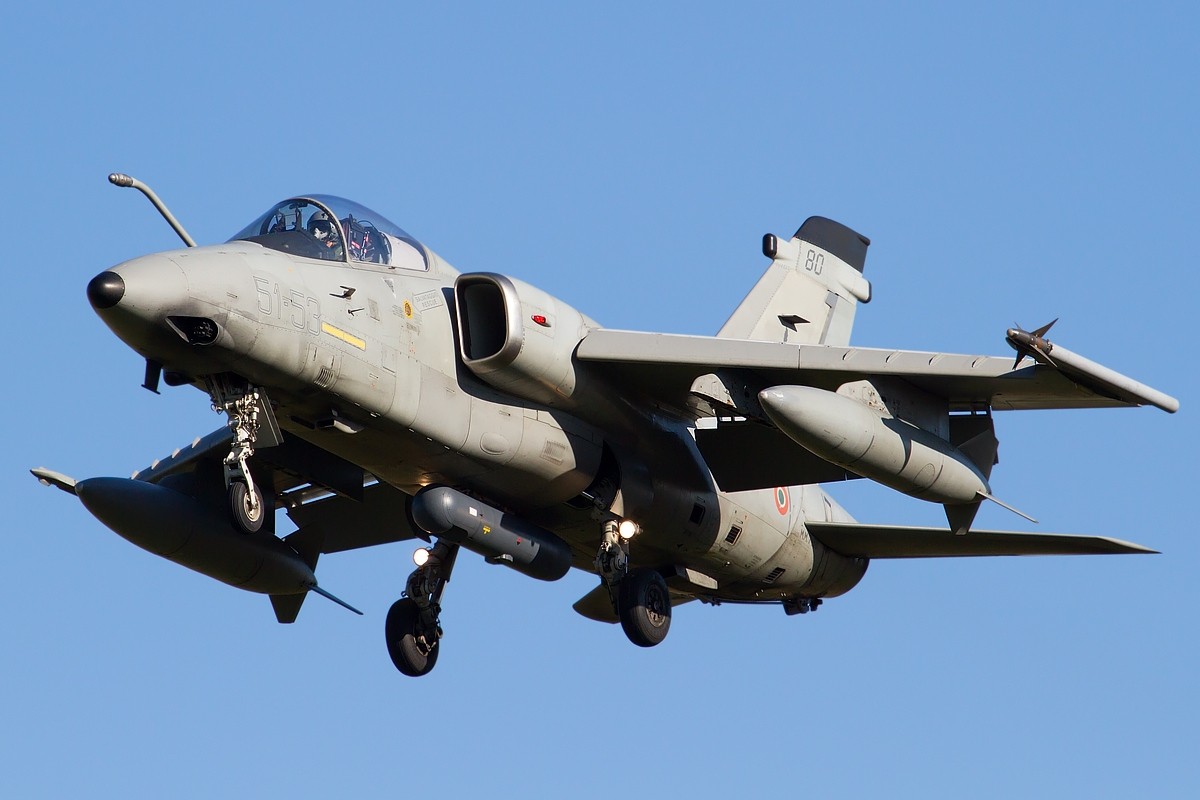
The AMX achieved operational status with remarkable efficiency, entering Italian Air Force service in November 1989 when the 103° Gruppo of 51° Stormo formed as the first operational squadron. The Brazilian Air Force followed shortly after, with both nations ultimately operating 230 aircraft total—136 delivered to Italy and 94 to Brazil. The aircraft proved its combat effectiveness during Operation Deny Flight in 1995, when Italian AMX aircraft flew strike missions over Bosnia, marking the type's first combat deployment.
Subsequent operational deployments validated the AMX's design philosophy. Italian squadrons deployed AMX aircraft to Afghanistan and Libya between 2009 and 2011, demonstrating the aircraft's capability in modern expeditionary operations. The type also entered Venezuelan service, expanding its operational footprint beyond the original partner nations.
International Manufacturing Innovation
AMX International represented a revolutionary approach to military aircraft development, establishing the template for modern international aerospace collaboration. Formed in Rome in 1981, the consortium divided manufacturing responsibilities with mathematical precision: Aeritalia controlled 46.5 percent, producing the central fuselage, stabilizers, and rudders from Turin; Aermacchi held 22.8 percent, manufacturing the forward fuselage and tail cone from Varese; while Embraer contributed 29.7 percent, building wings, air intakes, pylons, and drop tanks from São José dos Campos.
This distributed manufacturing approach eliminated redundancy while maximizing each partner's expertise. The strategy proved so successful that no component duplication occurred across the three production sites, creating unprecedented efficiency in military aircraft manufacturing during the 1980s.
Development Origins
The AMX program originated from Italy's urgent requirement in early 1977 for 187 new strike fighters to replace the obsolescent Aeritalia G.91 and Lockheed RF-104G Starfighter fleet. Rather than competing against each other, Aeritalia and Aermacchi proposed collaboration, building upon Aermacchi's MB-340 design studies from the early 1970s and Aeritalia's Model 3-20 project.
Formal development commenced in April 1978, with Brazil joining the partnership in July 1980 after expressing interest three months earlier. The detailed definition phase concluded in March 1980, establishing the foundation for what would become one of the most successful international military aircraft programs of the late Cold War era.
Engine and Technical Innovation
The Rolls-Royce Spey 807 turbofan was selected in October 1978 after extensive evaluation of competing powerplants, including the Turbo-Union RB199, Rolls-Royce Turbomeca Adour, and Rolls-Royce Viper. American engines were deliberately excluded to prevent potential export restrictions on the completed aircraft.
Survivability dominated the AMX's design philosophy, with engineers mandating that the aircraft sustain any single system failure without performance degradation. Critical systems featured full redundancy, while vital components received enhanced protection. This emphasis on survivability reflected lessons learned from contemporary conflicts and established new standards for ground-attack aircraft design.
Flight Testing and Production
The prototype program utilized seven flight-capable aircraft plus two static test airframes, distributed among the three manufacturing partners. The first Italian-assembled prototype flew on May 15, 1984, though this aircraft was lost during its fifth flight, killing the test pilot. The first Brazilian-assembled prototype successfully flew on October 16, 1985, while the two-seat AMX-T variant made its maiden flight on March 14, 1990.
Production aircraft deliveries began in 1988, with the first operational example (MM.7091) officially delivered to the Italian Air Force on April 19, 1989. Manufacturing continued until 1999, with Italian deliveries concluding in 1998 and Brazilian deliveries finishing the following year.
Operational Challenges and Solutions
The AMX fleet experienced a significant setback in February 1992 when both Italian and Brazilian aircraft were grounded following an engine-related crash. The crisis demonstrated the program's international coordination effectiveness—engineers from both nations collaborated to develop engine modifications, returning the fleet to service by May 1992. This incident reinforced the aircraft's reputation for systematic problem-solving and international cooperation.
Legacy and Current Operations
The AMX established new paradigms for international military aircraft development, proving that geographically separated manufacturing could produce world-class combat aircraft. Known as the A-11 Ghibli in Italian service and A-1 in Brazilian operations, the aircraft continues serving with multiple air forces decades after its introduction.
The program's success validated the concept of distributed international manufacturing, influencing subsequent collaborative aircraft programs worldwide. Today, surviving AMX aircraft represent both the technological achievement of 1980s aerospace engineering and the diplomatic success of Italian-Brazilian cooperation during a critical period in both nations' military modernization efforts.