
Military Dominance
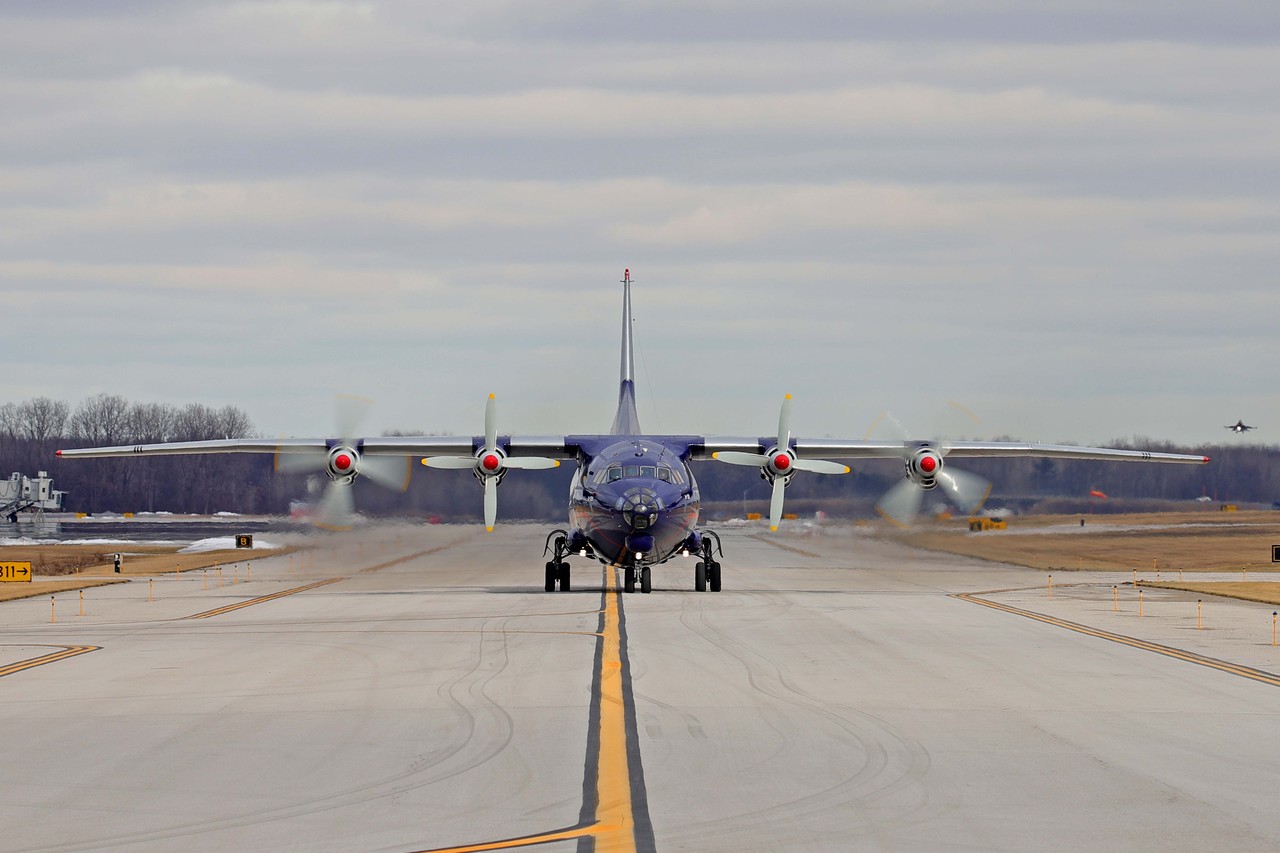
The An-12 became the standard tactical transport for Soviet and Warsaw Pact air forces, with at least 800 aircraft initially delivered to the Soviet Air Force alone. During its peak service years, the aircraft provided the primary medium-lift capability for communist military forces worldwide, transporting everything from combat troops to heavy equipment across vast distances. The aircraft's ability to carry 58 fully-equipped paratroopers or 82 regular soldiers made it indispensable for airborne operations throughout the Cold War era.
Combat Operations
The An-12 saw its most extensive combat use during the Soviet-Afghan War from 1979 to 1989, where it performed cargo transportation, search and rescue missions, and paratroop deployment. Among Soviet soldiers, the aircraft gained a grim reputation for carrying "Cargo 200" – the military code for coffins containing fallen soldiers transported from Afghanistan to Tashkent. This somber duty became one of the aircraft's most remembered roles during the decade-long conflict.
The Antonov Legacy
The Antonov Design Bureau, a Soviet aircraft design organization, developed the An-12 as an evolution of the earlier An-8 and as the military variant of the civilian An-10 passenger transport. The bureau, now operating as the Antonov Aeronautical Scientific Technical Complex based in Ukraine, created a design that would influence transport aviation for generations. The An-12's robust construction and reliable performance established Antonov's reputation as a premier developer of large transport aircraft.
Production Excellence
From 1957 to 1973, three Soviet factories produced 1,248 An-12 aircraft. The State Aviation Factory in Irkutsk built the first 154 aircraft from 1957 to 1962, while the Voronezh factory manufactured 258 aircraft from 1961 to 1965. The Tashkent factory became the primary production center, building 830 aircraft from 1961 to 1972. This distributed manufacturing approach ensured steady production throughout the aircraft's 16-year production run.
Engineering and Performance
Powered by four Ivchenko AI-20 turboprop engines, the An-12 achieved a maximum speed of 660 km/h and a cruise speed of 570 km/h. The AI-20 engines, developed by the Soviet Ivchenko design bureau, proved exceptionally reliable and powered numerous other Soviet aircraft designs. The aircraft required a five-person crew consisting of two pilots, a flight engineer, navigator, and radio operator, reflecting the complex systems management required for extended military operations.
Specialized Variants
Approximately 20 specialized variants were developed, including the An-12BK-IS electronic warfare variant (145 aircraft total including conversions), the An-12PP electronic countermeasures aircraft (27 built), and the An-12BK-PPS pathfinder variant (19 aircraft). The An-12BP became the standard tactical transport version, featuring improved equipment and capabilities that made it the preferred choice for most military operators.
International Impact
A total of 183 An-12 aircraft were exported to foreign air forces, including those of France, Guinea, Ghana, and Iraq. The civil variant An-12B, introduced in 1965, extended the aircraft's reach into commercial aviation markets. By 2000, approximately 515 of the original 1,242 aircraft remained in service with Russian forces, foreign militaries, and nearly 70 airlines worldwide.
Chinese Connection and Continuing Legacy
In the 1960s, China purchased several An-12 aircraft and obtained assembly licenses before the Sino-Soviet split ended cooperation. Chinese engineers reverse-engineered the design, eventually producing the Y-8 variant beginning in 1981. This Chinese development became one of the country's most successful military and civilian transports, with modern variants like the Y8-F600 representing joint ventures between Shaanxi Aircraft Company, Antonov ASTC, and Pratt & Whitney Canada.
Though no longer serving in Russia or Ukraine, the An-12's influence continues through its Chinese derivatives and its role in establishing the foundation for Soviet transport aviation doctrine that persisted throughout the Cold War.