
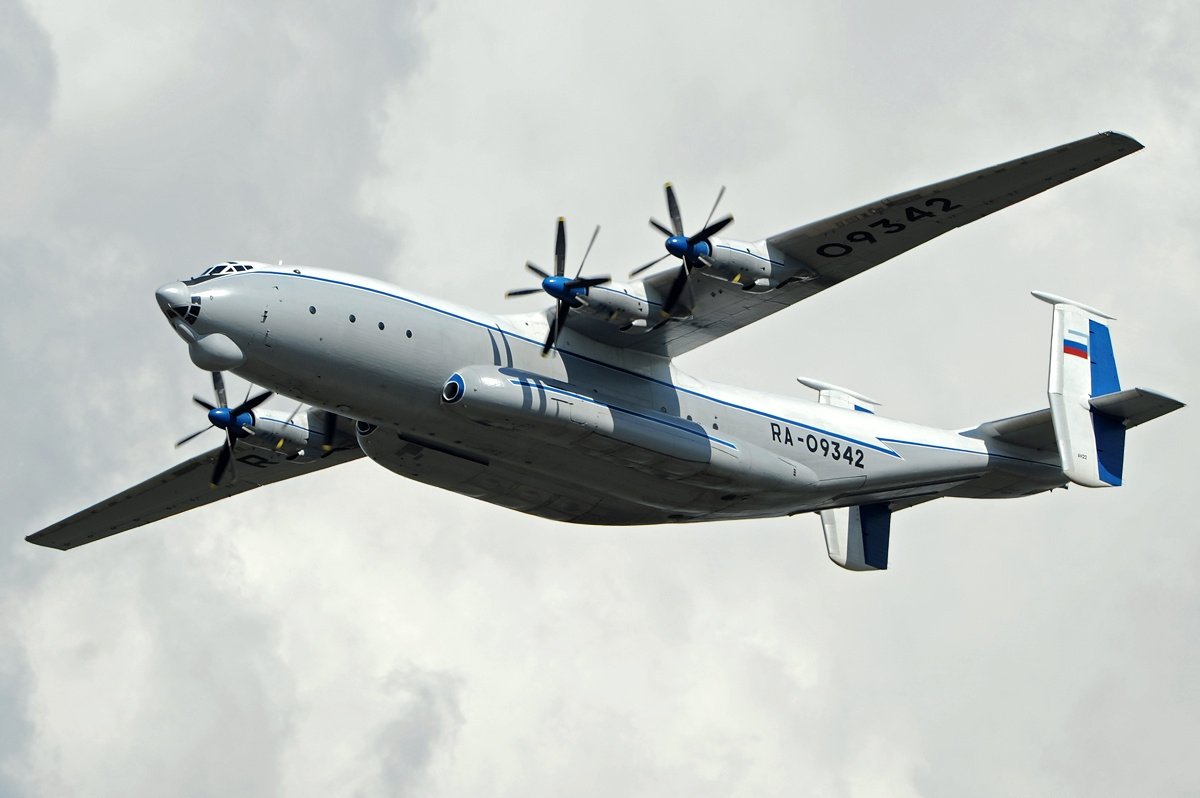
Service History
The An-22 dominated Soviet strategic airlift operations from 1969 through the late 1980s, providing unmatched heavy-cargo transport capabilities to remote regions including the Soviet Far East. By the late Soviet period, approximately 45 aircraft remained in active service with military transport units, including the Air Transport Wing at Ivanovo Airbase and the 76th Military Transport Air Squadron at Tver. The 566th 'Solnechnogorsk' Military Transport Aviation Regiment operated the type from 1970 to 1987, utilizing its unique ability to transport main battle tanks and missile launchers to previously inaccessible locations.
Military Operations
While serving as a strategic transport rather than in direct combat roles, the An-22 proved essential for Soviet military logistics throughout the Cold War era. The aircraft's massive cargo hold accommodated equipment that previously required sea transport or disassembly, including complete armored vehicles and large missile systems. Military operators designated two primary variants: the initial An-22 with 37 aircraft built featuring external engine starting systems, and the improved An-22A comprising 28 aircraft with self-starting capability.
The Manufacturer
The Antonov Design Bureau, established in 1946 by Oleg Antonov in Kyiv, Ukraine, specialized in large transport aircraft throughout the Soviet era. Operating initially as a Soviet design bureau, the company evolved into a Ukrainian state-owned enterprise following Ukraine's 1991 independence. Three prototypes were constructed at the Antonov facility in Kyiv, while production aircraft were manufactured at the Tashkent State Aircraft Factory in Uzbekistan from 1965 to 1976. Despite facing nationalization challenges during the 2022 Russian invasion, Antonov continues operations today as part of Ukraine's state aviation conglomerate.
Engine & Technical Innovation
Four Kuznetsov NK-12MA turboprops power the An-22, each producing 15,000 shaft horsepower and driving pairs of four-blade contra-rotating propellers. These engines, also utilized on Tu-95 and Tu-142 bombers, represent the most powerful turboprops ever placed in service, with thousands manufactured for various Soviet aircraft including over 500 Tu-95s alone. The aircraft's distinctive twin-fin tail configuration countered rear fuselage flexing under heavy loads, while the high-wing design facilitated ground loading operations.
Performance Achievements
The An-22 established 14 payload-to-height world records, including lifting 104,445 kilograms to 2,000 meters altitude. In 1967, the aircraft carried 100 metric tonnes to 7,848 meters, demonstrating unprecedented heavy-lift capability. Speed records included achieving 608.5 kilometers per hour over 1,000 kilometers while carrying 50,000 kilograms in 1972. With a maximum takeoff weight of 250,000 kilograms and operating weight of 114,000 kilograms, the aircraft could reach 10,000 meters altitude and cruise at 680 kilometers per hour.
Production & Commercial Service
Production totaled 68 aircraft between 1965 and 1976, with annual output peaking at 12 units in 1975. Despite primarily military applications, Aeroflot operated approximately 32-34 aircraft in civilian markings to facilitate international overflight and landing permissions. The airline utilized the type for oversized cargo transport, including Antonov An-124 components beginning in 1980. Civil operations required crews of five to six personnel and offered flexibility between 80,000-kilogram cargo loads or 28-29 passenger configurations.
Current Status and Legacy
As of 2020, only three An-22s remained airworthy worldwide: two with Russian forces and one civilian aircraft with Antonov Airlines that was subsequently damaged during the 2022 Russian invasion of Ukraine. Six aircraft remained in service at Tver in 2018, though retirement was announced despite original plans for operation until 2033. The type suffered six known accidents, including CCCP-09303 which crashed during takeoff at Tver on November 11, 1992, reportedly due to overloading. The An-22's legacy as the heaviest aircraft before the 1968 Lockheed C-5 Galaxy and largest turboprop ever built established the foundation for subsequent Soviet heavy-lift aircraft, including its successor, the An-124 Ruslan, which first flew on December 24, 1982.