
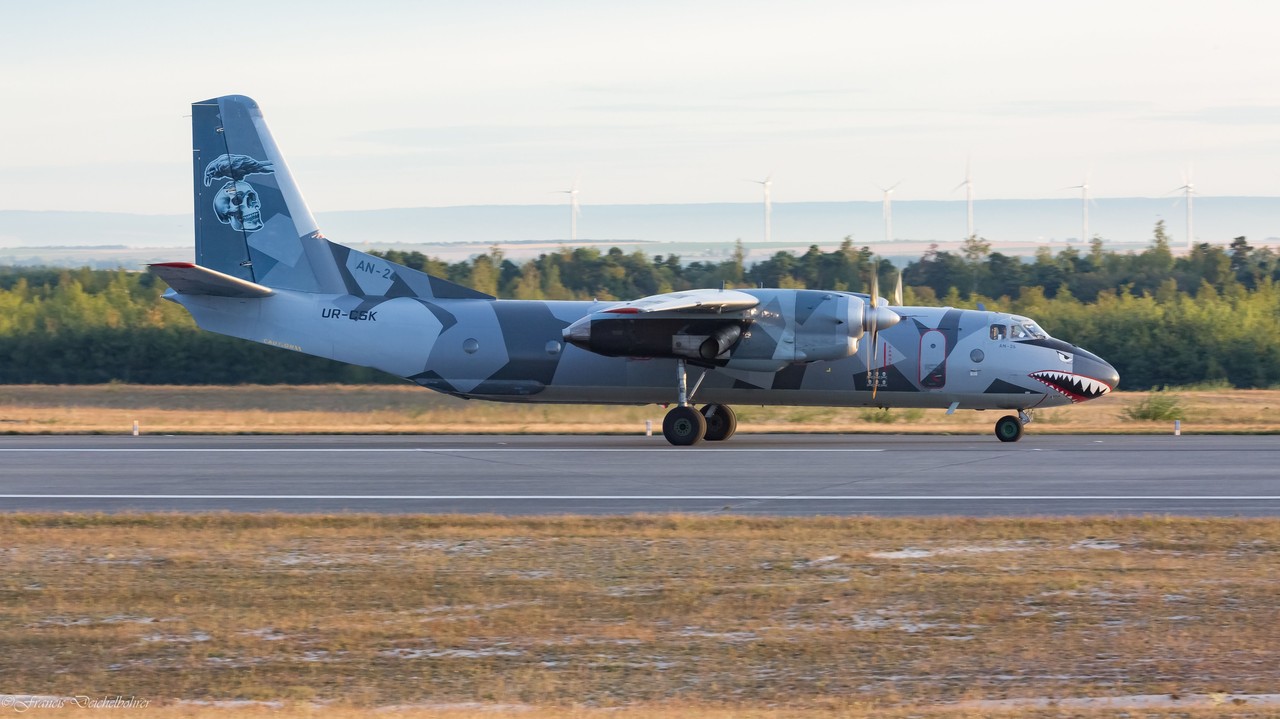
Service History
The An-26 dominated short-haul transport operations throughout the former Soviet Union and Warsaw Pact nations, with Aeroflot operating the largest civilian fleet. By the 1980s, these aircraft provided essential connectivity to remote locations across Siberia, Central Asia, and Eastern Europe where larger jets could not operate. The type's ability to use unprepared strips made it invaluable for oil and gas industry support, humanitarian missions, and regional passenger service to communities with basic airfield infrastructure.
Military Operations
Soviet Air Forces employed the An-26 extensively during the Soviet-Afghan War from 1979 to 1989, where it served as the primary tactical transport for troops, supplies, and wounded personnel. The aircraft suffered notable combat losses, including the November 19, 1988 shootdown by Pakistan Air Force fighters near Parachinar that killed all 30 aboard. A specialized military variant, the An-26Sh navigator trainer, saw production of 36 aircraft specifically for aircrew training roles.
The type continued serving in regional conflicts well into the 21st century. Ukrainian Air Force, Russian Aerospace Forces, and various African operators maintained active fleets, though the 2022 conflict in Ukraine significantly reduced available aircraft numbers.
The Manufacturer
Antonov Design Bureau, founded by legendary designer Oleg Antonov in 1946, established itself as the Soviet Union's premier transport aircraft manufacturer. Originally based in Novosibirsk, the company relocated to Kyiv in 1952, where it developed the successful An-24 family that included the An-26. Following the Soviet dissolution, political upheaval split the company in 2014-2015 between Ukrainian state enterprise and Russian private corporation, with the Ukrainian Antonov State Enterprise continuing operations today.
The design team under Oleg Antonov's leadership prioritized rugged reliability and operational flexibility over pure performance, creating aircraft capable of sustained operations in harsh environments with minimal ground support infrastructure.
Engine and Technical Innovation
Two Progress AI-24VT turboprop engines, each producing 2,103 kilowatts, powered the An-26 through four-bladed constant-speed propellers measuring 3.90 meters in diameter. A unique feature was the auxiliary Tumansky Ru-19A-300 turbojet providing 7.85 kilonewtons of thrust for enhanced takeoff performance and serving as an auxiliary power unit.
The aircraft's defining characteristic was its rear cargo ramp measuring 1.65 by 2.2 meters, allowing rapid loading and unloading without ground equipment. An integral crane system further enhanced cargo handling capabilities, while the pressurized cabin enabled operations at altitudes up to 7,500 meters to clear weather systems.
Performance Characteristics
Pilots appreciated the An-26's forgiving handling qualities and reliable systems, though the type demanded respect during single-engine operations due to significant asymmetric thrust. Normal cruise speed ranged from 440 to 540 kilometers per hour, with maximum range of 2,500 kilometers when carrying fuel instead of cargo, or 1,100 kilometers with maximum 6,000-kilogram payload.
The aircraft's short-field performance proved exceptional, with the ability to operate from strips as short as 800 meters on firm surfaces. This capability, combined with robust landing gear designed for unpaved runways, made it ideal for operations in developing regions.
Production and Global Reach
Beyond the 1,403 aircraft built by Antonov through 1986, China's Xi'an Aircraft factory produced unlicensed copies as the Y-14, later incorporated into the Y-7 series. This Chinese production extended the design's influence into Asian markets where Soviet aircraft were politically unacceptable.
Major operators included Cuba's Cubana de Aviación, Afghanistan's Ariana Afghan Airlines, and numerous African carriers who valued the type's ability to connect remote airstrips with major cities. The aircraft proved particularly valuable for time-sensitive cargo like aircraft parts, medical supplies, and emergency equipment.
Legacy and Current Status
More than 100 An-26s remained in limited service as of 2024, though exact numbers fluctuate due to maintenance issues and parts availability. The design's influence extended beyond its own production through the Chinese Y-7 and MA60 derivatives, which incorporated modern avionics and engines while retaining the basic airframe concept.
Recent incidents, including the February 25, 2025 crash near Omdurman that killed 46, highlight both the continued operational use and aging infrastructure challenges facing remaining aircraft. Known to NATO as "Curl," the An-26 earned recognition as a reliable workhorse that bridged the gap between small aircraft and larger transports, establishing a niche that few modern aircraft have successfully filled.