
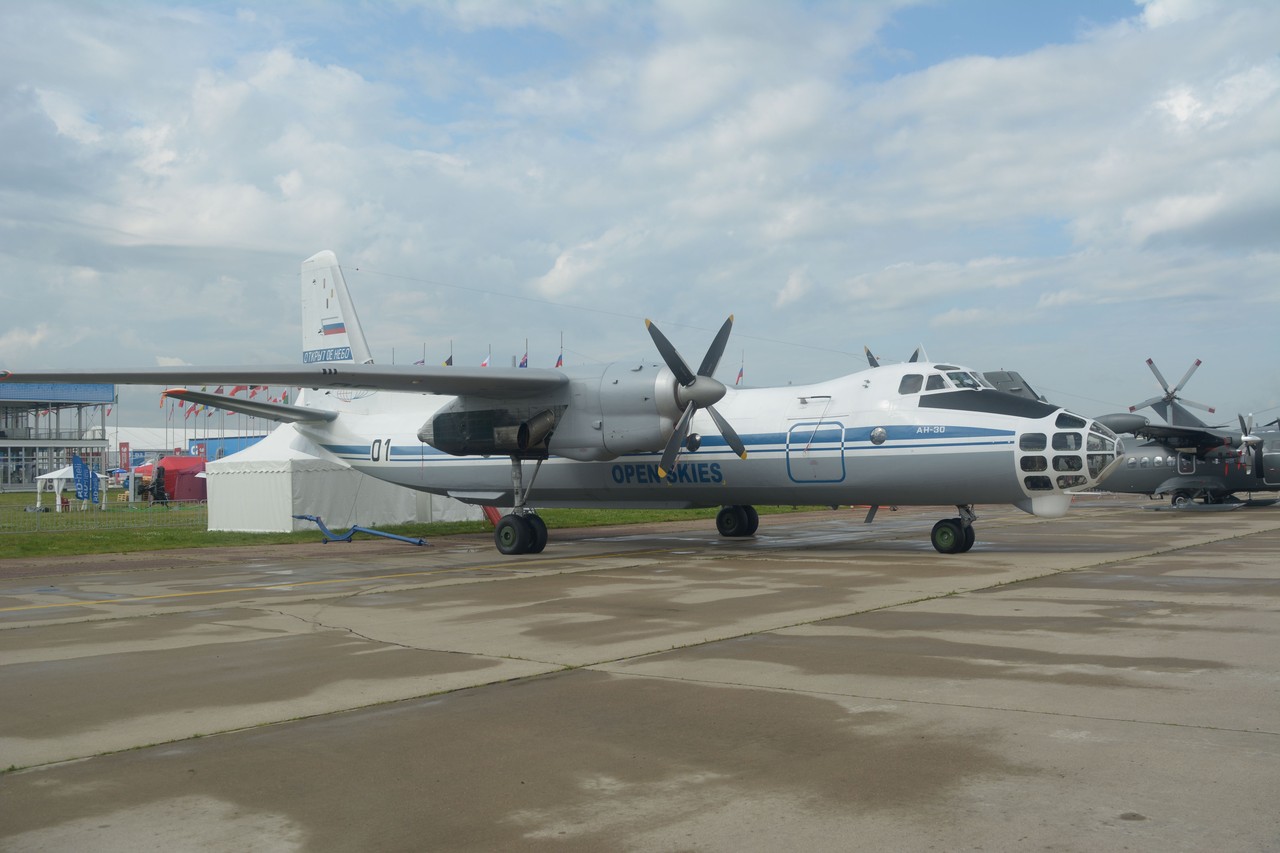
Service History
The An-30 dominated Soviet aerial survey operations throughout the 1970s and 1980s, with Aeroflot operating 65 of the 89 aircraft produced. An additional six served other Soviet civil organizations, while 18 were exported to allied nations including China (7 aircraft), Afghanistan, Bulgaria, Czechoslovakia, Mongolia, Romania, and Vietnam. The aircraft's specialized configuration made it indispensable for geographic and resource mapping across the vast Soviet territory, providing capabilities that no other aircraft in the Soviet inventory could match.
Military and Operational History
Beyond its civil survey role, the An-30 saw extensive military service with the Soviet Air Force, particularly during the Soviet-Afghan War. On 11 March 1985, an An-30B (registration 05 red) crashed 25 kilometers north of Kabul Airport, killing two crew members during reconnaissance operations. Earlier, another An-30B was lost on 19 October 1979 on Iturup Island in the disputed Kurils.
Following the Soviet Union's collapse, both Russian and Ukrainian air forces continued operating the type. The aircraft became tragically involved in the 2014 conflict in eastern Ukraine when a Ukrainian Air Force An-30B was damaged at Slavyansk on 22 April 2014. Two months later, on 6 June 2014, another Ukrainian An-30B crashed near Drobyshevo, killing all five aboard during what appeared to be a reconnaissance mission over the conflict zone.
The Manufacturer
Antonov, based in Kyiv, Ukraine, established itself as the Soviet Union's premier designer of transport and specialized aircraft. Founded by Oleg Antonov, the design bureau became synonymous with rugged, reliable aircraft capable of operating from primitive airfields. The company produced numerous successful designs including the An-2 biplane, An-12 transport, and later the massive An-124 and An-225 cargo aircraft. Today operating as Antonov State Enterprise, the company's operations have been severely disrupted by the ongoing conflict in Ukraine, with its Hostomel facility suffering significant damage.
Engine and Technical Innovation
The An-30's powerplants were two Ivchenko AI-20 turboprops, the same reliable engines used in the An-26 transport. These 4,000-horsepower engines drove AV-72T four-blade constant-speed propellers with full feathering and reversible-pitch capabilities, allowing for shorter landing rolls on unprepared strips. The aircraft incorporated a water injection system for the turboprops, enhancing performance in hot climates and high altitudes where survey work often occurred.
The design team at Antonov adapted the proven An-26 airframe structure while incorporating specialized modifications for survey operations. The enhanced fuel system could carry 6,200 liters, significantly more than the standard transport variant, extending range for long-duration mapping missions over remote territories.
Pilot Perspective
Pilots appreciated the An-30's inherent stability during photographic runs, a critical characteristic for survey accuracy. The aircraft's high-wing configuration provided excellent downward visibility for survey operators while maintaining the rugged landing gear necessary for operations from unpaved airstrips. The reversible propellers proved invaluable when operating from short fields in mountainous terrain, particularly during survey missions in Central Asia and Siberia.
Production and Legacy
Production at the Kyiv Aviation Plant spanned just six years, from 1973 to 1979, reflecting the aircraft's specialized nature and limited market. The first production aircraft rolled out in 1971, with the type making its Western debut at the 1975 Paris Air Show. This relatively short production run of 89 aircraft contrasted sharply with the thousands of An-26 transports produced, highlighting the An-30's niche role.
The aircraft's operational longevity exceeded expectations, with examples remaining active into the 21st century. As recently as 21 April 2023, a Sudanese Air Force An-30 was damaged at Khartoum International Airport, demonstrating the type's continued utility in developing nations requiring cost-effective survey capabilities.
China emerged as the most significant export operator with seven aircraft, using them extensively for geographic surveys across its vast territory. These aircraft provided crucial mapping data during China's rapid infrastructure development in the 1980s and 1990s.
Today, surviving An-30s represent an important chapter in specialized aircraft development, demonstrating how proven transport designs could be successfully adapted for highly specific missions. The aircraft's service record spans five decades and multiple conflicts, from Cold War reconnaissance missions to modern survey operations, cementing its place as one of the most enduring Soviet aircraft designs.