
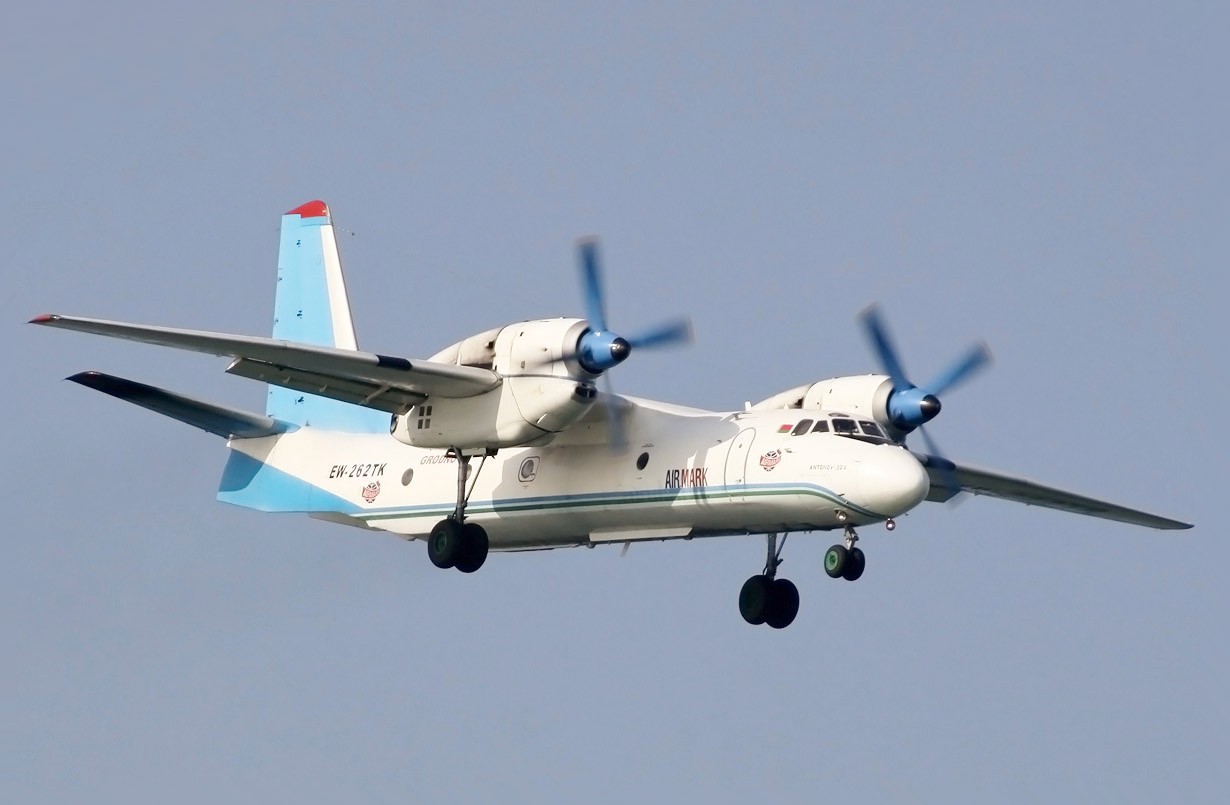
Development Origins
The An-32's creation stemmed from a specific Indian Air Force requirement for a transport aircraft capable of reliable operations in the demanding conditions of high-altitude Himalayan airstrips and India's scorching summer temperatures. The Antonov Design Bureau recognized that their successful An-26 transport needed substantial modifications to meet these extreme operational parameters, leading to what became essentially a new aircraft design.
The prototype's maiden flight on July 9, 1976, marked the culmination of intensive engineering efforts. Test pilot Volodymyr Tkachenko commanded the six-man crew that included co-pilot Yurii Kurlin, navigator Grigorii Gumeniuk, flight engineer Mykhaylo Troshin, radio operator Vitalii Yaskov, and leading flight test engineer Anatolii Zagumennyi. This first flight validated the aircraft's revolutionary design approach of mounting engines above the wing rather than beneath it.
Engineering Innovation
The An-32's most distinctive feature—its over-wing engine placement—provided crucial ground clearance benefits for operations on unprepared airstrips while improving short-field performance through enhanced airflow over the wing's high-lift devices. The aircraft incorporated automatic leading-edge slats and sophisticated high-lift systems that enabled steep approach angles and abbreviated landing rolls essential for tactical operations.
Power came from two AI-20DM turboprops manufactured by Ukraine's Progress Design Bureau, providing significantly more thrust than the An-26's engines. This powerplant selection proved ideal for maintaining performance in the thin air of high-altitude airfields and the reduced air density of hot climates where conventional aircraft suffered dramatic performance penalties.
Military Service Record
The Indian Air Force became the An-32's launch customer, receiving their first production aircraft in July 1984 following completion of state acceptance trials in 1983. This marked the beginning of widespread military adoption across multiple air forces facing similar operational challenges.
The Soviet Air Force acquired 25 An-32s in 1987, while Afghanistan received 75 aircraft starting in 1986 during the Soviet-Afghan conflict. These deliveries demonstrated the aircraft's value in the mountainous terrain and extreme conditions of Central Asian operations. Subsequent operators expanded to include the Ukrainian Air Force, Russian Air Force (which became the largest operator), Bangladesh Air Force, Iraqi Air Force, Mexican Air Force, and Sudanese Air Force.
In 1985, the An-32 established 14 world altitude records while carrying various cargo loads, definitively proving its high-altitude capabilities and bringing international recognition to its specialized performance envelope.
The Antonov Legacy
Antonov's origins trace to 1946 when Oleg Antonov established the design bureau that would become synonymous with innovative transport aircraft. Operating initially within the Soviet aviation industry, Antonov developed expertise in creating aircraft for challenging operational requirements that Western manufacturers often overlooked.
Following Ukraine's 1991 independence, Antonov transitioned to become a Ukrainian state enterprise, eventually reorganizing as the Antonov Company. The design bureau maintained its focus on aircraft development, testing, certification, and support services, though actual manufacturing occurred at associated production facilities like the Kyiv Aviation Plant.
Production and Variants
Serial production at the Kyiv Aviation Plant spanned from 1982 to 1996, producing 358 aircraft during this primary manufacturing period. Limited production continued beyond 1996, with the final aircraft completing assembly in 2012, bringing total production to 373 units according to most sources, though alternative figures cite 361 completed aircraft.
The An-32P firefighting variant emerged as a significant specialized version, with its prototype (UR-48004) conducting its maiden flight on February 16, 1993, under the command of captain Anatolii Slobodeniuk and co-pilot Volodymyr Terskiy. The aircraft performed its first water drop demonstration on March 15, 1993, and earned Type Certificate approval in 1995 for restricted category operations.
The An-32B military variant received official designation on May 11, 1987, incorporating specific modifications for enhanced military transport capabilities.
Current Status and Future
Production was suspended in July 2019, with no new aircraft built since 2012. However, substantial numbers remain active with military operators worldwide, particularly the air forces of Ukraine, Russia, and India, which continue operating significant fleets.
Antonov has developed the An-132D demonstrator as a potential successor, incorporating modern systems while maintaining the specialized hot-and-high performance characteristics that made the An-32 valuable. A December 16, 2021 contract for An-32P firefighting conversions was interrupted by Russia's invasion of Ukraine on February 24, 2022, highlighting how geopolitical events continue affecting the program.
The An-32's legacy lies in proving that specialized aircraft designed for extreme operational conditions could achieve commercial success and military significance, influencing subsequent transport aircraft development and establishing performance benchmarks for high-altitude, hot-climate operations that remain relevant today.