
Development Origins
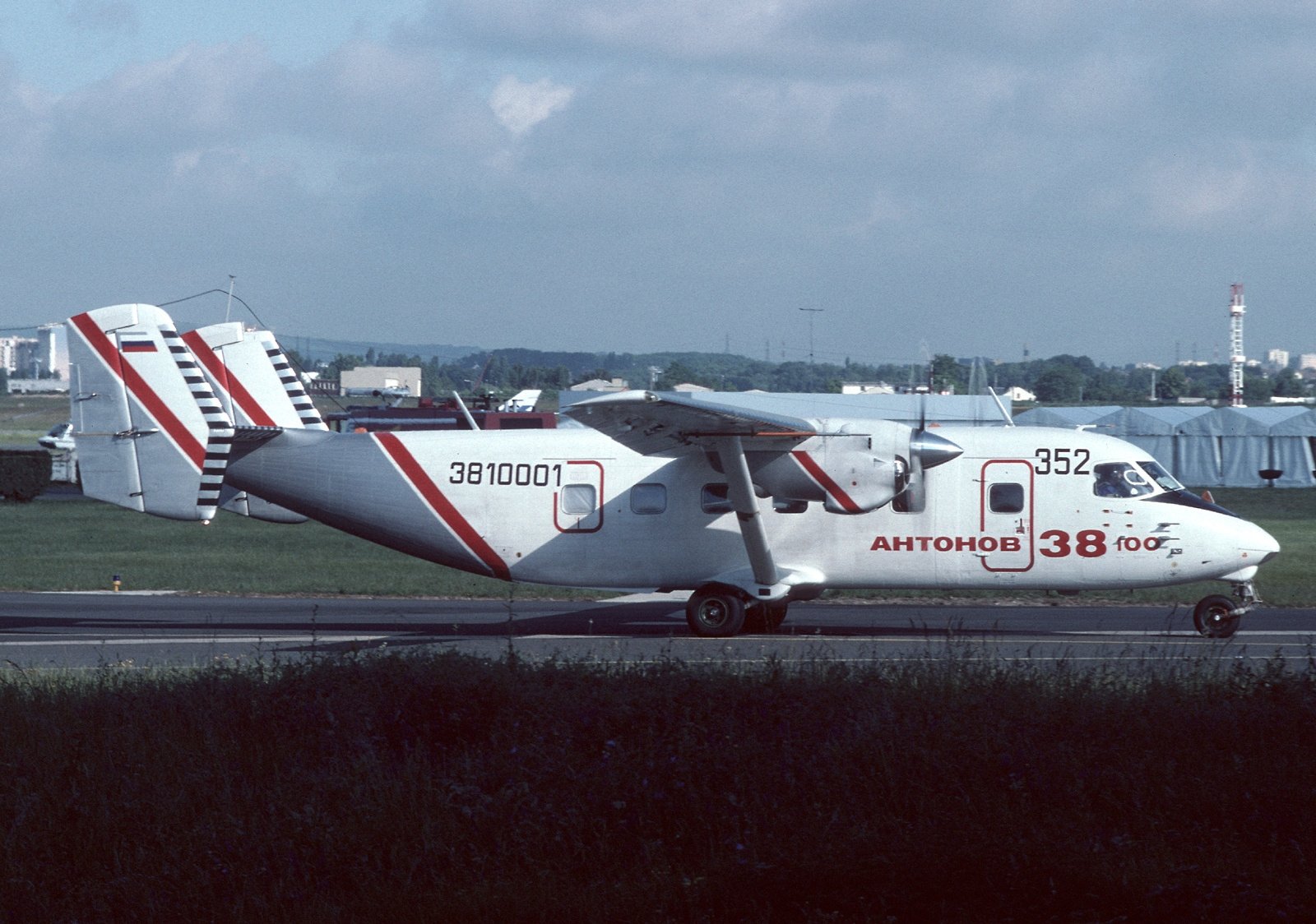
The An-38's genesis traced back to a 1989 sales tour of India, where demand emerged for a 25-30 seat development of the successful An-28. The Soviet Ministry of Aviation approved development of this entirely new aircraft in late 1990, with the Antonov Aviation Scientific Technical Complex in Kiev, Ukraine, leading the design effort. The project represented Antonov's strategy to capture the regional transport market with an aircraft capable of replacing aging An-24s, Let L-410s, and Yak-40s throughout the former Soviet Union.
Prototype 01001, equipped with Honeywell TPE331 engines, achieved first flight on June 23, 1994, marking the beginning of an extensive certification process that would span six years. International flight certification finally arrived in April 2000, opening the door for commercial operations.
The Manufacturer's Legacy
Oleg Antonov established his design bureau in Novosibirsk in 1946, relocating to Kiev in 1952 where the organization adopted its distinctive focus on military transport, cargo, passenger, and multi-purpose aircraft. The An-38 program required unprecedented international cooperation, with the Ukrainian Antonov Design Bureau providing engineering expertise while the Novosibirsk Aircraft Production Association (NAPO) in Russia handled manufacturing, and Belarus supplied crucial components.
In December 1995, Antonov and NAPO formalized their partnership by creating Siberian Antonov Aircraft, a joint venture dedicated to producing, marketing, and supporting the An-38. This arrangement reflected the complex post-Soviet industrial landscape, where aircraft programs required coordination across multiple newly independent nations.
Engineering Innovation
The An-38 represented a significant advancement over its An-28 predecessor, retaining the proven wings and tail configuration while incorporating a substantially lengthened fuselage. Engineers focused on operational versatility, designing the aircraft to function in extreme temperatures ranging from -45°C to +45°C while operating from unpaved runways.
Automatic leading-edge slats provided enhanced short-field performance, while improved sound insulation reduced cabin noise levels significantly compared to earlier Soviet designs. The rear cargo ramp enabled rapid loading of containers, pallets, and freight, transforming the aircraft from passenger to cargo configuration efficiently.
Two engine variants emerged during development. The An-38-100 featured twin Honeywell TPE331-14GR-801E turboprops, each producing 1,118 kW (1,499 hp), while the An-38-200 utilized Russian-built Omsk MKB 'Mars' TVD-20-03 engines generating 1,029 kW (1,380 shp). Both configurations employed 5-bladed Hartzell HC-B5MA constant-speed propellers measuring 2.85 meters in diameter, selected in July 1994 after competitive evaluation.
Limited Commercial Success
Despite technical capabilities, the An-38 struggled commercially in the chaotic post-Soviet aviation market. Production at NAPO commenced with six aircraft: one prototype, four trials aircraft, and one static test airframe. Vostok Airlines became the launch customer, ordering eight An-38-100s with the first three delivered by mid-1995 for intensive operational trials.
Alrosa-Avia, supporting diamond mining operations, ordered five aircraft with the first entering service in early 2000. Two Vostok aircraft found their way to Malaysia in 2001, where Layang Layang Aerospace employed them for tourist flights, cargo transport, and aerial photography. Chukotavia placed an initial order for ten aircraft, though only two were delivered in the initial batch.
Production suspended between 2000 and 2003 before resuming with an agreement for five additional aircraft in March 2003. By program's end in the early 2000s, only 11 An-38s had been completed, far short of the hundreds originally envisioned.
Performance Characteristics
The An-38 achieved respectable performance figures for its class, with a maximum speed of 405 km/h and fuel capacity of 2,210 kg enabling substantial range capabilities. The aircraft's 2,500 kg maximum payload provided flexibility for cargo operations, while the 27-passenger seating arrangement suited regional route requirements.
Maintenance requirements proved competitive at four man-hours per flying hour, with a projected service life of 30,000 hours. The conventional manual control system featured hydraulically actuated double-slotted flaps, electrically actuated trim tabs with manual backup, and twin rudders providing positive control authority.
Operational Legacy
By August 2019, only two An-38s remained in airline service from the original production run of 11 aircraft. Recent documentation indicates that as of 2021, merely one aircraft continues operational with ALROSA Airlines, marking the effective end of the type's commercial career.
The An-38's limited success reflected broader challenges facing post-Soviet aviation, where political upheaval, economic instability, and fragmented markets prevented promising designs from achieving commercial viability. While technically competent and operationally capable, the aircraft arrived at a time when the regional aviation market it was designed to serve had largely collapsed along with the Soviet Union itself.