
Revolutionary Design Philosophy
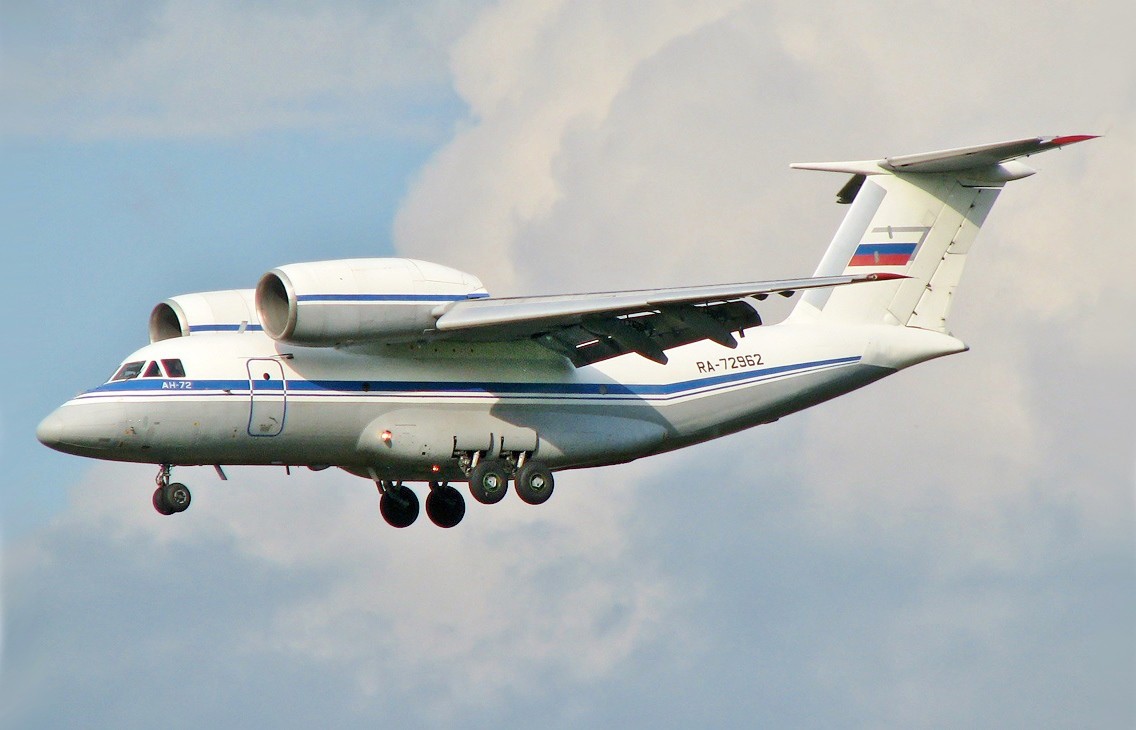
The An-72's most distinctive innovation lay in its application of the Coanda effect through over-wing engine placement. The two Lotarev D-36 Series 3A turbofans, each producing 73.6 kN of thrust, were positioned above the wing's upper surface to direct exhaust flow over the wing and flaps during takeoff and landing. This upper surface blowing technique significantly enhanced lift generation, enabling the aircraft to operate from unprepared airstrips that would challenge conventional transport aircraft.
Test pilot V.I. Terskikh, who commanded the prototype's maiden flight from Kyiv with flight engineer A.L. Kroots, described the An-72 as "a pleasure to fly," praising its modern instrumentation and remarkably low noise levels for an aircraft of its era.
Manufacturing and Production Challenges
Production proved more complex than anticipated, beginning three years behind schedule in 1984. The Kharkiv Aircraft Manufacturing Company manufactured approximately 114 aircraft through 1992, though total production estimates range as high as 250 when including variants and aircraft assembled at other facilities. An unsuccessful attempt to establish a duplicate production line in Omsk resulted in only six additional aircraft assembled from Kharkiv-supplied components.
The extensive use of composite materials, while advancing Soviet aerospace technology, created significant manufacturing difficulties. These composite assemblies represented relatively unfamiliar territory for Soviet manufacturers in the 1980s, contributing to production delays and quality control challenges.
Military Service and Variants
The Soviet Air Force began operating production An-72s in May 1987, utilizing the aircraft's exceptional short-field performance for tactical transport missions. The aircraft's ability to operate from 600-meter airstrips made it invaluable for supporting remote military installations and forward operating bases across the vast Soviet territory.
A specialized patrol variant, designated An-72P, was developed for Russian Border Guards, featuring modifications for surveillance and patrol missions along Soviet frontiers. This variant demonstrated the aircraft's versatility beyond pure transport roles.
Civil Aviation Applications
Aeroflot recognized the An-72's potential for serving the Soviet Union's numerous short and remote airfields, particularly in northern regions and the Far East. This interest led to development of the An-74 civil variant, which first flew in 1986 and entered service in 1988. The civil version featured significantly more passenger windows and interior modifications to accommodate both passenger and freight operations.
The aircraft's cruise speed of 540 km/h and operational range of 4,320 km made it competitive with conventional airliners while offering superior short-field capabilities. These performance characteristics proved particularly valuable in regions where runway length and surface conditions limited conventional aircraft operations.
The Antonov Organization
The Antonov design bureau, originally a Soviet institution, initiated An-72 development during the 1970s as part of requirements for a twin-engine military transport with exceptional short-field performance. Following Soviet dissolution, Antonov continued as a Ukrainian company headquartered in Kyiv, retaining a small fleet of prototype and development aircraft at their facilities.
Antonov's design philosophy emphasized practical solutions to operational challenges, with the An-72 representing a successful application of advanced aerodynamic principles to meet specific military and civil transport requirements.
Technical Advancement and Legacy
Later production aircraft incorporated improved D-36 engines offering 20% better fuel efficiency compared to original powerplants, along with cowling-type thrust reversers for enhanced landing performance. The aircraft's 28.07-meter length and 8.65-meter height provided substantial cargo volume while maintaining the structural integrity necessary for rough-field operations.
Production ceased following deteriorating Ukraine-Russia relations, ending prospects for continued manufacturing or major upgrades. However, the majority of produced aircraft remain in service, with Russia operating the largest fleet through both military and civil operators.
Current Operations
Russia maintains dozens of An-72/74 aircraft across military and civilian fleets, while Ukraine operates several dozen machines including development aircraft retained by Antonov. Smaller numbers serve with operators in former Soviet states and Bulgaria, testament to the aircraft's continued utility decades after introduction.
The An-72's legacy extends beyond its operational service, representing successful Soviet-era innovation in applying advanced aerodynamic principles to practical transport aviation. Its demonstration of the Coanda effect's viability in production aircraft influenced subsequent transport aircraft design, particularly in applications requiring exceptional short-field performance.