
Design Philosophy and Development
Carl A. Mortenson conceived the Angel in 1972 with a singular mission: creating an aircraft specifically engineered for humanitarian work in the world's most challenging environments. Having previously designed the Evangel for similar missionary operations, Mortenson established The King's Engineering Fellowship (TKEF), a non-profit organization dedicated to supporting aircraft development for humanitarian purposes. The design phase consumed more than 11,000 man-hours across over 1,000 engineering drawings, reflecting the meticulous attention to creating an aircraft that could operate reliably in conditions where maintenance support was minimal.
Mortenson began prototype construction in 1977 from his home but soon realized the aircraft's size necessitated relocation to Orange City Municipal Airport in 1980. The design objectives were uncompromising: low manufacturing costs, exceptional short-field performance, durability for rough and soft field operations, simplified maintenance requirements, and the ability to carry bulky humanitarian cargo alongside passengers.
Engineering Innovation
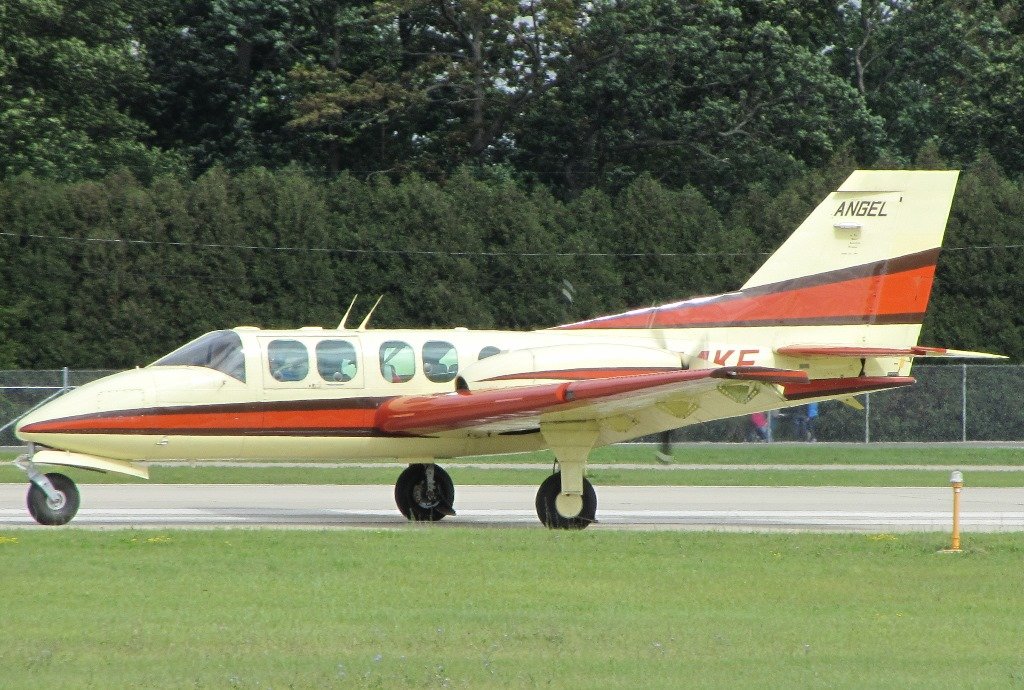
The Angel's most distinctive feature was its twin pusher-propeller configuration, positioning two 300-horsepower Lycoming IO-540 engines behind the wing driving Hartzell propellers. This arrangement provided several advantages for bush operations: reduced propeller damage from debris, improved forward visibility for pilots, and better weight distribution. The aircraft employed spoilers for primary roll control, an unusual feature that was later supplemented with outboard trimmerons to enhance single-engine controllability.
During flight testing, Mortenson made significant modifications to optimize performance. Initially, the engines were raised on pylons, but subsequent testing led to repositioning them in longer nacelles, which increased cruising speed by an estimated 15 mph. The all-metal construction featured a retractable tricycle undercarriage and was fully certified to FAR 23 standards with complete IFR equipment capability.
Limited Production Success
The prototype N44KE completed its maiden flight on January 13, 1984, and accumulated over 250 flight hours by August 1986. TKEF received Type Certificate A2W1 on October 20, 1992, followed by FAA Production Certification in 2003. However, production remained extremely limited, with only four aircraft completed at the Orange City facility through the early 2000s.
The first Angel demonstrated the aircraft's global reach capabilities, logging nearly 3,000 hours in operations spanning from Turkey in the east to Chile in the south, and north of the Arctic Circle. This operational record validated Mortenson's design philosophy, proving the aircraft could deliver reliable service in diverse and demanding environments.
International Expansion
In 2013, production expanded internationally when Chinese company Hubei Taihang Xinghe Aircraft Manufacturing acquired a production license. The first Chinese-assembled Angel was delivered in May 2013, with Chinese certification approved in July 2015. This licensing agreement represented a significant expansion of the Angel's potential market reach, though specific Chinese production numbers remain undisclosed.
Operational Capabilities
The Angel's performance specifications reflected its specialized mission requirements. With maximum gross weight, the aircraft could clear a 50-foot obstacle after a 1,270-foot ground roll and climb at 1,423 feet per minute. Landing performance was equally impressive, requiring only 1,046 feet over a 50-foot obstacle. These capabilities made the Angel suitable not only for missionary work but also for pipeline patrol, search-and-rescue operations, and personnel transportation in remote areas.
The eight-passenger cabin could be reconfigured for cargo operations, providing the flexibility essential for humanitarian missions. The aircraft's design emphasis on field maintenance meant operators could service the Angel with basic tools and limited spare parts inventory.
Safety Record and Challenges
The Angel's limited production meant operational data remained sparse. A significant incident occurred on December 14, 2019, when VH-IAZ crashed near Mareeba Airport, Queensland, Australia, killing both pilots during a flight review. Investigation revealed the aircraft had remained inactive for more than two years without proper storage procedures, resulting in fuel system contamination and reduced engine component life. This incident highlighted the importance of proper maintenance protocols for aircraft designed for extended remote operations.
Legacy and Current Status
The Angel represents a unique chapter in aviation history as one of the few aircraft designed exclusively for humanitarian operations. Its extremely limited production run of four U.S.-built examples makes it among the rarest certified aircraft types. The design's emphasis on rugged reliability and simplified maintenance established principles later adopted by other manufacturers targeting similar market segments.
Today, the Angel's legacy continues through the Chinese production license, though the original Orange City operation ceased aircraft production. The type remains a testament to specialized aircraft design, proving that purpose-built aircraft could successfully serve niche markets despite limited commercial viability. For aviation historians and enthusiasts, the Angel stands as Carl Mortenson's successful attempt to create an aircraft that prioritized mission capability over mass-market appeal.